Burrard Bridge
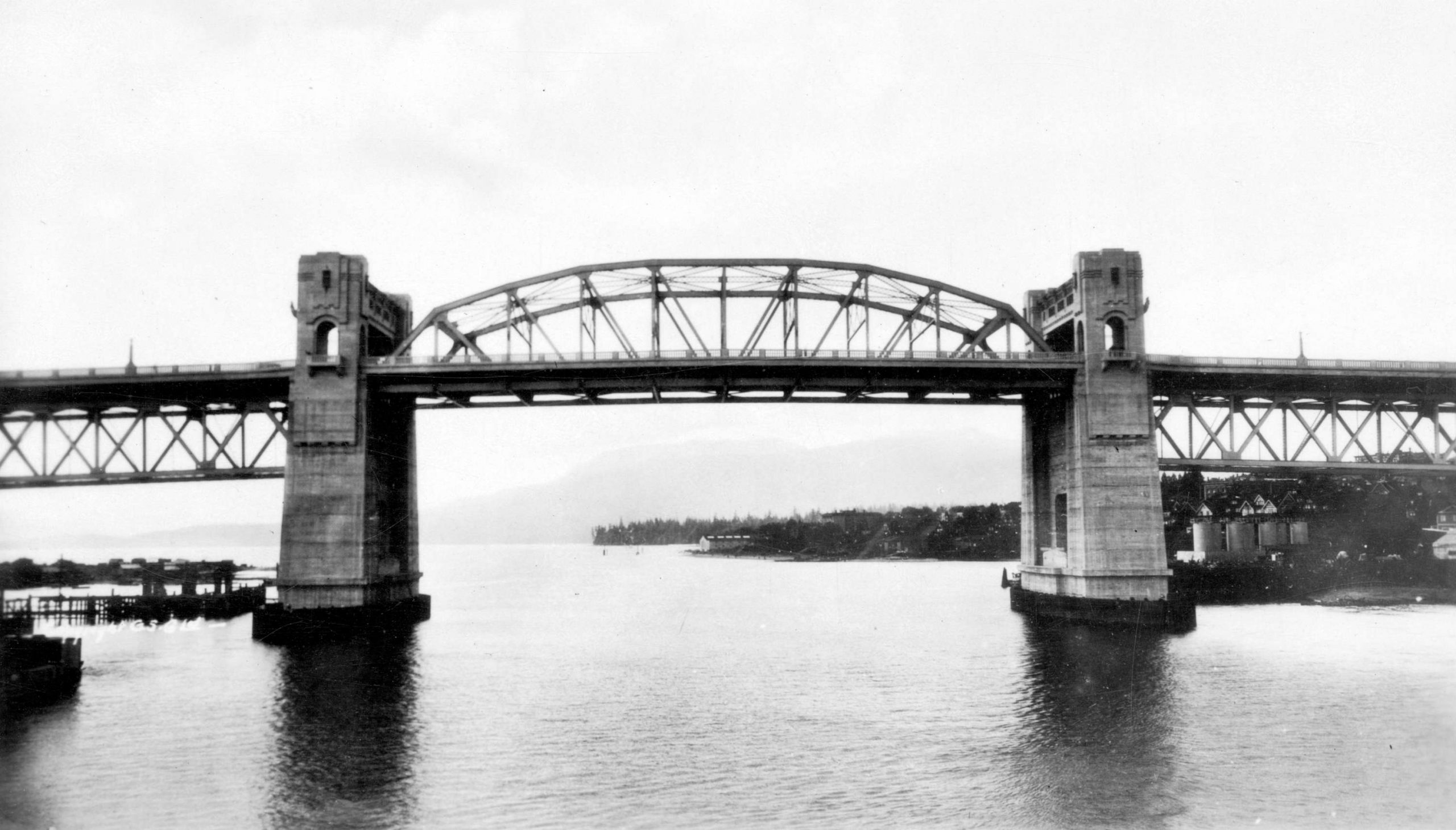
It was July 1, 1932. “A snip of a pair of golden scissors in the hands of Mayor Louis D. Taylor,” ran a news report, “and Vancouver’s $3 million Burrard Bridge was opened to the public Friday afternoon, July 1 . . . Hardly was the ribbon cut in front of the devouring eyes of movie cameras, than thousands of pedestrians and hundreds of cars surged across the magnificent white structure in a procession of triumph, celebrating another step in Vancouver’s progress.” One headline called it: A Symphony of Steel and Concrete.
The Kitsilano Boy’s Band played; so did the Fireman’s Band. An RCAF seaplane zoomed under the bridge, “to the great amazement of the congregated thousands.”
At a civic reception later, in the Hotel Vancouver, a replica of the bridge was unveiled. It was made of sugar.
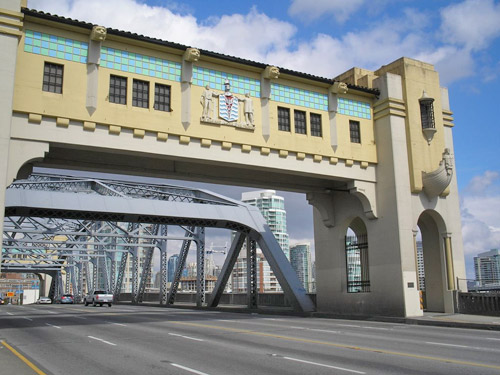
Work on the bridge had started December 8, 1930. The architect (of the concrete version) was G.L. Thornton Sharp, of Sharp and Thompson. It was Sharp who was responsible for the most noticeable physical feature of the bridge, those tall galleries in the middle. “Both central piers,” Sharp told a reporter, “were designed and connected with an overhead gallery across the road. This helped to mask the network of steel in the truss from the two approaches, and has been treated as an entrance gateway to the city.”
So if you’ve ever wondered what those two big concrete structures were for, the answer is they’re to hide all that messy steel. (The story that people once lived in apartments inside one or both of them is an urban myth.)
“In the gallery centre,” Sharp went on, “the arms of the City of Vancouver are carved, flanked by windows which overlook the bridge deck. On the two piers which support the gallery are molded the prows of boats with figureheads to represent Captain George Vancouver and Captain Harry Burrard . . . both so closely associated with the earliest history on Vancouver.”
Not quite. Harry Burrard never came within 5,000 kilometres of this area. He’d been an acting lieutenant with Vancouver on the Europa in the West Indies; George was just honoring an old chum.
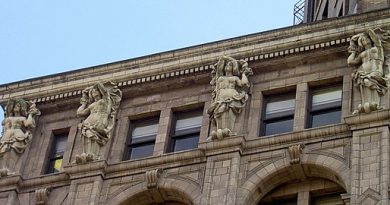
The busts of the two men were carved by local sculptor Charles Marega. He’d done the coat of arms, too.
Tribute to Our Soldiers
[Photo: wikipedia]
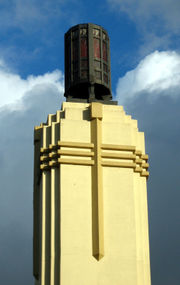
The two huge lamps at both ends of the span—bridge engineer John Grant’s inspiration— are a tribute to Canadian WWI prisoners of war, who huddled around open fires in their prison camps. The lamps are 1965 replacements of the originals, which had to be taken down in 1963 because of corrosion.
There’s a sheaf of correspondence at the Vancouver City Archives between Grant and an American consulting engineer (and friend) whom Grant had commissioned to advise him during the building of the bridge. It amounts to a continuing progress report on the work, much of it technical, and contains some fascinating stuff about a rival, a very well known Vancouver engineer, who tried to get the work away from him. (Grant, by the way, was the engineer for the present-day Granville Street Bridge, too.)
One small change that resulted from the construction of the Burrard Bridge: Cedar Street disappeared. When the bridge went in, it connected to Cedar Street south of the bridge—the name Burrard was simply extended and Cedar disappeared. Shortly after the opening the city got a letter from Sir Harry Paul Burrard, a justice of the peace in Worthing, Sussex, thanking them for naming the bridge after his ancestor.
Some years after the bridge opened, its designer reacted to remarks by a local art teacher that the bridge was a “monstrosity.” F.A. Ames of the Vancouver Art School had told a Lions Club gathering that the bridge pillars were “ashcans with a gasoline station on top.” Grant explained, said the Sun, that the pillars “were built as large as they are on request from the harbormaster, who wanted them prominent to avoid a navigation hazard at the False Creek entrance.” He went on to explain that the large base of the piers was required because at the time the B.C. Electric Railway had planned running a railway on a lower deck beneath the roadway. “That railway will never go in now,” Grant said. “The BCER is no longer interested.” He pooh-poohed Ames’ criticisms, said he’d rather trust the “esthetic ideas of the engineer.” We’re with him.
Busy Bridge
[Photo: martingoodman.com]
A lot of people drive over Burrard Bridge: about 65,000 a day. It was once the most crowded of all the city’s bridges. Shortly after the Burrard opened, in fact, traffic on the congested Granville Street bridge (not the present span) was considerably eased.
There’s a story behind that: in March of 1978 Aileen Campbell of The Province interviewed real estate broker Percy Burr, then 89, who took credit for speeding up the construction of the bridge. “I promoted the building of the Burrard Street bridge,” Burr told her. “Real estate moves in cycles and you have to spot the trends ahead of the next fellow. I knew Georgia Street was going west and Burrard was going to have a bridge and move south. We needed a bridge and I knew it would bring good prices for properties along Burrard. Granville Street was getting jammed. I jammed it up more, so when the vote came it was favorable.”
Aileen wrote that Burr declined to go into details.
The first suicide off the bridge was Oct. 21, 1933.
There were many to follow. In fact, reading back through the clippings, at times it almost seems there were line-ups of people waiting their turns to leap off this bridge. A grimly comic story from August, 1950, quotes at length from an Imperial Oil gas barge attendant, who’d just helped pull yet another nearly-dead jumper from the waters of False Creek. (The bridge isn’t quite high enough to guarantee a speedy end, you see. What often results is mere injury, usually severe.) “I shouted to Pete to take him to the Georgia Towing wharf,” this attendant said. “That’s where we always take ’em . . . They generally come through all right. I pulled out my first one 15 years ago. Since then I’ve chalked up nine and only two of ‘em died.”