The Marine Building
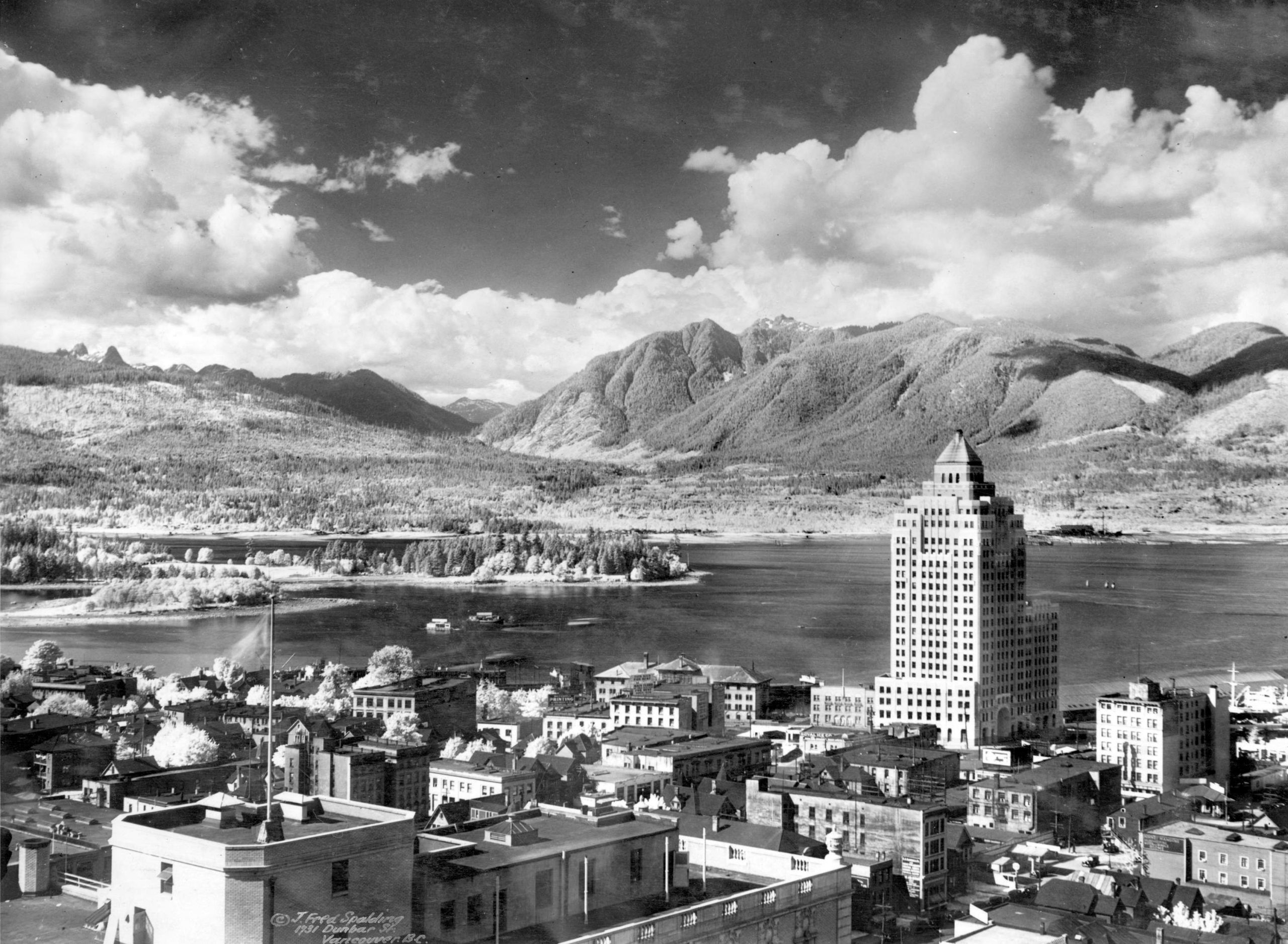
The Marine Building is still, for old-timers, the building most clearly identified with Vancouver. Its unique wedding cake “icing”, topped by that vaguely Mayan tower, makes a dramatic and exciting backdrop as you look west down Hastings. It is one of the great art deco buildings in the world.
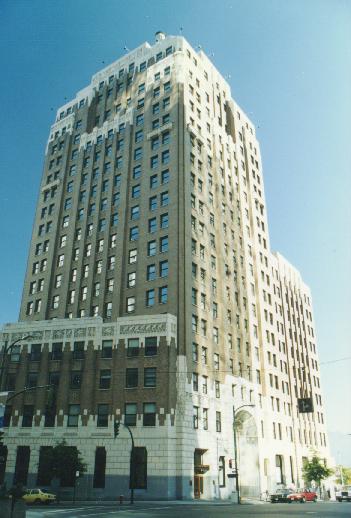
Construction started in the spring of 1929 with a ceremony in keeping with the style of the building. “Yesterday morning,” said a March 14 newspaper report, “His Worship Mayor W.H. Malkin blew a blast on a golden whistle and with it set in motion the steam shovel that will excavate the site for the new Burrard Street Marine skyscraper.”
From that first breaking of the ground to the formal opening October 7, 1930 was 16 months. And, when the Marine Building opened—with 21 floors at a height of 97.8 metres (321 feet)—Vancouver had seen nothing like it.
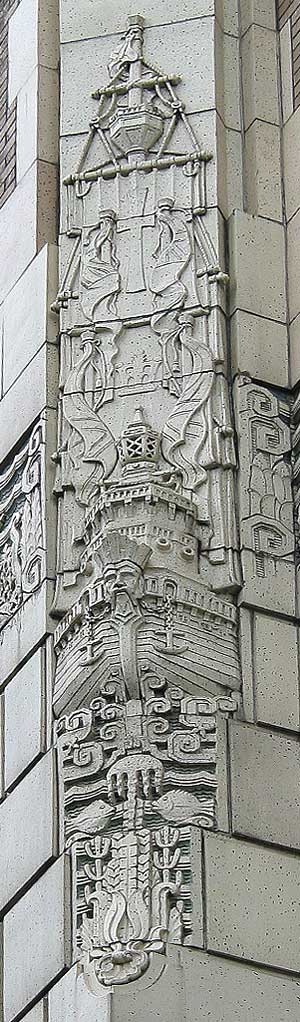
Uniformed doormen stood beneath a huge arched entrance framed in glittering polished brass. The doormen have gone now but everything else is as it was. An Art Deco flock of Canada geese, the rays of the setting sun blazing over them, still fly past a mass of intricately carved marine life—lobsters, crabs, prawns and starfish crawling over each other through a waving forest of seaweed.
Great Entrance
Seahorses and pufferfish still swim along outside the building between the second and third floors. Boats and ships move past, biplanes and a Zeppelin fly by. A train chugs past. It’s one of the great entrances in Canada. Seventy-six years ago, when it was new and the colors were brighter, it must have been a dazzler.
The lobby, small as it is, is a masterpiece. There are five elevators, their doors of solid brass intricately and interestingly designed. There was a time when five uniformed young women stood beside them, each carefully chosen for her beauty. The elevators were the fastest in the city at 700 feet a minute, at a time when 150 feet a minute was the norm. Above the elevators (with their interior walls of intricately inlaid hardwood of 12 different kinds) small plasterwork ships burst out of waves set into the lobby walls—the boats support the lobby’s lights. Daylight streams through a big stained window at one end of the lobby. The ceiling—and what a ceiling it is—looks as if it might once have been part of the set of a Cecil B. DeMille movie. (In fact, although we haven’t been able to winkle out his name yet, we’re told the man who designed it went to Hollywood and became a set designer.)
John Holroyd, a retired accountant who worked on the crew that did that plasterwork (his father, Giles, was in charge of the work), told me that it was done by melting down something called horse glue, then pouring that over the required form. The mold would pull off easily.
(He also told me his father gave courses in that decorative plasterwork during the early ’50s in a chicken shed on the PNE grounds. The results were put up on the ceiling. “That was the fanciest chicken shed you ever saw.”)
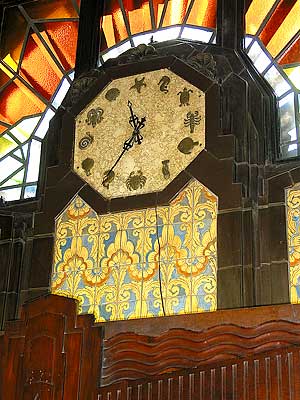
When the big hand is on the starfish . . .
On the east wall of the lobby is a clock with unusually shaped numbers. When the big hand is on the starfish and the little hand is on the crab, it’s six o’clock.
The lobby floor has 12 inlaid signs of the zodiac and was once made of a material called Corkoid, imported from Inverness, Scotland. It has now been replaced with look-alike material.
But all this lavishness went for nothing. Midway through construction of the building, Wall Street crashed. The Marine Building, and the G.A. Stimson Co. that put it up, were in trouble. They had a lot of company, true, but Stimson’s experience could be called a paradigm of the collapse brought about by the Great Depression. By the time the building had opened for business, business was dying. Many of the offices stayed empty.
The building’s lavishness frightened people away—even though space rates were made comparable with other downtown buildings.
By 1931, only a year after the building opened, its owners were willing to sell it to the city for its new city hall for about the same as, and maybe even a little less than it had cost them to build. But that deal fell through.
By 1933, the owners knew they were licked. They sold the building to British Pacific Building Co. (owned by the Guinness brewing people) for $900,000. Stimson had taken a million-dollar bath.
New tenants
A.J.T. Taylor, who was managing director of British Pacific, moved into the building’s penthouse with his wife and had a tiny elevator built to connect it with the 18th floor. They had a lavish apartment looking over the city but Mrs. Taylor eventually decided she didn’t like heights, so they moved out.
It seems appropriate that the longest-lasting of the building’s tenants was the architectural firm that designed it: McCarter and Nairne. They moved in as soon as space was available and moved out in February of 1980, a tenancy just five months short of 50 years. In their new offices, in the Credit Foncier Building at 850 West Hastings, McCarter and Nairne staff could look out the window and, just a block or so to the west, see their creation.
Today, the top floors of this beautiful building are occupied by Urbanics Consultants, a firm of land economists and development management headed by V. Philip Boname.
A spectacular set of photographs of various beautiful aspects of this building can be found here.