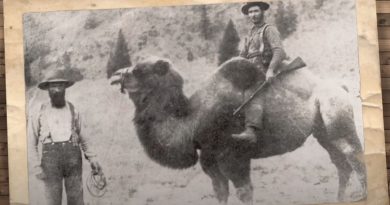
![Van Winkle Bar Gold Mine, Fraser River, near Lytton, B.C. on C.P.R. circa 1895. [City of Vancouver Archives CVA 256-02.35]](https://vancouverhistory.ca/wp-content/uploads/2021/01/07bbb393-3ae6-4a51-bc7b-4e29bd9ff6d3-CVA256-02.35-scaled.jpg)
Biz-Biz 1903
Mining Matters
The regular monthly meeting of the Board on February 3rd was mainly concerned with the new Provincial Mining Association (PMA) of British Columbia, “recently launched into activity at Victoria by a number of prominent mining men.” A.C. Hirschfield of Atlin explained that the movement was not for the purpose of obtaining special legislation for the new association’s members, but to attract prospectors to come and to stay. Frequently quoted was the new group’s president, J.B. Hobson, who couldn’t be present as he was touring the Kootenays in the association’s interests. Hobson had said that while the provincial government’s laws had succeeded in preventing the country being locked up in the hands of speculators, it had also shut out prospectors. The laws were too stringent, and as a result mining money was being invested in California rather than the Cariboo.
As an indication of its desire to involve the whole province, the PMA would hold its 1904 convention in Vancouver.
Member Charles Wilson, KC, commented that the “hydraulic miners . . . appeared to think they should be placed on the same basis as the rock miners, namely, that they should obtain security of title to the land.” It was well known, the Province article of February 4th said, quoting Wilson, that many had refused to put capital in hydraulic mining properties held under BC law, because a title could not be shown. “If the association,” he said, “could only devise a scheme by which security of title could be obtained, and yet not lock up the land in unproductiveness, so soon would the difficulties in the way of inducing capital to come in be removed.
“Mining was without doubt the most important industry of British Columbia, and the opening up of placer mining districts would contribute largely to the prosperity of this city.”
A resolution was passed expressing the support of the Board for the aims of the PMA.
The Navy League
H.F. Wyatt, a local representative of the Navy League, an English organization that trained seamen for the British Navy, said he was pleased that Canada was about to establish a naval militia. He urged that members of that militia be trained on our naval reserve ships, rather than on vessels expressly built for them. There would be great savings. A vote of thanks to Mr. Wyatt was moved and unanimously carried . . . and some members of the Board joined the League on the spot.
AGM heavily attended
The Board’s March 3, 1903 AGM was held in the board rooms of the Molson’s Bank building at the northeast corner of Hastings and Seymour, and attendance was “unusually large.”
The Board had struck a committee to approach the CPR with a request to lower its freight rates between Vancouver and Calgary, and that committee had come back with a comment that the railway’s response was unsatisfactory, even unfair. The only argument put forward by the railway, the committee reported, “being that to disturb the existing state of things would meet strong objections from the merchants of Winnipeg.”
The Board’s present membership of 125 was not as large as it should be. “The population of our city is increasing, new business houses are starting in our midst, and the membership, instead of decreasing, should be on the increase. Matters of great commercial importance are continually cropping up, and there never was a time in our civic history when it was so necessary for businessmen to engage actively in all matters affecting the commercial interests of our community as at the present.” (Emphasis added.)
The 1901 federal census had shown that the population of Vancouver then was 27,000.
Malkin’s Parting Shot
President Malkin, in his final address in that office, said “We should at the least have a membership of 250. With the present membership, it is impossible to get our finances into the satisfactory shape they should be. The regular issuance of the annual report, which reaches every civilized country in the world, is most important, and we ought now to be creating a reserve fund which, in time, might be applied to the erection of a building of our own.”
Vancouver, Malkin said, was rapidly becoming the great distribution centre, not only for British Columbia and the Yukon Territory, but also for the country, extending as far east as Calgary and Lethbridge. “A few years ago the merchants of the Kootenay and the Crow’s Nest looked to the East to supply most of their requirements, but a large proportion of these are now being purchased from Vancouver.” That trade could be increased with better freight rates, but the CPR was not cooperating. “I hope the time will soon be here when the grain raised in the Northwest [he’s referring here to Alberta and Saskatchewan, not yet provinces] will be brought to Vancouver and shipped hence by sea to various parts of the world.”
Malkin was succeeded as Board president by H.T. Lockyer, local manager of the Hudson’s Bay Co.
False Creek
The Board at its May 5 meeting protested against the grant of False Creek tide flats by the Dominion Government to Messrs. Robert Kelly and Frank Burnett. A copy of the resolution was sent to Prime Minister Laurier and others. Vancouver mayor Thomas Neelands had agreed on the telephone that the city’s own protest against the decision would be greatly strengthened by the support of the Board of Trade.
Member Francis Carter-Cotton recalled that some years earlier the Board had gone on record “as supporting a general scheme of reclamation and wharfage on False Creek, and had gone on record against any scheme whereby private individuals might secure the foreshores.” The resolution to endorse the city’s protest was passed unanimously.
Trade and Other Imperial Matters
The June 18 meeting passed, among other matters, two important resolutions: one was in favor of assisting, as far as possible, Britain’s trade with China in face of rising competition from other European nations, and the other was to show its support for preferential duties and other measures to increase trade between the member colonies of the Empire.
The Board’s August 3rd session was told of a resolution passed by the Toronto Board of Trade to be discussed at the upcoming convention of the Associated Chambers of Commerce of the Empire. That meeting was to be held in Montreal August 17 to 20—with Board member H. Bell-Irving as Vancouver’s delegate. The resolution was “that the laws respecting the naturalization of aliens in the different constituent parts of the British Empire should be amended and assimilated, so that citizenship conferred in any part of the Empire shall be recognized as valid throughout the Empire.”
And the Board was also told there would be a representative at the Montreal convention of the Canadian Manufacturers’ Assn., who would move “that in the opinion of this Congress, in all contracts for imperial public works, the preference should be given, as far as possible, to British subjects.”
Another resolution that would be discussed was that Newfoundland “should be included as a constituent part of the Dominion of Canada.” (That event would take 46 more years!) Still another resolution, this one from the London Chamber of Commerce, would call for wireless telegraphy to be installed in all Canada’s lighthouses and lightships. We’re assuming this is the London in England, since the Ontario city has so few lighthouses!
Bell-Irving’s Report
On September 1 member H-O Bell-Irving reported on the Montreal convention cited above. He said, reported the September 2 Province, “there were no fewer than 500 delegates present, from every quarter of the Empire, including South Africa, India, the West Indies, Ceylon and the Antipodes.” (In this case, Antipodes refers to Australia, New Zealand and other colonial outposts in the South Pacific.)
“A great proportion of the individual members were in favor of preferential trade,” Bell-Irving reported, “but their hands were tied more or less by instructions from their respective chambers against definite committal to that policy.”
Most of the report centered on the social aspects of the convention. Everybody seemed to have a good time and one of the dinners, attended by 500, was addressed by both Governor General Lord Minto and Prime Minister Laurier. (Lord Minto, by the way, had in 1901 donated the Minto Cup which, until 1934, would be awarded annually to Canada’s senior lacrosse champions. After 1934 it went to the junior champions.)
A digression: there is an interesting biography of Lord Minto here, written by John Buchan, a future Governor General. It seems Minto visited Vancouver as far back as 1885.
More on Freight Rates
A committee that had been struck to question the CPR as to its unequal freight rates (Winnipeg’s merchants paid much lower rates than did Vancouver’s) reported that, as a result of their presentations, the rates had been lowered slightly, but that there was still an imbalance . . . and rumor had it that Winnipeg’s rates had been lowered, too, so that the imbalance continued. “We did not ask for a cut rate,” the committee said, “but simply that Vancouver pay no more than Winnipeg.” The Board made its displeasure with the railway known. “While the reduction is appreciated, it is not sufficient by any means to satisfy the merchants here.”
Sympathy was extended to the family of former Board president (1901) Frederick Burns, who had recently died.
Image, top: Van Winkle Bar Gold Mine, Fraser River, near Lytton, B.C. on C.P.R. circa 1895. [City of Vancouver Archives CVA 256-02.35]
![Coal Creek, B.C. looking northwest [on the] Crow's Nest Pass Railway [City of Vancouver Archives Out P1223]](https://vancouverhistory.ca/wp-content/uploads/2021/01/0c133abd-c38b-4063-b1d4-ffe2cb46f66b-A34129-390x205.jpg)
![Ford Motor Dealers of B.C. Convention. Vancouver, B.C. Jan. 22-23, 1923 [City of Vancouver Archives CVA 99-3457]](https://vancouverhistory.ca/wp-content/uploads/2021/01/1112502a-34f8-4fba-b87d-1074d100cbb6-A17121-390x205.jpg)