1915
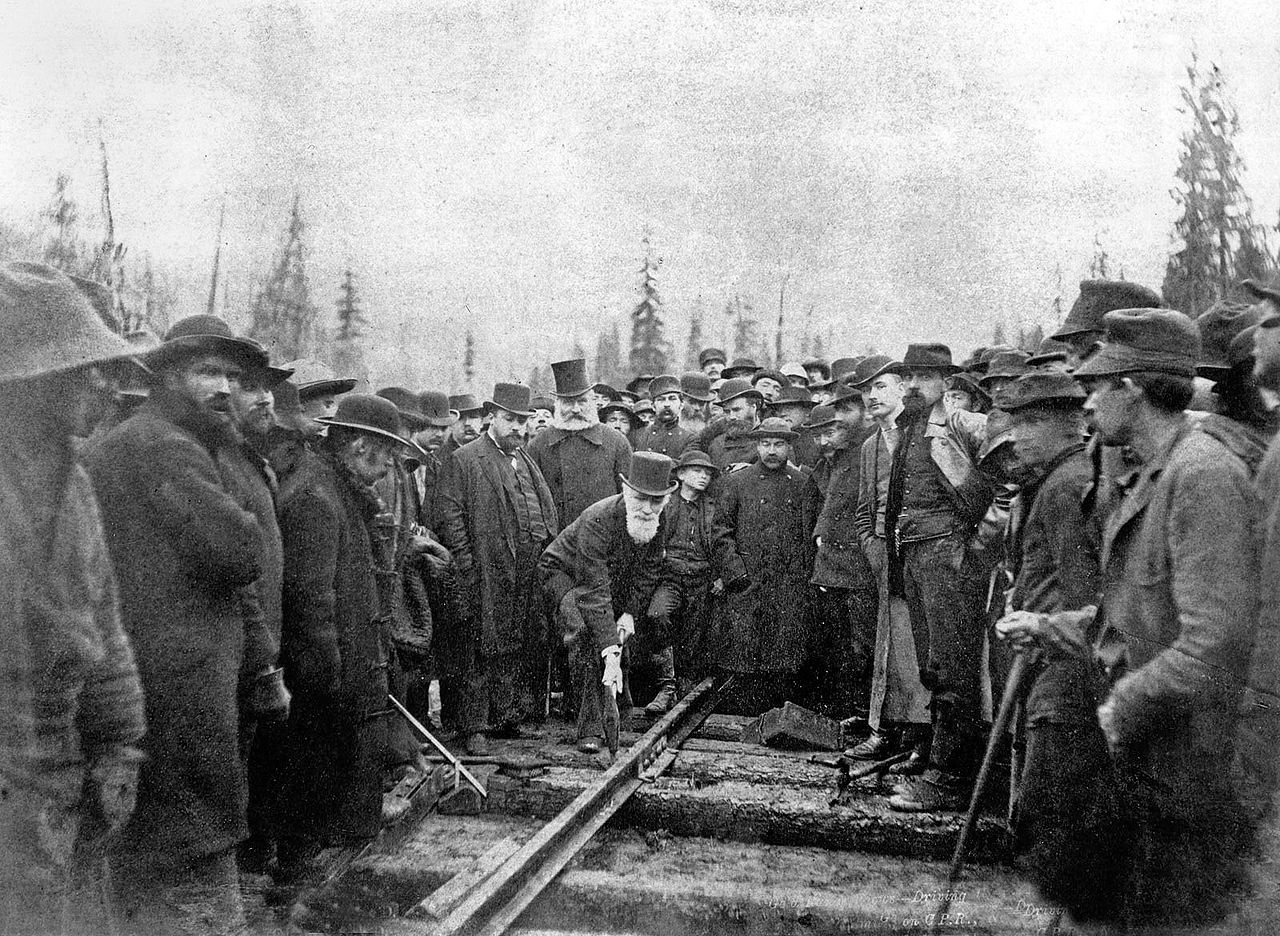
Above: Last Spike of the CPR – Craigellachie, British Columbia, Canada. Donald Alexander Smith driving the last spike of the Canadian Pacific Railway. Also in the photo are (generally left to right) Albert Bowman Rogers (Surveyor), Michael Haney (Contractor), William Cornelius Van Horne (CPR Manager), Sir Sandford Fleming, Edward Mallandaine (teenager), Henry Cambie (engineer), John Egan (General Superintendent), Sam Steele (NorthWest Mounted Police), James Ross (engineer). The man at the rear of the photo, just right of centre, with a white cowboy hat and moustache, is reputed to be Tom Wilson, guide & outfitter & the first white man to see Lake Louise.
[Image: By Ross, Alexander, Best & Co., Winnipeg]
*****************************************
You’ll note that these years include events listed under “Also in . . .” These are events for which we don’t have a specific date. If YOU know the specific date of an event shown there, please notify us . . . and cite the source! Many thanks!
*****************************************
January 11 Mewa Singh died in New Westminster. After the 1914 Komagata Maru incident (see the 1914 Chronology) tensions arose among members of Vancouver’s Sikh community. Some had a particular enmity for William Hopkinson, a local customs official, formerly with the Calcutta Police Force. Mewa, a supporter of India’s independence movement and the passengers of the Komagata Maru, shot Hopkinson to death at the Vancouver provincial court house in 1914. He was hanged for the crime January 11, 1915. A hall in the Ross Street Sikh Temple is named for him.
January 23 The last spike of the Canadian Northern Railway (running from Quebec to Vancouver) was driven at Basque, BC, near Ashcroft. This line would eventually be absorbed into what became CN, the Canadian National Railway.
January 29 Richard Henry Alexander, former manager of the Hastings Mill, died at 70 in Seattle.
February 2 Golfer Stan Leonard, said to be British Columbia’s greatest golfer, was born in Vancouver. Leonard would caddie at Shaughnessy Heights for 50 cents in the late 1920s.
February 15 The Imperial Theatre opened a brand-new musical comedy, Fifty Years Forward. Among its predictions for 1965: a lady mayor in Vancouver.
February 25 Israel Wood Powell died. He was the first Masonic Grand Master of the Grand Lodge of B.C. He donated the site for Vancouver’s first city hall, and has Powell Street named for him.
March 12 Seattle longshoremen and others on the West Coast boycott all ships going to or coming from Vancouver, B.C., in support of striking Vancouver longshoremen.
March 26 The Vancouver Millionaires win the Stanley Cup in the Denman Arena, led by the scoring of Cyclone Taylor. There’s a big photograph of the team on the wall of the White Spot on Marine Drive in Vancouver.
March In a room in the old Mount Pleasant School on East 8th Avenue the first class for deaf students in B.C. began. There were nine boys and girls, ranging in age from nine to 16 years. Mabel Bigney, who had come from the Halifax School for the Deaf, was the teacher. (In 1922 deaf students—62 of them by then—would get their own building.)
April 25 Pharmacist Sam Bass was born in Winnipeg. In 1945 he will begin London Drugs in Vancouver.
April The creosoted wood deck of the Cambie Street Bridge caught fire, with the collapse of a 24.4-metre steel side-span. (This is obviously not the current bridge!)
May 15 Walter Moberly, important in the planning of the CPR’s route through the west, died. (An oddity: he also designed New Westminster’s first sewer system.)
May North Vancouver City Council made enquiries of all not-yet-naturalized city residents of German or Austrian birth to determine if they should be interned or deported. (Remember, World War One was raging.)
June A sports ground was opened at Mahon Park in North Vancouver.
Spring To avoid violating American neutrality a Seattle company, British Pacific Engineering, built submarines for Russia at top-secret plants in Burnaby and Vancouver. Once completed the hulls are dismantled and shipped to Petrograd for re-assembly.
July 1 The first Georgia Viaduct opened to extend Georgia Street over the CPR’s Beatty Street yard. (There was no Dunsmuir Viaduct in the beginning.) It was named the “Hart McHarg” bridge for a World War I hero, but the name didn’t catch on. The viaduct was badly made, and in later years chunks began to fall off and threaten pedestrians below.
July 7 Captain G.P. Bowie, who designed the original Lumbermen’s Arch (note the plural), erected at Pender and Hamilton for the 1912 visit of the Duke of Connaught, was killed at Ypres.
July 30 The White Rock pier was officially opened. It had been built the year before at a length of 628 feet long, had a further 983 feet added this year.
August 11 The North Shore’s Marine Drive was opened by Premier Richard McBride, allowing access to previously secluded areas such as Caulfeild.
August 26 North Vancouver City Hall relocated in the old Central School, whose staff and pupils had moved to the new Queen Mary’s School. Council intended it as a temporary structure, but met there for many years. It is now Presentation House, home of North Vancouver’s Museum, a theatre and a photographic gallery.
August 28 The Canadian Northern Pacific Railway completed its rail line and its first through train from the east arrived in Vancouver today. The railway later became part of the CNR, Canadian National Railway. The terminal is still here, now named Pacific Central Station.
September 11 William Cornelius Van Horne, former CPR president who supervised construction of the railway across Canada and who named Vancouver (it had been Granville), died at 72 in Montreal.
September 30 The first president of the University of British Columbia was Frank Wesbrook. On taking office today at the “Fairview Shacks,” a ramshackle collection of wooden buildings at West 10th and Laurel in Vancouver’s Fairview neighborhood, he said “We take occasion this morning to congratulate ourselves that, though the Empire is at war, such a good beginning of the university has been possible.” There were 379 students in three faculties: Arts and Science, Applied Science, and Agriculture. (UBC moved to its present location in 1922.) An Officers Training Corps was established at UBC this year.
October 12 The UBC Alma Mater Society was formed.
December 15 Vancouver lawyer William John Bowser (1867-1933), Conservative, became premier, succeeding Sir Richard McBride. Bowser will serve less than a year, to November 23, 1916.
Winter The Hoffar-Beeching Shipyard at 1927 West Georgia, at the foot of Cardero Street on Coal Harbour, began assembling aircraft, when the Hoffar brothers, Henry and Jimmie, fitted floats to the Curtiss Jenny belonging to Vancouver’s first licensed pilot, Billy Stark. (Two years later the company will be owned by Boeing.)
Also in 1915
Seaton Street disappeared as a name and became a simple extension of Hastings Street west of Burrard. It had been originally named in1886 by Lauchlan Hamilton after a lake he chose at random from a B.C. map. (Because a lot of wealthy folk lived along Seaton at the time, it was called “Blueblood Alley.”)
The 255 hectares of Moodyville joined the City of North Vancouver which then took on its present shape. The following year the abandoned sawmill will be destroyed by fire.
French inventor George Claude was granted patents for neon light this year. This will later have an important effect in Vancouver.
Wallace Shipyards and North Shore Iron Works got contracts for high-explosive shells.
Alexandra Park Bandstand opened on Beach Avenue at Burnaby Street in the West End.
The year began with Louis D. Taylor as mayor. He was succeeded by Malcolm Peter McBeath, an alderman in Vancouver from 1912-14.
One of the city’s great stories concerns Mayor L.D. Taylor. When former US President Teddy Roosevelt and his wife visited Vancouver this year on holiday the Vancouver Board of Trade unwisely did not include Mayor Taylor in the official reception at the CPR station. (They didn’t like him.) Undaunted, Taylor boarded the train at an earlier stop, greeted the Roosevelts, introduced himself and chatted amiably with them as they came into Vancouver. The train stopped at the station, the Board of Trade party surged forward . . . and Mayor Taylor stepped down onto the platform. He introduced the Roosevelts to the open-mouthed Board members, then whisked the former U.S. president and his wife off for a drive around Stanley Park. The story is told in Daniel Francis’ lively book, LD: Mayor Louis Taylor and the Rise of Vancouver, published this year by Arsenal Pulp.
The eminent planner Thomas Adams, in an essay Report on the Planning of Greater Vancouver, wrote in 1915 that it “is unique both in regards to natural beauty and business prospects,” but “is suffering in a special degree from haphazard growth and speculation in real estate, notwithstanding the progress that has taken place in the last few years in regard to the control of sanitary matters and local improvements.”
Brazil established a consulate in Vancouver.
Goodman Hamre (see 1914) expanded his bus service with a line from New Westminster to White Rock.
Ivor Neil began a sightseeing bus and taxi service in Vancouver.
The newly-created Harbour Commission gave Ottawa one dollar for False Creek sandbars and received clearance to reclaim the land. What was beginning to be created was Granville Island.
The Vancouver Exhibition (today’s PNE) had become a permanent fixture in Hastings Park, housing nearly a dozen buildings and an athletic field. The 1915 Exhibition also had a new feature: $50,000 in prizes.
Scotland-born (1874) James Inglis Reid, who had come to Vancouver in 1906, opened his own butcher shop at 559 Granville. The store became famous for its meats, including Ayrshire bacon, Belfast ham, black pudding and oatmeal-coated sausage, its haggis, and its sign: “We hae meat that ye can eat.”
Professor Frederick Wood, the first B.C.-born educator at UBC, founded the Player’s Club there this year. The troupe produced their own very popular shows in downtown Vancouver.
Helena Gutteridge convinced the Vancouver Trades and Labour Council to support equal pay for equal work in their constitution.
There was a woman’s hardball team in Vancouver in 1915. They were called the Minnehahas.
The Phoenix Cannery began operation, and would last until 1967.
Capt. Alexander MacLean died when he fell overboard from his tug in False Creek. MacLean was the model for Capt. Wolf Larsen in Jack London’s novel Sea Wolf.
Imperial Oil, which had relocated its refinery to Ioco, an acronym for Imperial Oil Company (see 1914) began to build a company town there. The refinery processed 1,000 barrels a day.