1923
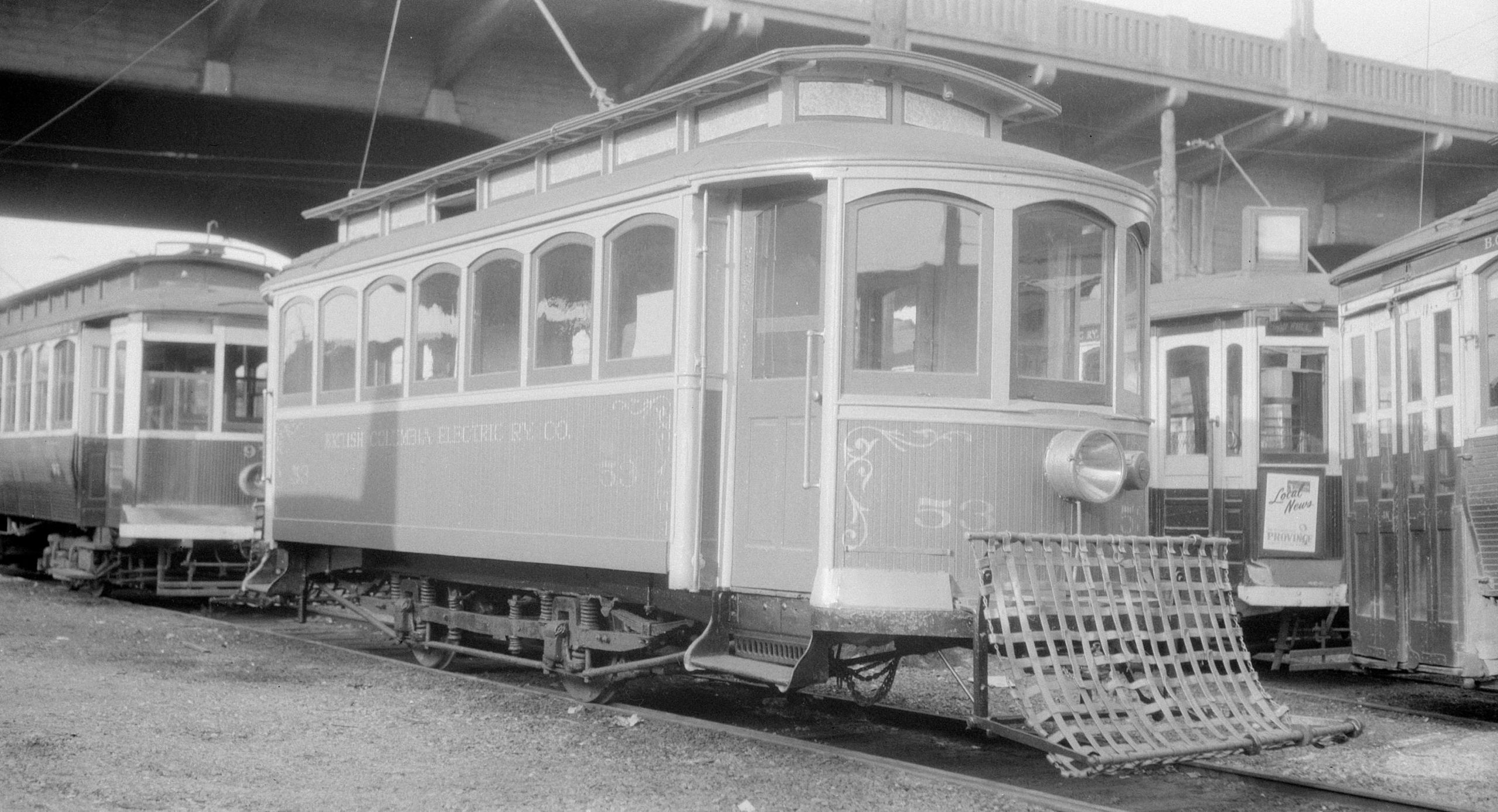
Above: B.C.E.R. Street Car #53 circa 194?
[Image: City of Vancouver Archives CVA 447-1651.1]
*****************************************
You’ll note that these years include events listed under “Also in . . .” These are events for which we don’t have a specific date. If YOU know the specific date of an event shown there, please notify us . . . and cite the source! Many thanks!
*****************************************
February 14 Irving K. “Ike” Barber was born in Edmonton. On October 3, 2002 Barber, a UBC alumnus and founding chairman of Slocan Forest Products Ltd., announced a $20 million donation to transform UBC’s Main Library. The B.C. Government is contributing $10 million, and UBC is matching the sum of these donations for a total of $60 million to build the Irving K. Barber Learning Centre. You can read more details by clicking here.
February 19 Singer Bobby Hughes was born.
February 27 The Surrey Gazette, a weekly, began publication in White Rock.
February The three north shore municipalities urged the Port of Vancouver to develop grain handling facilities on the north shore.
March 2 “Fighting Joe” (Joseph) Martin, former BC premier (for three-and-a-half months in1900) died in Vancouver, aged 70. Born in Ontario in 1852, Martin, a former Manitoba MLA and cabinet minister, began practising law in Vancouver in 1897. He became one of the city’s largest landowners. He was elected an MLA (Vancouver City) in 1898. After Premier Semlin was forced to resign by Lt. Governor McInnes in February 1900, Martin became acting premier. Four months later, he was defeated by James Dunsmuir. He moved to England in 1908, and was elected to the British House of Commons in 1910! Back in Vancouver, he tried (and failed) to get elected as an Asiatic Exclusion League candidate, and lost out in a bid to become mayor.
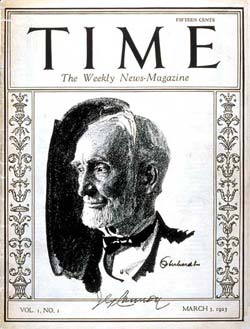
March 3 First issue of TIME Magazine.
March 19 The BC Electric Railway inaugurated a motorbus line on Grandview Highway. Brian Kelly, transit historian, has written: ”In 1923, under [B.C. Electric Railway] general manager George Kidd, the first vehicle to challenge the supremacy of the electric streetcar arrived on the scene. To inaugurate a new route connecting Broadway and Commercial with the Grandview area at 22nd and Rupert the company bought two 23-passenger buses from the White Motor Company, with bodies built locally by G.W. Ribchester. They were hand-cranked, sported solid tires, and were so successful that more buses were ordered…”
March 26 The Province published a special edition to mark their 25th year as a Vancouver daily.
March The CNR station had just been completed and the parks board started work on an undeveloped parcel of land in front of the station, at the corner of Main and Terminal. Sir Henry Thornton, the first president of the CNR, provided a special track to bring sand and black soil from Chilliwack. Upon completion, the park—outfitted with benches and rare trees—was named after Thornton.
April 1 CFDC Nanaimo, which was moved to Vancouver and renamed CKWX in 1926, went on the air.
April When city engineer F.L. Fellows drew up plans for the proposed Canadian National and Great Northern railways’ passenger stations, he found himself with a nameless thoroughfare on his plan. Since it led to the stations, he thought Station St. would be a good name. Fellows also named Terminal Avenue.
May 15 Architect Ron Thom was born in Penticton. He will become a very busy and influential architect in Vancouver. (There may be as many as 200 houses in Metropolitan Vancouver designed wholly or in part by Thom.)
June CFCB call letters became CKCD.
July 1 A new Chinese Immigration Act came into effect. It virtually banned Chinese immigration to Canada. Only four kinds of Chinese immigrants were allowed: diplomats, children born in Canada, students and merchants. Only 44 Chinese entered Canada during the next 24 years. Chinese Canadians long referred to July 1 as “Humiliation Day” and many refused to join in Dominion Day celebrations. The act would not be repealed until 1947 and then only wives and children under 18 of Canadian citizens were admitted. Chinese were not able to come to Canada on the same basis as other immigrants until 1967.
July 10 Arctic yachtsman Willy de Roos born.
July 26 U.S. President Warren Harding visited Vancouver, the first serving president to do so. Premier John Oliver and Mayor Charles Tisdall hosted a lunch in his honor at the Hotel Vancouver. More than 50,000 of us crowded into Stanley Park to hear him speak, thrilled that such an important figure was visiting.
July 27 The official opening of the Prospect Point Signal Station in Stanley Park. It was installed to regulate all shipping in and out of Vancouver’s harbour. To quote a web site established by the Prospect Point Lookout: “The Lookout is the most popular panoramic viewpoint in the city, situated 64.3 metres (211 feet) above the sea. It has also been named South Head, Calamity Point, Observation Point and Prospect Bluff.” The Signal Station, a two-storey structure, was made redundant by the construction of the Lions Gate Bridge, which would open in November 1938.
August 2 President Harding died of heart failure in San Francisco, exactly one week after visiting Vancouver. The city was shocked and saddened. The Kiwanis Club initiated a drive for a grand memorial to him in Stanley Park, at the site where he spoke. (Harding was a Kiwanian.) The monument, designed by Vancouver sculptor Charles Marega (also a Kiwanian), is there to this day. (p.s. Harding was succeeded by vice president Calvin Coolidge.)
August 4 (or 14?) Southam assumes control of the very successful Vancouver Daily Province.
September 3 Vancouver was linked with California with the opening in Cloverdale of the Great Pacific Highway. “A smooth unbroken highway, dustless and rutless,” the Province reported, “now undulates evenly from Vancouver to Los Angeles, linking two nations and joining three states to the Province of British Columbia.” The new link, the Province reported, was now the world’s longest paved road. (Drive down 176th Street in Surrey and you link to I-5 in Washington. That route is this road.) The road benefited from a planting effort by the Kiwanis Club of Vancouver, who put in 1,150 ornamental trees as a gesture toward hiding some ugly clearcuts left by decamped lumber companies. At the end of the formal ceremonies “one side of the highway through the village was then overspread with flax seed and borax for dancing. The Vancouver pipers piped, the New Westminster band played, and the many hundreds present danced gaily . . .”
Flax seed and borax???
September 4 West Vancouver High School opened in the Hollyburn elementary school building.
September 8 In the Province, a couple of knee-slappers:
(1) “Oh, no,” soliloquized Johnny bitterly, “there ain’t any favorites in this family. Oh, no! If I bite my fingernails I get a rap over my knuckles, but if the baby eats his whole foot they think it’s cute.”
(2) Foreman: Yes, I’ll give ye a job sweepin’ and keepin’ the place clean.
Applicant: But I’m a college graduate.
Foreman: Well, then maybe ye better start on somethin’ simpler.
September 14 “On the evening of September 14, 1923,” nine-year-old Stuart Keate (future publisher of the Vancouver Sun) recalled, “I was listening to a radio broadcast of the heavyweight boxing championship between Jack Dempsey and Luis Firpo, ‘the Wild Bull of the Pampas.’ When Firpo knocked Dempsey out of the ring [onto a sportswriter’s typewriter, in the first round], I dashed into nearby Granville Street and stopped the first car I could find. ‘What’s up, son?’ asked the driver. ‘Firpo has just knocked out Dempsey and won the heavyweight championship of the world,’ I cried. Which, in retrospect, was an authentic harbinger of the career to come: I was not only first with the news, but had it totally wrong!”
After being knocked through the ropes, Dempsey returned to the ring and knocked Firpo down twice in the second round, finally knocked him out.
September 17 Hank Williams was born.
October 1 The first ship of the Canadian government mercantile marine left Vancouver with grain bound for Britain.
November 19 Writer and teacher Robert Harlow was born.
November 26 Journalist and author Geoffrey Molyneux was born. His 1992 book British Columbia: An Illustrated History is a good brief look at the province’s past.
December 4 Maria Callas was born.
December 5 Radio was used for the first time in a Vancouver mayoralty election campaign: candidate W.R. Owen, a former blacksmith, gave a ten-minute speech over Station CJCE. He won the election.
December 9 Thomas George Shaughnessy died in Montreal, aged 70. The old-money Vancouver neighborhood was named for him. Born in Milwaukee, Wisconsin in 1853, Shaughnessy became a railroader. In 1882 he was recruited over a glass of beer as general purchasing agent for the CPR. He became the railway’s president in 1898, held the job for 20 years. He was knighted in 1901 and became Lord Shaughnessy in 1916.
December 12 The Rotary Club’s first Christmas Carnival was held.
Also in 1923
Vancouver’s population topped 130,000, a growth of 13,000 in two years.
Jimmy Butterfield, aged about 44, began a daily column in the Province. Butterfield’s name stands out because he wrote on local doings (beginning in 1923 and carrying on to his death in1941), at a time when newspaper style was often stiff and long-winded, in a voice that sounded human. His column was titled The Common Round. Jimmy was born in London (the big one) about 1879, died September 23, 1941 in Penticton.
The Vancouver Park Board issued a map showing the location of “squatters” in Stanley Park. The map is at the City Archives.
A court case was initiated to attempt to expel eight native families from Stanley Park. See previous item.
The parish hall at St. Mary’s Church at 2498 West 37th Avenue in Kerrisdale was built. It is a heritage building today.
In her 1943 book Ports of British Columbia Agnes Rothery says Diesel engines began to be used locally in tugboats this year. (Page 236.)
The oldest local functioning amateur sports organization in Vancouver, the Meralomas, was established as the Mermaid Swim Club. “Meraloma” was coined from “mer” for mermaid, “al” for alpha and “om” for omega. The last “a” was added for the sound.
The investment firm Odlum Brown was incorporated in Vancouver. Appropriately, they have sponsored 1923 in The History of Metropolitan Vancouver.
The Alcazar Theatre, built on Commercial Drive in 1913, was taken over by Vancouver Little Theatre. (They sold it in 1978). Today, as the Raj Theatre, it shows films from India.
Back in 1920 a referendum brought in an experiment in Vancouver with proportional representation, then being tried out in a number of North American cities. This year another referendum brought back the eight-ward, single-member system.
Myrtle Philip was Whistler Valley’s most significant female pioneer. Born in the Eastern United States in 1891, Myrtle migrated to the west coast of BC in her early twenties with her husband Alex. The young couple fell in love with the Coast Mountains and decided to carry out their dream of building a holiday retreat. With the guidance of an old trapper, the Philips travelled north of Vancouver up the Pemberton Trail to a place called Alta Lake – the perfect wilderness setting for a fishing lodge.
Burnaby got its first fire truck, a Model T Ford converted in his garage by mechanic (and fire truck driver) Bill Banks. He later converted a 12-cylinder Packard limousine.
Coquitlam joined the Greater Vancouver Water Board. Annual rates were introduced: 75 cents for houses without bath, $1.15 for houses with.
Ocean Park got its first post office. It was featured in Ripley’s “Believe it or Not” as the smallest in the world. People wrote from distant places just to get the postmark.
Pacific Stage Lines and B.C. Rapid Transit Company, subsidiaries of B.C. Electric Railway, began regular passenger service in the Fraser Valley.
The Canadian Northern Railway became part of the Canadian National Railway.
Construction began on the Main Library at UBC. Architectural historian Dr. Harold Kalman writes: “The central portion (1923-25) features the stone walls and medievalizing detail of the Collegiate Gothic style, originally intended for the entire campus.”
Construction began on the Centre Lawn building at Essondale (now Riverview Hospital).
The Burnaby Civic Employees Union Memorial Fountain was erected, designed by William Williamson of Westminster Monumental Works. Made of BC granite, the fountain was erected to honor union members killed in the First World War. Originally located on Kingsway near Edmonds at the old Municipal Hall, in 1974 it was moved to Burnaby Village Museum.
Star of the Sea Parish in White Rock, a Catholic church, was established.
The Women’s Institute, a province-wide group of community-minded women, sparked the idea of creating a Crippled Children’s Hospital in Vancouver. The name will change to Children’s Hospital in 1947.
The Canadian Daughters League was established with approximately 30 members. It is a Fraternal and Benevolent organization whose members believe in Canada and its people. Today it has about 300 members in British Columbia. There are three branches in the lower mainland with about 90 members.
The quarterly Butter-Fat first appeared. Published by Agrifoods International Cooperative, it informed members of activities in the co-op and dairy industries.
The West Ender/Kitsilano News first appeared (as the West Ender). Today it has a circulation of about 59,000.
The Toronto-based Bank of Hamilton, which had several Vancouver area branches after opening its first one in the city in 1898, merged with the Bank of Commerce.
The big wooded area known today as Pacific Spirit Regional Park, adjacent to the University Endowment Lands, was once a source of timber for the Hastings Sawmill. Their logging, started in 1860, ended this year. Then the land was endowed to the university. You’ll see second-growth Douglas fir, western red cedar, western hemlock and more here.
Writer Steve Gatensbury was born in New Westminster. He started work in the sawmill industry at 16. His “fly on the wall” approach to B.C. logging history, Once, To Learn It, is a light-hearted look at his 50 years of working mainly within small companies. His Queensborough: Images of an Old Neighbourhood recalls New Westminster.
Writer, columnist and MP Paul St. Pierre was born in Chicago. He grew up in Nova Scotia and came to Vancouver in 1945. He’s written a lot of good things, may be best known for his 1950s CBC television series Cariboo Country (which launched the acting career of Chief Dan George).
Photographer Ulli Steltzer was born in Frankfurt, Germany. She emigrated to the U.S. in 1953, moved to Vancouver in 1972. In 1992 she shared the Bill Duthie Booksellers’ Choice award with writer Robert Bringhurst for The Black Canoe, a celebration of the art of Bill Reid.
Executive and judge J.V. Clyne, 21, graduated from UBC. “J. V. Clyne worked summers,” writes Constance Brissenden in The Greater Vancouver Book, “as a cowboy, sawmill laborer, deckhand and placer gold miner. After graduation from UBC in 1923, he studied marine law at the London School of Economics. He was called to the BC bar January 8, 1927 and appointed to the BC Supreme Court in 1950.”
Scotland-born William Marr Crawford, shipping executive, was named president and managing director of Empire Stevedoring, B.C.’s largest waterfront employer.
Wisconsin-born newspaper photographer Claude Dettloff began his career with the Minneapolis Journal. He joined the Province in 1936. Wait for Me, Daddy, his memorable WWII photo of a boy running after his marching dad, was shot Oct. 1, 1940 as the New Westminster brigade went overseas.
Vancouver boxing promoter “Pop” (Charles) Foster began training a future world welterweight champion in 17-year-old Jimmy McLarnin, who had been selling newspapers on the street in Vancouver.
England-born Charles Cleaver Maddams, a Mount Pleasant settler, who in 1888 had bought five acres on the south shore of False Creek and, because of nearby Chinese farms named the area China Creek, transferred his “Maddams Ranch” to the Vancouver park board to cover his taxes. Maddams Street, originally a Mount Pleasant trail, is named for him.
North Vancouver mountaineers Don and Phyllis Munday discovered Mt. Waddington, B.C.’s highest peak. They will make four attempts to reach the top, coming within 18 metres in 1926. Don Munday described their attempts in an exciting 1948 book, The Unknown Mountain. Two more editions appeared. See also 1920.
27-year-old Gordon Shrum, who will loom large in BC affairs in the future, earns his PhD at the University of Toronto.
Fritz Ziegler, who had established Ziegler Chocolate Shops in 1921, died. His widow Wanda became president, grew the chain from three to 11 Lower Mainland stores.
Former BC premier John Turner (1895 to 1898; no relation to the former prime minister) died.
The name British Columbia Telephone Company was established, under a federal charter that the company had obtained in 1916.
Construction of Ballantyne Pier was completed.
The provincial government let contracts for completion of UBC’s Point Grey buildings: the Science building (today part of the Chemistry building); the Library (today the centre block of Main Library); a power plant, and “semi-permanent” buildings: Arts, Agriculture, Applied Science, Administration, the Auditorium, and four laboratory/workshop buildings, most of which are still in use today. Still, the university’s opening at Point Grey will not be until 1925.
Michael James “Mickey” O’Rourke, a VC winner in WWI, began working at local grain elevators, aged either 44, 45 or 49. There is a long, really interesting and ultimately depressing article on him at the History Cooperative site (click here to view article).
Construction began on a bridge across the Second Narrows. (Not the present bridge.)
Mrs. Tom Routley—president of Port Coquitlam’s Women’s Institute—thought it would be a good idea to have a joint May Day involving both PoCo schools, James Park and Central. Held alongside the Coquitlam River and ruled over by May Queen Evelyn Mars, it was the first Community May Day. It has been held every year since without a break and, in fact, is likely the city’s biggest annual event.
Milk output at Colony Farm at Essondale, the mental hospital, reached almost a million pounds. Among the more notable of the 62 Holsteins there was Colony Grebegga Valdessa, two years old, who produced 28,371 pounds of milk, a world record for her age group. (That’s nearly 78 pounds a day!)
Port Coquitlam paid tribute to the men it lost in the First World War with the construction of a cenotaph. It stands today in the park in front of city hall.