![The Hammond Cedar Baseball Team were BC champions in 1924. [P03920]](https://vancouverhistory.ca/wp-content/uploads/2020/11/p03920.jpg)
1924
Above: The Hammond Cedar Baseball Team were BC champions in 1924. [P03920]
[Image: Maple Ridge Museum]
*****************************************
You’ll note that these years include events listed under “Also in . . .” These are events for which we don’t have a specific date. If YOU know the specific date of an event shown there, please notify us . . . and cite the source! Many thanks!
*****************************************
January 16 Broadcaster Hal Davis (CKNW) was born.
January 26 The Red Ensign became Canada’s official flag.
February 21 The Lady Alexandra was launched in Scotland as a passenger ship to serve the B.C. coast. (And see June 21.)
March 11 The Vancouver Sun bought the Vancouver World. L.D. Taylor’s World had been in financial difficulty for some time.
March 20 Sara Ann McLagan, newspaper publisher, died in Vancouver, aged about 69. She was the first woman telegrapher in BC, probably in Canada, came here from Ireland in 1858 at age 3. Her father taught her telegraphy. When she was 12 a major forest fire threatened their Matsqui home, but Sara tapped a message through to New Westminster and that brought help. At 14 she took over the New Westminster telegraph station! She was married in 1884 to John McLagan, founder and editor of the Vancouver Daily World. He died in 1901, and she became the first woman publisher of a daily newspaper in Canada. (She was also managing editor, editorial writer, proof reader and occasional reporter.)
March 23 Department store executive Charles “Chunky” Woodward was born in Vancouver.
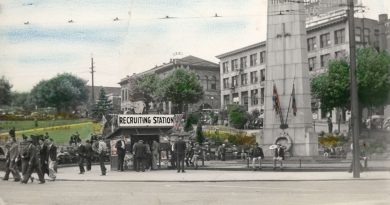
April 27 The Cenotaph at Vancouver’s Victory Square was unveiled in a ceremony presided over by Mayor William Reid Owen. A memorial to Vancouver’s soldiers who died in France, its inscription reads: “Their name liveth for ever more / Is it nothing to you—All ye that pass by.” An annual ceremony on November 11, Remembrance Day, sees former service members gather here to honor their fallen comrades.
April After some time off the air, CFYC was set up with a 25-watt transmitter in the First Congregational Church at Thurlow and Pendrell in Vancouver’s West End.
May 21 Jack Manzo Nagano, the first Japanese immigrant in BC (and possibly in Canada), died at 69 in Kuchinotsu, where he had been born in 1855. At 23, he worked as a cabin boy from Nagasaki to New Westminster on a British ship, arriving in 1877. He fished for salmon on the Fraser and later worked on the Gastown docks. He ran businesses in Yokohama, Seattle and Victoria, and pursued several ventures, including a hotel for Japanese immigrants. He prospered exporting salted salmon. In 1977, a mountain in Rivers Inlet area was named for him.
May 26 Broadcaster Wally Garrett (CKNW) was born.
June 14 BC’s most well-known architect, Arthur Erickson, was born in Vancouver.
June 20 Canada’s premier landscape architect, Cornelia Oberlander, was born in Muhlheim, Germany. She escaped with her family from Nazi Germany in 1939—and a few years ago returned to Germany to design the gardens for the Canadian embassy in Berlin.
Also June 20 Storekeeper Harry Eburne died in South Vancouver. In February 1875 he came to BC with his foster parents. In 1881, aged about 25, he opened the first general store and post office at the Sea Island end of the Fraser. Originally named North Arm, the settlement was renamed Eburne and, later, Marpole.
June 21 (And see February 21.) The Lady Alexandra, flagship of Union Pacific’s new excursion fleet, arrived from Scotland, where she had been built. With accommodation for 1,400 picnickers she was on the Howe Sound to Bowen Island run until 1953. Then, moored in Vancouver harbor and named Princess Louise II, she served as a restaurant until new American owners towed her to California.
Also June 21 Basil Plimley was born in Victoria, one of the few third-generation executives of a B.C. business. (The Plimley auto dealer companies closed in 1991, after 98 years.)
June 25 HMS Hood visited Vancouver. A Tyee Potlatch was held during the 10-day visit.
July 26 Nanny Janet Smith was found murdered in the Shaughnessy home of her employers. The Point Grey municipal police were summoned to 3851 Osler Avenue in Shaughnessy Heights, the home of F.L. Baker, a socially prominent exporter of pharmaceutical drugs, to investigate the apparent suicide of Janet Smith, the Baker family’s 22-year-old Scottish nursemaid. The Point Grey police botched the case, and only the suspicions of the city’s Scottish community reopened it. A sensational case followed “involving the city’s elite, political corruption and widespread racism.” A Chinese houseboy, Wong Foon Sing, was accused but acquitted. The murderer was never found. This crime and its astonishing aftermath were on Page One of local papers, every day—repeat: every day—for months. See Who Killed Janet Smith? by Ed Starkins, a very detailed account of a fascinating crime and the extraordinary sequence of events that followed it.
July 28 In 1924 Julian Hedworth George, Viscount Byng of Vimy had been Canada’s Governor-General (they capitalized and hyphenated the title back then) for three years, and it was in that capacity he came to the municipality of Point Grey on July 28 to lay the foundation stone for Lord Byng High School. A young student named Frances Dowman presented a bouquet to the GG, who’d received a lot of bouquets for his service in World War I, including commanding the Canadian Corps in the famous attack on Vimy Ridge in April, 1917. There were five teachers and about 100 students (compared to more than 1,000 today), but they wouldn’t get into the building itself when school began in September. For five months Lord Byng students attended classes in the nearby Lord Kitchener School building, then moved into their now completed building in March of 1925. (Incidentally, hockey’s Lady Byng Trophy—awarded for sportsmanship combined with excellence—was donated by Byng’s wife.)
July 29 North Vancouver’s Phyllis Munday became the first woman to ascend Mount Robson.
August 9 A painting by John Innes, a well-known Vancouver artist, of President Warren Harding’s speaking appearance before a huge crowd in Stanley Park, a painting commissioned by the Vancouver Sun, was presented today to the U.S. National Museum. (See July 26, 1923.)
August 21 The planet Mars was closer to Earth than it had been for many years. That lent exciting credence to the Province’s Page One story: “Mysterious signals picked up at Point Grey wireless station during the past few weeks culminated this morning in a recognized group of sounds which lead the operators to believe that Mars has succeeded in establishing communication with the earth. Four distinct groups of four dashes came in over the ether at 7:12 a.m., when Mr. W. T. Burford was on duty. These dashes were not in any known code but started on a low note, gradually ascending and concluding with a ‘zipp.’ The signals were not sent by spark nor continuous wave and the theory that Mars has at last managed to ‘get through’ is gaining support.”
September 19 A “Miss World””competition with 25 competitors was hosted aboard HMS Hood in Topsail Bay, Newfoundland The winner was Miss Honolulu, followed by Miss Vancouver in second place and Miss Melbourne in third.
September 27 50-watt CKFC went on the air from the First Congregational Church at Thurlow and Pendrell in Vancouver’s West End, the same location cited for CFYC. (See April listing above.)
September 28 Two US planes landed in Seattle, having completed the first flight around the world.
October 21 CFYC carried a speech made by Prime Minister Mackenzie King from the Denman Arena, considered to be Canada’s first federal political broadcast.
October 29 From the Province: “A westbound Canadian Pacific Railway train heading for Vancouver was hit by an explosion . . . and among the five dead were Doukhobor leader Peter Verigin, 65, and John McKie, the newly elected MLA for Grand Forks.” The cause of the explosion was never officially determined, but some speculate it was intentional and that Verigin was the target. The paper commented: “With the death of Peter Verigin . . . the breakup of one of the greatest communistic organizations in the world is forecast here . . .”
November 11 Business executive (Rivtow) Lucille Johnstone was born in Vancouver. She has become a legend in B.C. business.
November 11 The first reference to a football game in Vancouver: two teams, one junior and the other senior, were put together at UBC.
Also in 1924
22-year-old Nat Bailey hawked peanuts at local baseball games, then transformed his 1918 Model T truck into a travelling lunch counter, parking every Sunday at Lookout Point on SW Marine Drive. Hungry sightseers crowded around, paid a dime for a hot dog, a nickel for an ice cream. On a hot summer day in 1924, one customer leaned out of his car and shouted, “Why don’t you bring it to us?” That was the inspiration. Four years later, in June of 1928, Nat Bailey would proudly welcome guests to the first White Spot drive-in.
CFXC, founded by radio-shop owner Fred Hume, began broadcasting out of a tiny room in the back of his shop in New Westminster.
St. Luke’s Home was built at 309 East Cordova. Today, it’s a heritage building.
A.E. Austin became president of the Vancouver Real Estate Board.
Capilano Park came into being through The Vancouver Board of Trade; the land was donated by the B.C. Electric Company.
Charles Campbell, who sold the World to Robert Cromie this year, started the Evening Star. Victor Odlum, 44, became publisher and editor-in-chief. Now Vancouver had four dailies. A month and a half later Campbell sold the Star to Victor Odlum.
The United Church of Canada Act was passed in Parliament, uniting the Methodists, Congregationalists and Presbyterians into the largest Protestant Church in Canada.
Michigan-born Edgar Stewart Robinson, 27, was named head of the Vancouver Public Library. He would run the system for 33 years. See British Columbia Historical News Spring 2003, Page 15.
The Hammond Cedar Products Company baseball team of the Dewdney League won the BC baseball championship this year. Harry Butler was the star pitcher. Harry’s son Tom, long famous in Vancouver public relations circles and now living in retirement on PEI, sent us a picture of the team. Harry Butler is second from the left in the top row. “Dad played for the team starting in 1921,” Tom writes, “and, like all his teammates, had a job in the sawmill at 40 cents an hour . . . but he got a $5 bonus for every game he pitched and won.”
This is not directly connected to Metropolitan Vancouver, but it’s a nice 1924 tale and it affected all our lives, so . . . from the Buffalo News: “Thanks to an Indio resident and a Buffalo News reader, we can acknowledge a debt of gratitude to a little known source. That invaluable white (sometimes yellow) line that bisects all our streets and highways was the inspiration of an Indio woman. Dr. June McCarroll, a general practitioner in Indio during World War One years, is credited with the idea. According to the newspaper clipping sent from Cheektowa, N.Y., the idea came after Dr. McCarroll’s car was sideswiped by a truck. Determined to do something about drivers who crowded others off the road, she noted that a bulging joint down the middle of the road kept motorists on their own side. So she suggested to the Town Council that a line be painted down the center of the street. Like many councils, this one considered the idea ingenious but impractical. It took the good doctor many years, and the support of women’s clubs all over California and finally the California Highway Commission, before the idea was tested in 1924. Fortunately, Dr. McCarroll lived to see her idea become reality. Untold numbers also lived because the physician cared enough to pursue her goal.” Our thanks to Jim McGraw for sending this item along.
William Reid Owen, the first blacksmith in the Mount Pleasant neighborhood, became mayor of Vancouver. He had been the first mayoralty candidate to use radio in his campaign.
Lansdowne Track in Richmond opened, named for a former Governor General. The peat bog on which the track is built acted like a sponge and horses were known to run slower at high tide.
The rumrunner Beryl was hijacked in the Gulf of Georgia.
J.M. Fromme became reeve of North Vancouver District. He’s called the “Father of Lynn Valley,” because he built the first house there in 1899.
The first neon lights came to Vancouver, installed by enterprising Granville Street merchants.
Anne Sugarman became the founding president of the Vancouver Council of Jewish Women.
The Vancouver Jewish Community Chest was organized.
M.Y. Williams, a Canadian geologist, began the collection that today is the UBC Geological Museum.
Forest Lawn Cemetery opened.
Hazing was banned at UBC.
Minoru Park, shut down during World War I, was re-opened and renamed Brighouse Park.
Hastings Golf Course opened. It lasted to 1954 when the British Empire Games took over the space.
Scotland-born baker James McGavin moved to Vancouver, will later begin McGavin Bakeries.
The Kinsmen Club of Vancouver was founded.
Henry Avison, the first employee of the Vancouver Park Board, died in Prince George at age 69. He cut Stanley Park’s first trails (one is named for him), was its first zoo keeper (the “zoo” was a bear tied to a tree), designed the park’s first gardens, and lived in a lodge by its entrance.
North Vancouver High School, which had opened in 1910 and was for many years the only high school on the north shore, moved to its own building at 23rd and St. Georges.
The Burrard Inlet Tunnel and Bridge Company ran into legal and financial difficulties. By 1924 the municipalities of West Vancouver, Vancouver and the two North Vancouvers owned all the stock in the company.
The Pacific Coast Hockey Association folded. The PCHA had been founded in 1911 by Frank Patrick and Lester Patrick with three teams: the New Westminster Royals, the Victoria Aristocrats, and the Vancouver Millionaires. It merged with the Western Canada Hockey League this year.
Capt. John Cates returned from the BC interior to Bowen Island to construct a house and run a hotel at Crescent Beach.
Harbour Navigation built the Harbour Princess (the old one). She carried passengers and freight to Wigwam Inn (up Indian Arm), and was the first diesel-powered passenger boat on the coast.
Curling became an Olympic sport for the first time in Chamonix, France. (France, Great Britain and Sweden were the only countries to participate.)
UBC’s Hart House Quartet was founded.
England-born Charles Edward Findlater, choir director, 31, who had come to Vancouver in 1918 to teach voice and piano, founded the Wesley Sunday School Choir.
Alexander Russell Lord, educator, began teaching at Vancouver’s Normal School. In 1950 he retired as principal. Awarded the Fergusson Memorial Award in 1950 for his “outstanding contribution to education in B.C.,” an elementary school in Vancouver is named for him.
Ranjit Mattu, star athlete, born in 1916 in the Punjab, came to Vancouver. He graduated with a BA from UBC as a star athlete in rugby and football. He coached Canadian high school football and later junior football to 1949. His team, the Vancouver Blue Bombers, were the Dominion Champions of 1947, the first such championship won by Vancouver.
Sam Randall, thoroughbred race promoter, took over the operation of Lansdowne Park on Lulu Island, beginning a 21-year stretch.
Architect Francis Mawson Rattenbury, 57, (his most well-known Vancouver building is the Courthouse, now the Vancouver Art Gallery) fled Victoria for his native England with his 30-year-old mistress, Alma Pakenham. Their affair was scandalizing the residents of the city, who were positively . . . Victorian. A little over 10 years later Rattenbury was murdered in England by a young lover of Alma.
Thomas Reid became reeve of Surrey, would hold the post for 10 years.
Archimandrite Antonin Pokrovsky founded the Holy Resurrection Church in Vancouver. (An archimandrite in the Eastern church is “the superior of a large monastery or group of monasteries.”) For an intensely interesting story about the church in Vancouver, visit this website.
Charles Brakenridge became the Vancouver city engineer. He will become the longest-serving in that role, holding the post for 22 years until 1946.