1926
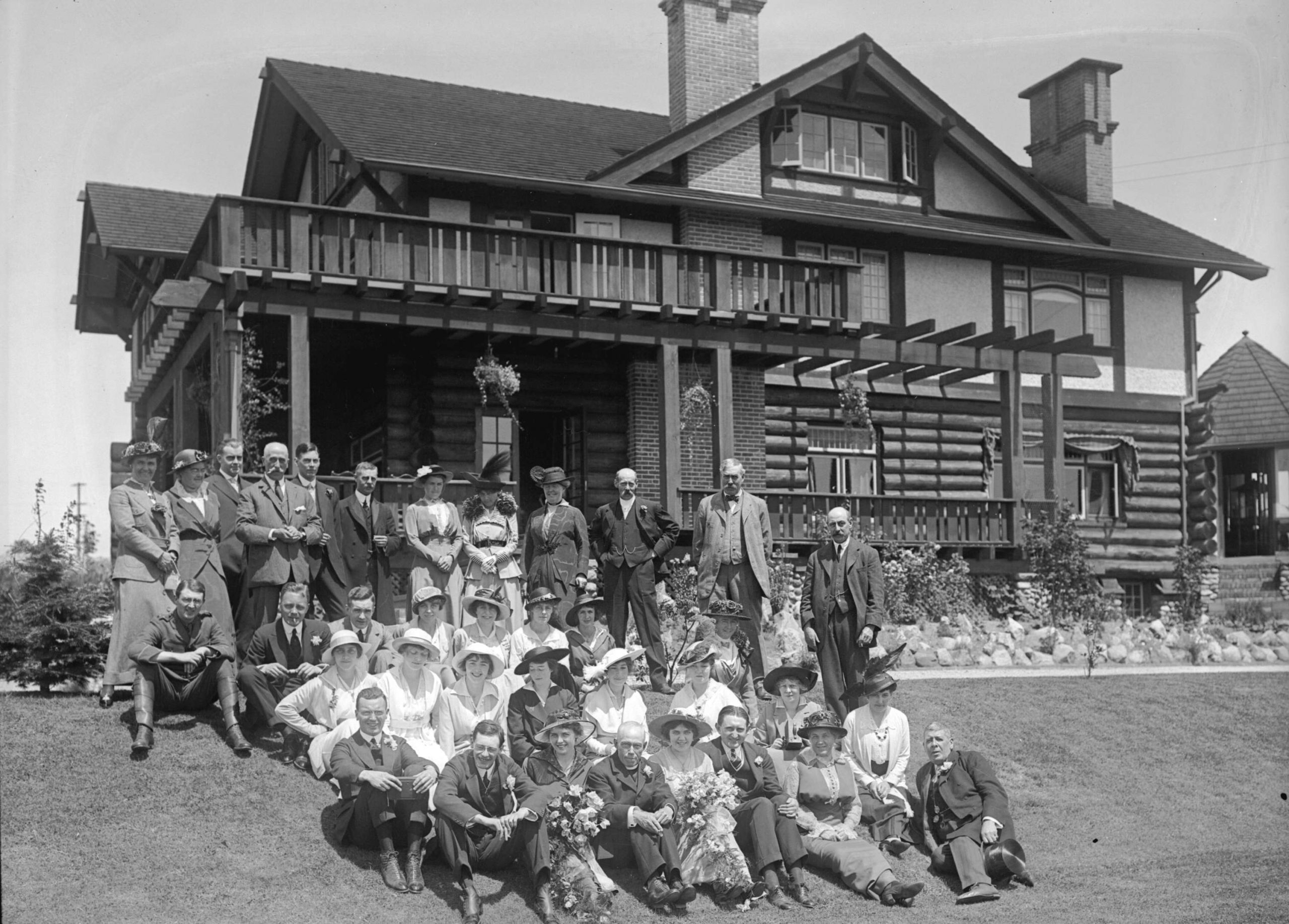
Above: Wedding party at house of C. Gardner Johnson who started the first insurance agency in the city.
[Image: City of Vancouver Archives AM1535-: CVA 99-1116]
*****************************************
You’ll note that these years include events listed under “Also in . . .” These are events for which we don’t have a specific date. If YOU know the specific date of an event shown there, please notify us . . . and cite the source! Many thanks!
*****************************************
January 18 Poet and photographer Roy Kiyooka, was born in Moose Jaw, Sask. He came to Vancouver in 1960, died here January 15, 1994.
January 19 Charles Gardiner Johnson, called “the father of Vancouver’s shipping industry,” died in Vancouver, aged 68. Born February 8, 1857, near Dunblane, Scotland, he went to sea in 1870. In the 1880s he left seafaring to farm in Manitoba. On September 5, 1885, broke and married, he arrived in Vancouver and went to work for the CPR as a laborer. In 1886 he opened a shipping and insurance agency, the first in the city. C. Gardner Johnson & Co. (at Hastings and Granville) became one of the city’s major shipping agents.
January 27 The West Vancouver Town Planning Commission was created, and banned the construction of temporary waterfront shacks and unsightly summer camps. Industry was also banned and West Vancouver became a residential suburb of Vancouver.
January 31 Final day of the assay office at 501 Granville at Pender (in the old post office).
January Wong Foon Sing, a houseboy in the Shaughnessy home in which nanny Janet Smith was murdered in 1924, and who was an early suspect in the killing, returned to China. He had earlier been found innocent of any wrongdoing. More»
February 1 The Vancouver Town Planning Commission was established by City Council, following the passing of the province’s Town Planning Act. The Act gave Councils the authority to:
* prepare official town plans (as well as harbor, railway, rapid-transit, and street-railway plans to coordinate with them)
* designate land use districts and enforce the regulations (i.e., zoning regulations)
* consider any matters dealing with the physical development of the municipality.
The Commission, a group of nine citizens, Mayor L.D. Taylor, and representatives from the School, Harbor, Park, and Sewer Boards, hired Harland Bartholomew & Associates, Town Planning Consultants from St. Louis, Missouri to prepare a comprehensive town plan for Vancouver. Bartholomew planned for a city of one million people focused on the “great seaport” of Burrard Inlet. The Fraser River banks and False Creek would be industrial. Businesses would spread evenly over the central business district to “prevent undue traffic congestion.” The nearby West End would provide apartments close to jobs. “The Bartholomew Plan,” city planner Dr. Ann McAfee has written, “was never formally adopted by City Council. Nevertheless, over the years, much of Bartholomew’s vision was realized.”
For more, click here.
April 9 The West Vancouver News began publishing.
April 18 Broadcaster Gerry Davies was born.
April 21 Queen Elizabeth II was born.
April 25 Newspaper headline: Vancouver’s Building Activity Shatters All Records.
April 28 Vancouver restaurateur Hy Aisenstat was born in Calgary. He moved to Vancouver in 1960.
May Howard and Alma Fletcher opened West Vancouver’s first theatre, the Hollyburn, on Marine Drive near 18th Street.
June 17 Susanna Gertrude Clarke Mellon, a long-time supporter of arts and worthy causes, died in Vancouver, aged about 82. (She was born in London, England about 1844.) She had convinced her husband, Captain Henry Augustus Mellon, to move from Winnipeg to B.C. in 1886, arriving just after the Great Fire of June 13. She was a fundraiser for local arts groups, and a founder (on April 3, 1894) of the Historical and Scientific Society.
July Anatole Portnoff was one of a group of Russian immigrants who arrived this month in Vancouver from Harbin, aboard the Empress of Canada, only to discover that, for some of them, including Portnoff, the passports they had (issued to them by the British consulate in Harbin) were somehow not sufficient to get them into the country. They were ordered to wait aboard the Empress until its departure, taking them back to Harbin. To read the REALLY interesting story of what happened next, go here. To give the site its full title: Mr. Anatole E. Portnoff’s memoirs of the Russian colony in Vancouver, existing since 1926 around the Holy Resurrection Church.
August 17 Author David Watmough was born in London. He moved to the U.S. in 1952, living first in New York and then in San Francisco. He moved to Vancouver in 1960 and became a Canadian citizen in 1967.
September 11 The first seaplane flight from Montreal to Vancouver began. It took eight days. The plane arrived in Vancouver September 19.
September 30 The Vancouver Women’s Building at Thurlow and Alberni was dedicated.
September Here’s an interesting excerpt from a September 1926 report by Constable W. J. Hatcher of the B.C. Provincial Police, Westminster District, regarding the policing of Port Coquitlam: “At times the auto traffic is very heavy on the Dewdney Trunk Road, a count at different times shows that from 250 to 300 an hour pass along this highway, especially on Sunday afternoons and evenings.” Constable Hatcher appended a statement of expenditures for the month: Salary was $106.50, office supplies totaled $12.75, travelling expenses amounted to $6.30, equipment was 60 cents, and “prisoners meals” cost $2.64. There is no indication of how many prisoners were fed that month.
October 12 Theatre teacher, actor, local showbiz expert Norman Young was born.
October 14 Thomas John Janes, stagecoach owner and driver, died in Vancouver, aged 71. He had arrived in Granville (later Vancouver) Oct. 31, 1883. He ran a butcher shop, then began operating Janes Stage, the first stagecoach line to carry passengers between New Westminster and Vancouver. The route was along Westminster Avenue (now Main Street and Kingsway).
November 2 The Society of Notaries Public of B.C. was incorporated. (Membership would be optional until it became compulsory through statutory amendments in 1956.)
November 5 Queen Marie of Romania (a granddaughter of Queen Victoria) paid us a visit. En route to Vancouver from Seattle, the queen visited the Samuel Hill family home in Blaine, went into the kitchen and prepared pancakes and honey for the family. Her train left at 10 a.m. for Vancouver, where she was greeted by the Mayor and Lieutenant-Governor. She briefly toured the city before attending a luncheon given by the Women’s Canadian Club, an event the Province covered, listing the names of every member of every committee involved in the do. Afterwards, she visited UBC, and that same evening she went to a banquet where she was escorted into the hall by Scottish bagpipers.
The next morning the train again stopped at Blaine and Queen Marie visited the Peace Arch, erected to commemorate the 100th anniversary of peace between the United States and Canada. (Sam Hill was one of the driving forces behind the Arch. See 1921.)
November 20 Vancouver’s first big show of radio receiving sets opened in the winter garden at English Bay pier.
November 29 Baseball’s Babe Ruth hammed it up on stage in Vancouver during a personal appearance tour of North America. He posed as a batter, with Vancouver mayor L.D. Taylor crouching behind him as catcher, and the city’s chief of police umpiring.
November After the 1925 construction of the bridge across the Second Narrows, industrialist W.C. Shelly had a vision that a popular resort could be placed atop Grouse Mountain if a road could be built to make it easier to get up there. So he formed a company, Grouse Mountain Highway and Scenic Resort Ltd., to put in a road up the mountain and build a chalet at the end of it. Grouse Mountain Chalet opened in November. It was a magnificent wooden structure, built— without a nail—by Scandinavian craftsmen. There was a huge stone fireplace, bearskin rugs, fine furniture and dining ware. The popularity of the place “was particularly evident on Saturday nights,” a fan wrote, “when a trail of limousines streamed up the highway to deliver guests for the evening.”
Shelly’s group also commissioned a book, Chinook Days, to mark the opening of the highway. I have a copy in my library: of the 1,000 copies produced, this is No. 319, and is signed by the author, Tom MacInnes. It’s a well-written, old-fashioned combination of local native legends and early Vancouver history. It’s also casually racist. If it had been written a little later, its tone might have been gloomier. There were dark days ahead for Shelly’s project.
December 21 Broadcaster Wilf Ray was born.
December Vancouver shoppers had a brand new department store. David Spencer opened his nine-storey building at the corner of Hastings and Richards Streets. The store went five stories below street level, as well, providing customers with 320,000 square feet of shopping space . . . and Spencer’s toyland offered a paradise for children.
Also in 1926
The local newspaper world got complicated: Victor Odlum’s Evening Star became the Morning Star and took over the Morning Sun’s circulation. The Evening Sun (which had been the World), took over the Star’s circulation. The city was now back to three papers: the morning Star, the evening Sun, and the Province—the latter the biggest of the three.
Henderson’s Directory listed six radio stations in Vancouver. They were CNRV, the Canadian National Railway Company’s station, operated from studios in the CNR station on Main Street (the CNR ran a radio service for its train passengers); CFYC, operated by Commercial Radio Ltd; CFDC, owned by the Sparks Co; CFQC, operating out of the 16th floor at 500 Beatty, home of the Sprott Shaw Radio Co., which had been in business for years teaching the technical aspects of radio; CKFC, a “United Churches” station and CKCD, owned by The Province newspaper.
William Curtis Shelly, a 46-year-old businessman, who’d made his fortune in the bakery business (4X Bread), organized Canadian Bakeries Ltd., serving all of western Canada. He was also active in real estate. And see the Grouse Mountain entries above.
The Richmond Record ran an article titled “Our Town Hall Luck,” summing up the Hall as “. . . our own, happily, and we might venture to think it the trimmest of its kind on the Pacific Coast, which is not saying much.” Later in the piece, the writer rates the hall second to the CPR building in Vancouver in terms of beauty, and is inspired to romantic comparisons: “Unlike many civic office buildings we know, it is simple and clear-cut in form as a ballad, as firm and strong in line and color.”
Butcher shop owner James Inglis Reid set up a $25,000 fund for Vancouver General Hospital as a memorial to his teenaged son Knox who drowned off Bowen Island. The fund was used for therapeutic services for boys.
Prospect Point and Brockton Point Lighthouses were destaffed, converted to automatic control.
The Greater Vancouver Water District was incorporated. It was folded into the Greater Vancouver Regional District in 1991. (The first chief commissioner was Ernest Albert Cleveland, after whom Cleveland Dam is named.)
By the 1920s, the Dutch immigrant community in Metropolitan Vancouver had become large enough to organize major social events. In 1926 Holland Society members aided in the establishment of the first of BC’s 36 Christian Reformed Churches.
St. Andrews Presbyterian Church, built in 1904 on Lower Keith Road in North Vancouver, later relocated to 10th Street and St. Georges, became St. Andrews United.
Future businessman Jack Diamond, 17, arrived in Vancouver from Poland with a straw suitcase and the clothes on his back.
The Council of Jewish Women opened a Neighbourhood House in Strathcona.
Seven friends started the Polish Friendship Society in Vancouver to maintain the Polish identity, preserve the Polish language, and help new arrivals.
The Vancouver Board of Trade made a grant to the University of British Columbia for the purpose of establishing a Faculty of Commerce, and assisted in the formation of the Canadian Chamber of Commerce.
The Western Canada Hockey League, which had started in 1921, changed its name to the Western Hockey League. Then, still in 1926, it changed again to the Prairie Hockey League. The league would fold in 1928.
Julian Hedworth George, Viscount Byng of Vimy, ended his term as Governor General of Canada. He was succeeded by the Marquis of Willingdon, who would serve to 1931. Willingdon Avenue in Burnaby is named for him.
Realtor Ernest Leonard Boultbee, who had formed Allan & Boultbee Ltd. “around” 1922, merged with Macaulay, Nicolls & Maitland “around” 1926.
CFDC, which had gone on the air in Nanaimo in 1923, moved to Vancouver and changed its name to CKWX, the oldest existing call letters in local radio.
North Vancouver mountaineers Don and Phyllis Munday came within 18 metres of the top of Mt. Waddington, B.C.’s highest peak.
The mining company Placer Development Limited was incorporated this year in Vancouver. In 1987 it would merge with Dome Mines Limited to form Placer Dome.
Hudson’s Bay Company extended its store at Granville and Georgia. The original 1893 store at that corner was demolished, and an addition created that echoed the style of (and was seamlessly attached to) the 1913 store adjacent to the east.
The company that today is Dueck Chevrolet Cadillac Hummer Ltd. was established.
The Catholic community of Maple Ridge established St. Patrick’s Parish. The original St. Patrick’s Parish included all of the present day St. Luke’s. In the earliest days everyone in the area went to Haney for Sunday Mass.
Future MP and federal cabinet member Arthur Laing, born in Eburne in 1904, joined the Vancouver Milling and Grain Company. He was 22. (The Arthur Laing Bridge was named for him.) He died in February 1975.
Patient population at Essondale Mental Hospital was about 1,200.
Around 1926 the Langer circuit of suburban theatres began. “Joseph Langer,” Ivan Ackery recalled, in his autobiography Fifty Years on Theatre Row, “was an English gentleman who rode in a big maroon Daimler, seated grandly behind a maroon-liveried chauffeur.” He had come to Vancouver a few years earlier and had built several suburban theatres—the Victoria Road Theatre, the Kitsilano, the Windsor, the Alma and the Kerrisdale. He sold them to raise the money to build the Orpheum. (That palace of entertainment opened in November, 1927.)
Earle Birney, Calgary-born poet, graduated from UBC at 22.
Angelo Branca, future judge, born March 21, 1903 in Mount Sicker, B.C. began practising law in Vancouver.
J.P. Nicolls was president of the Vancouver Real Estate Board.
Charles H. Scott became Principal of the Vancouver School of Decorative and Applied Arts. He would hold that post until his retirement in 1952.
Takao Tanabe, artist and teacher, was born in Prince Rupert, the son of a commercial fisherman.
Simon Fraser Tolmie, a future BC premier, became the federal minister of agriculture.
F.E. Burke became president of the Vancouver Board of Trade.
A road to Whytecliff and Horseshoe Bay was opened.
The Native Sons of British Columbia published Romance of Vancouver.
A wooden truss bridge was constructed over the Coquitlam River to link the Dewdney Trunk Road with Pitt River Road. (That stretch of the Dewdney is now part of the Lougheed Highway.) It replaced an old plank bridge that had been closed for two years for reasons of safety. The new bridge was painted red. The “Red Bridge” would be a prominent PoCo landmark for more than 50 years, keeping the name even when it was painted in other colors. (Its modern replacement has been deliberately colored red.)
Charles Davies became an alderman in Port Coquitlam. He would hold that office for 21 years, then be elected mayor and serve in that capacity for another nine years, an unbroken 30 years of service to the city.
A park at Whytecliff Point opened, called Rockcliffe at first. A tea-room with a dance floor was built, about where the present lookout is.
Hollyburn Lodge on Hollyburn Mountain was built by three Scandinavians, Oscar Pearson, Ole Anderson and Andrew Israels to promote the recreational potential of the mountain. They hauled up lumber salvaged from the old Naismith Mill buildings, a mile down the mountainside.
Whistler’s first sawmill was built by the Barr brothers on Green Lake. At its peak it employed up to 50 men, and gave the PGE more business than any other stop on the line.
The North Burnaby Board of Trade was established.
John Hendry Park in the east end (site of Trout Lake) was donated to the city by Aldene Hamber, the daughter of Hastings Sawmill owner John Hendry, and her husband Eric Hamber, a future lieutenant-governor of B.C.
The first of several Ladies Auxiliaries to the Fraternal Order of Eagles was founded in 1926. (They are attached to but entirely independent of the men’s Aeries.)
The Soroptomist International club, established in 1921 in Oakland, California, saw its first Vancouver club established this year. The Soroptimists now have 100,000 members in 100 countries. There are 16 clubs in Metropolitan Vancouver. (“The club’s name,” researcher Barbara Rogers has written, “was coined from the Latin ‘soror’ meaning sister, and ‘optima,’ meaning best, loosely interpreted as ‘the best for women.’ This is a non-political, non sectarian international club for business and professional women who wish to give something back to their communities.”)
Pacific Stage Lines opened a new depot at Dunsmuir and Seymour with ticket offices, an inside bus bay for loading, restaurant, travel agency and more.
Langara Golf Course was established southeast of 49th and Cambie.
Douglas Park was established in the Riley Park/South Cambie neighborhood. It had been a Chinese vegetable farm. (And before that a small milk ranch, and before that a pasture to feed the oxen of logger Jerry Rogers, and before that, forest.)
Development of “Third Shaughnessy,” between King Edward and West 41st Avenue, began.
The Joe Fortes Memorial Drinking Fountain was placed in Alexandra Park, much of the cost being raised from pennies donated by local school children—hundreds of whom had been taught to swim by Joe. The bronze-granite fountain was designed by Charles Marega.
King George School changed its name. Many people confused it with another school named King George in Vancouver, so it was decided to rename it after Hugh Crawford Magee, a successful pioneer farmer who took up land in Point Grey in 1867, the first farmer to settle on the North Arm of the Fraser. Magee died in 1909.
The Vancouver National Labour Council was organized.
McKim Advertising, Canada’s oldest agency (1889 in Montreal), set up a local office.
The tallest Douglas fir ever recorded in Stanley Park, 99 metres tall, toppled.
Dr. Herbert Nowell founded the Dominion Herbal College. Now located in Burnaby, it’s the oldest college of its kind in North America.
Francis William Caulfeild, an English land developer, made his last visit here, aged about 86. He never lived in B.C., but was attracted by the beauty of the B.C. coast. In 1899 he had purchased waterfront property east of Point Atkinson, an area called Skunk Cove. He renamed it Caulfeild (thanks!) and developed it as a “charming Old World community.” The village was laid out to follow land contours, with broad paths (later roads) and a quarter mile of waterfront parkland. Caulfeild died in London in 1934 at age 94.
Zebulon Franks, storekeeper, and the first Jewish religious leader in Vancouver, died here aged about 62. He was born about 1864 in Odessa, Ukraine. “Son of a High Rabbi,” writes Constance Brissenden, “he had a deep knowledge of Judaism. At 17, he survived a pogrom that murdered his family. He met his wife Esther during his escape across Europe. They came to Vancouver in 1887, the year after incorporation. A ‘junk merchant’ at first, he opened a general hardware store on Water Street. He held the first Orthodox services in his home and store.”
On her husband J. Stewart Jamieson’s death, Laura Jamieson succeeded him as Burnaby Juvenile Court judge, the first B.C. woman in this position.
Seattle-born Sadie Marks, who lived for a time in Vancouver and first met Benny Kubelsky there in 1922, met him again in Seattle. They hit it off, got married and went on to entertainment fame, he as Jack Benny, she as Mary Livingstone.
Scotland-born Jock MacDonald, one of the first abstract painters in Canada, came to Vancouver, aged about 29. He would live here until 1946. He was a “leading exponent of modern art as teacher and painter.” He would go on to teach at the Vancouver School of Decorative and Applied Arts, and the B.C. College of Arts (1933-35), co-founded with Fred Varley.
Pugwash, Nova Scotia-born Larry (Norman Archibald MacRae) MacKenzie, future UBC president (1944-62), was called to the Nova Scotia bar.
Alexander Duncan McRae, who had arrived from Ontario in 1907, was elected MP.
The Vanderpant Gallery opened on Robson Street. Run by photographer John Vanderpant, it would become a centre of intellectual life in the city for more than a decade. See Underlying Vibrations: The Photography of John Vanderpant by Sheryl Salloum.
The Tomahawk Barbecue opened.
Our Lady of Sorrows Convent opened.
The company that today is Benwell-Atkins was incorporated in Vancouver.