1928
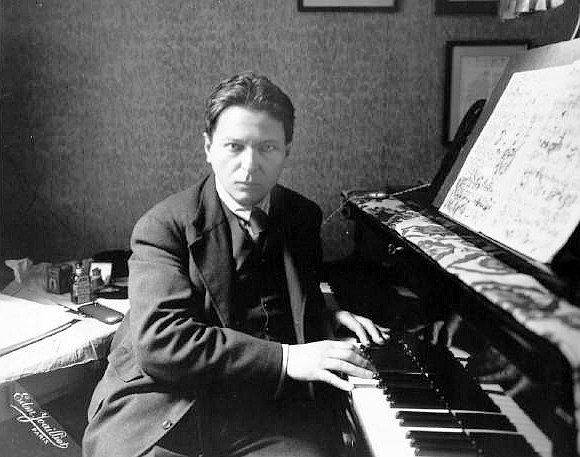
Above: Romanian composer George Enescu (1881-1955) at the piano. He performed in Vancouver in 1928.
[Image: Wikipedia – E. Joaillier, Paris (photographer)]
*****************************************
You’ll note that these years include events listed under “Also in . . .” These are events for which we don’t have a specific date. If YOU know the specific date of an event shown there, please notify us . . . and cite the source! Many thanks!
*****************************************
January 1 St. Francis in the Wood church in Caulfeild, West Vancouver, was consecrated. It was designed by Henry A. Stone, a local resident, businessman and early benefactor of the Vancouver Art Gallery.
Also January 1 16-year-old Ivy Granstrom made her first entry into the chilly waters of English Bay in the Polar Bear Swim. Ms. Granstrom, blind from birth, will go on to appear at 77 consecutive Polar Bear events.
January 22 Singer Evan Kemp was born.
January 26 The famous Romanian violinist Georges Enesco appeared at the Vancouver Theatre. This was an early engagement sponsored by impresario Lily Laverock.
January 28 Voters in Point Grey and Vancouver approved amalgamation.
January 31 Artist Gathie Falk was born in Alexander, Manitoba. She came to Vancouver in 1946.
January The General Gordon School Band was formed in Kitsilano under the direction of 36-year-old Arthur W. Delamont, once a Salvation Army trumpet player. Under Delamont, it became the famous Kitsilano Boys Band. He will lead it for five decades.
January The Women’s Institute Hospital for Crippled Children at 8264 Hudson Street admitted its first patient.
February 8 John Francis Bursill, columnist and poet, whose pen name was Felix Penne, died in Burnaby aged about 80. He was born in 1848 in London, England. From 1865, he worked as a Fleet Street journalist. Nearing 60, he came to Vancouver in 1905 to join his eldest son in East Collingwood. In 1911 he founded the Collingwood Free Library. He became well-known as a Vancouver Sun columnist in the 1920s under his pen name Felix Penne.
February 27 Future mayor Jack Volrich was born.
March 1 Capt. W.D. “Davey” Jones, the first man appointed to fire the Nine O’Clock Gun, died at age 85 . . . appropriately, at 9 p.m.
March 4 The Model 204 (B-1E), a Boeing four-seat civilian flying boat, made its first flight. Ten were built and were the last aircraft Boeing built specifically for private ownership by civilians. Four of the 204s were built by Boeing in Vancouver; they were called “Thunderbirds.”
March 19 The Japanese Hall and Japanese School at 475 Alexander Street was dedicated. It’s still there, a heritage building.
March 22 Future city councillor Bruce Eriksen was born.
March 31 Hockey’s Gordie Howe was born.
March Fenwick Fatkin staged a display of daffodils in the community hall at Bradner, in conjunction with local growers. Bradner will become known as a floral centre.
April 23 The Norwich City struck the Second Narrows bridge. It was the 18th major bridge mishap in three years. Shipping interests took the Burrard Inlet Tunnel and Bridge Company to court, maintaining the bridge was a hazard to navigation. The Privy Council found against the bridge company, but the bridge remained.
Also April 23 Henry John Cambie, railway engineer, died in Vancouver aged 91. He was born October 25, 1836 in Tipperary, Ire. Cambie came to Canada in 1852, worked for the Grand Trunk Railway until 1859. He was in charge of CPR surveys from 1876 to 1880. His survey from Yellowhead Pass to Port Moody set the route to the lower Fraser. In 1903 he moved to Vancouver, where he retired in 1921. Cambie Street was named for him.
Also April 23 Agnes Deans Cameron died. There’s a movie in her life. She was born in Victoria December 20, 1863 and died there at age 64, but spent a good deal of time in Vancouver and was the city’s first woman high school teacher and first woman principal. (She was once fired for allowing students to use a ruler during a drawing exam.) But that’s not the whole movie. In her mid-forties she traveled 16,000 kilometres up the Mackenzie River to the Arctic Circle, and wrote a book about it: The New North: An Account of a Woman’s 1908 Journey Through Canada to the Arctic, illustrated with photos by her niece and travel companion Jessie Cameron Brown. It was a smash.
May 7 The 95-foot St. Roch is launched by Burrard Dry Dock. Built for the RCMP of Douglas fir and Australian “iron bark” and reinforced to withstand ice pressure, she was designed as an Arctic supply and patrol vessel.
Also May 7 Actor Bruno Gerussi was born in Medicine Hat, Alberta.
May 18 A new company, British Columbia Packers Limited, was incorporated. Among its most famous products is Clover Leaf salmon, first sold under that name in 1889.
May 25 A 6-cylinder, 125 HP La France pumper (pictured at right) was placed in service at Number 11 Fire Hall in Vancouver. Built by La France Fire Engine and Foamite Limited in Toronto, it weighed 5.5 tons and cost $14,945. It was in service until December 8, 1966. For many years people walked by it or let their children play on it at Ceperley Park (Third Beach at Stanley Park.) “Then” says the VFD’s Rob Jones-Cook, “during the summer of 2004 the Vancouver Park Board hired a group of students to refurbish it. They have done a wonderful job and it is now ‘assigned’ to Stanley Park Fire Department where I am sure many more children for many more years will have the fun of ‘driving’ old Shop No. 77 to fires.”
May 31 Australian aviators Charles Kingsford-Smith and Charles Ulm, along with Americans Harry Lyon and James Warner, took off from Oakland, California in a plane dubbed the Southern Cross to make the first flight across the Pacific Ocean. Kingsford-Smith is cited here because he briefly lived in Vancouver with his family when he was a young boy. He arrived in the city in 1905, at the age of eight. A school in the city has been named in his honor. It’s at 6901 Elliott Street. For a description of the flight, and much biographical information on him, visit this website.
June 16 In the 1920s, local car owners discovered the scenic loop through Point Grey along newly-paved Marine Drive and Granville Street. That inspired a young entrepreneur named Nat Bailey to sell snack food to motorists off the back of a truck at Lookout Point on Marine Drive. On June 16, 1928 Bailey established a permanent restaurant in a small log hut at 67th and Granville, calling it the White Spot Barbecue. Over the years, it grew into a large dining room, but a lot of his patrons preferred to eat their “Triple-O” burgers in their cars: the first White Spot drive-in. Read Constance Brissenden’s 1993 book Triple O: The White Spot Story.
July 1 Vancouver’s longest-serving postmaster, G. H. Clarke, began his term. He will serve to March 30, 1947, or 18 years, 8 months.
July 18 “After twelve years of Liberal rule,” the Province reported, “the people decided it was time for a change.” Did they ever! The Tories, under Simon Fraser Tolmie, 61, took 32 of the province’s 48 seats, including every seat in Vancouver and Victoria. Tolmie was a veterinarian who had once been chief inspector of livestock for the Dominion. He was premier from August 21, 1928 to November 15, 1933.
July 20 On the Province’s front page: TRIO CONQUERS MYSTERY MOUNTAIN, STRADDLING KNIFE-EDGED PEAK HIGHER THAN MAN HAS EVER CLIMBED IN B.C. The “mystery” mountain was Mount Waddington, and the climbers were Don and Phyllis Munday of Vancouver and A. R. Munday of Winnipeg. To local mountaineers, the Mundays need no introduction: beginning in the 1920s and for decades after they climbed all the major mountains in B.C., and are credited with “discovering” the tallest of them all: Waddington (4,016 metres, the highest mountain entirely within B.C. and higher than any peak in the Rockies.) The paper’s headline was not quite accurate, and the Mundays themselves never claimed to have conquered the mountain. What they had reached was the second highest of Waddington’s peaks. Read Don Munday’s 1948 book The Unknown Mountain for a thrilling record of their adventures.
July 26 Cited here because of Boeing’s early connection with Vancouver, the dedication of Boeing Field occurred today in Seattle. King County built the complex after William Boeing threatened to move his growing company to Los Angeles.
July Gordon Farrell, 38, became president of the B.C. Telephone Company. His father William had been the company’s first president.
August 1 Vancouver’s Percy Williams won a gold medal at the Amsterdam Olympics for the 100-metre dash. Then he won another for the 200-metre. He is still the only Canadian to win two gold medals in track and field. And see September 14.
Also August 1 Surrey held its third Annual Municipal Picnic on Bowen Island. Up to World War Two the municipality hosted annual picnics for residents. Union Steamship Company boats were hired and special trains laid on by GNR or BCER, and day trips taken to Pitt Lake, Bowen Island, Sechelt and even Victoria. Some 500 to 600 people would attend. (After 1946 the influx of new residents made the picnics impractical.)
August 7 Broadcaster Jim Cox was born.
August 12 Ste. Anne’s Academy opened.
August 14 The fireboat J H Carlisle, named for the long-serving fire department chief, was launched with retiring Chief Carlisle proudly looking on. The boat was put into service September 1 at No. 16 Station at the south foot of Drake Street.
August 21 Simon Fraser Tolmie, Conservative, became premier. (He succeeded John MacLean.) Tolmie was premier of B.C. Aug. 21, 1928 to Nov. 15, 1933. (1867-1937)
August 25 B.C. Airways operated the biggest airliner in Canada, a Ford Trimotor, between Seattle and Vancouver starting in early August 1928 from Lulu Island. But it crashed into Puget Sound on the 25th, while trying to fly under the fog, after a passenger challenged the pilot for being reluctant to take off. All seven aboard were killed.
Also August 25 A statue of the famed Scottish poet Robert Burns (1759-96) was unveiled in Stanley Park. “The heads of Vancouver Scotsmen were tilted high and their hearts beat fast . . . when at 2:30 o’clock Rt. Hon. Ramsay Macdonald pulled aside the St. Andrew’s Cross which draped the monument to Robert Burns in Stanley Park. As the former premier of Great Britain concluded a fervent tribute to the genius of Scotland’s bard, he pulled the unveiling cord, and the great crowd, which stretched far along the causeway, roared its approval.” The bronze and granite statue is an exact replica of one standing in Burns’ birthplace in Ayrshire, Scotland. (Local Scots annually mark Robert Burns Day (January 25), but it was in the 1930s that fervor was particularly marked. Even the Chinatown Lions’ Club organized an annual Burns dinner, complete with haggis served with a sweet and sour sauce. Burns is also depicted in a stained-glass window in Lord Strathcona School on East Pender Street.)
August A private company, the Vancouver Armoury Association Limited, was formed to raise funds and acquire land to build an armory. They built the shell of the structure, then turned it over to the Crown. This complicated procedure — made necessary because Parliament was reluctant to spend money on new facilities in the aftermath of World War One — gave us Bessborough Armouries at 2025 West 11th. The official opening, however, was not until March 27, 1934, when the Governor-General, the Earl of Bessborough, dedicated this structure that was named for him.
August The Rev. J.W. Ogden, an amateur artist of some skill, wrote a letter to The Province, an angry, impassioned attack against “the notorious Group of Seven,” a collection of whose paintings had recently arrived from Ottawa.
September 8 According to the Vancouver Star the first airmail from eastern Canada (Ottawa) arrived in Vancouver today.
September 14 Olympic gold-medal winner Percy Williams came home to Vancouver. (See August 1 item). “Perhaps the most remarkable home-coming in the history of British Columbia,” said Premier Simon Tolmie in welcoming Williams home. Thousands of people jammed Granville Street from the Canadian Pacific Railway station to Georgia Street to cheer Percy on. “The demonstration affected spectators in the Fairfield Building to such an extent that they tore up the contents of waste paper baskets, and sent the fluttering scraps out over the crowds as confetti.”
September 17 It’s not local, but it’s irresistible. A news story out of Alberta: “Inspector Hancock of the Royal Canadian Mounted Police, stationed in Alberta, declared at the Chief Constables’ Association Convention here [Toronto] that in his opinion it would be possible for properly trained police officers to read criminal minds. Speaking of the psychological experiments of Dr. Maximilian Langsner, Viennese psychologist, in the case of a recent farm murder in Alberta, when the Austrian savant solved the mystery of the disposal of the weapon by a process of ‘thought waves,’ Inspector Hancock said: ‘I know from my own personal experience that this man can read one’s mind’.”
October 1 Businessman Jimmy Pattison was born in Saskatoon.
October 17 Voters in Vancouver, Point Grey and South Vancouver okayed amalgamation of the three. The merger would take effect January 1, 1929. By 1928 the population of the Lower Mainland outside Vancouver was well over 150,000. More than 80,000 of those people, however, were residents of South Vancouver and Point Grey. So when newly-elected Mayor W. H. Malkin walked into his office January 2, 1929 he was the chief executive of a city that had, overnight, grown in population by more than 50 per cent to become the third largest in Canada. (There were 12 aldermen, one for each of 12 oddly-shaped new wards. They ran in arrow-straight lines north and south, ignoring neighborhoods.)
October 18 Vancouver got its first automated (i.e., not manually operated by a police officer) traffic light. It may have been at Main and Hastings Streets, or at Carrall and Hastings. We’re still checking. (Back then Main Street was called Westminster Avenue.)
October 20 The first talking motion picture to be shown in Vancouver, Mother Knows Best, opened at the Capitol Theatre on Granville Street.
November 5 The Princess Royal, a CP steamship, hit Ballantyne Pier and was damaged. There were no injuries, and no passengers were aboard.
November 6 Brig.-Gen. Victor W. Odlum was elected president of the Vancouver Canadian Club at its annual meeting. A newspaper reference the next day also included this: “On motion of Judge Ellis, the incoming executive was instructed to make one of its objectives the selection of some plan whereby a monument would be erected in the city to Captain George Vancouver.”
November 11 Regular services commenced at Canadian Memorial Church in Vancouver. The history of this church and its stained glass windows is one of the more remarkable stories of our city. To quote the church’s own web site: “The striking part of the story is the unique manner in which funds were raised to underwrite the cost of these windows. The goal was to involve Canadians from coast to coast with the ideal of making this a truly national church.” The story is too detailed (and interesting!) to be treated briefly here. Especially intriguing is the involvement by famed contralto and mezzo-soprano Ernestine Schumann-Heink. Visit the church’s website.
November 20 Artist Toni Onley was born on the Isle of Man. He came to Canada in 1948.
November 25 An illustrated article in the Province is headlined “Will be the Highest Building in City.” It refers to the Marine Building, but the design shown is different.
November 29 The North Vancouver section of the Pacific Great Eastern Railway, opened in 1914 to run between North Vancouver and Horseshoe Bay, closed. It began losing money soon after the road to Horseshoe Bay opened in 1926. The line would later be revived.
November 30 Vancouver Technical School opened.
December 2 Campbell Sweeny died in Vancouver on his 82nd birthday. Born in Philipsburg, Quebec December 2, 1846 he arrived in the city in 1887 to become manager of the first Bank of Montreal here, but was also involved in a great many other ways in the city, especially as a sportsman and, later, sports executive: cricket, lacrosse, rowing, rugby, tennis and more. His interests were many. He was one of the original governors of UBC, a president of the Vancouver Board of Trade, and honorary life president of the Vancouver Club. He became superintendent of the bank’s B.C. branches in 1901, and retired in 1914.
December 4 Vancouver mayor L. D. Taylor blew a silver whistle to signal the start of construction on the present Hotel Vancouver.
December 10 The Province had a column called Rag Bag. They should bring it back. Here’s a sample: The life insurance agent called upon a big business man at the close of a busy day. When the agent had been admitted, the big fellow said: “You ought to feel honored, highly honored, young man. Do you know that today I have refused to see seven insurance agents?” “I know,” said the agent. “I’m them!”
December 19 Walter Cameron Nichol, newspaperman and BC’s 12th lieutenant-governor, died in Victoria. He was born October 15, 1866 in Goderich, Ont. In Toronto he founded Saturday Night magazine (1887). He moved to Victoria in 1897 and edited the Province newspaper which he moved to Vancouver in 1898. He bought the paper and owned it until the 1920s. From 1920 to 1926, Nichol was the lieutenant-governor of B.C., the only journalist so honored.
December 24 This joke appeared in the Province:
The schoolmaster was also chief of the village fire brigade.
“Jones,” he remarked in school one day, “correct the following sentence. ‘Before any damage could be done the fire was put out by the village fire brigade’.”
“Yes, sir,” replied the boy. “The fire was put out before any damage could be done by the village fire brigade.”
December Businessman William Shelly, 48, who had come to Vancouver from Ontario in 1910 with 12 years’ experience behind him, had organized Canadian Bakeries Ltd. in earlier 1928, serving all of Western Canada. (The well-known 4X Mills was one of his companies.) But his investment in Grouse Mountain Highway and Scenic Resort Ltd. led to financial grief, and in December an interim receiver was appointed. The news would get worse in 1929. This was a busy year for Shelly: He was elected to the B.C. legislature and was finance minister and minister of industry under Premier Simon F. Tolmie from late 1928 to late 1930, and later president of the executive council—the cabinet.
Also in 1928
Bartholomew and Associates, a consultant firm from St. Louis, Missouri, was commissioned by the City of Vancouver to prepare a city plan, in effect a blueprint for future development of the city. “Few cities,” Harland Bartholomew’s report began, “possess such a combination of nearby natural resources, a splendid harbor, a terrain ideally suited for urban use, an equable climate, and a setting of great natural beauty.”
“Bartholomew,” wrote city planner Dr. Ann McAfee in The Greater Vancouver Book, “planned for a city of one million people focused on the ‘great seaport’ of Burrard Inlet. The Fraser River banks and False Creek would be industrial. Businesses would spread evenly over the central business district to ‘prevent undue traffic congestion.’ The nearby West End would provide apartments close to jobs.”
“The retention of Vancouver as a city of single family homes,’ Bartholomew wrote in his 1928 report, “has always been close to the heart of those engaged in the preparation of the plan.”
Dr. McAfee: “West Point Grey was seen as a ‘desirable residential district’ and ‘those who gain their livelihood by manual labor could find in the Hastings Townsite and in a replanned South Vancouver a place where they can build modest homes.’ The Bartholomew Plan was never formally adopted by City Council. Nevertheless, over the years, much of Bartholomew’s vision was realized. Apartments covered the West End. The post war boom brought new families to South Vancouver. By the 1970s, well before the City reached Bartholomew’s planned one million people, the 1928 vision became obsolete. What had changed? The Bartholomew Plan was prepared by professionals with little input from citizens. Residents now wanted a say in the future of their neighborhood.”
Incidentally, the most prominent legacy of Harland Bartholomew’s work is the attractive boulevard on the city’s Cambie Street, south of West King Edward Avenue. One dramatic Bartholomew suggestion: build twin city halls, flanking Burrard Street at the north end of the bridge. It never happened. You probably noticed.
The old Hastings Mill, Vancouver’s first real industry, was demolished.
The North Vancouver Hotel burned down.
Vancouver’s original airport was a 16-hectare piece of land south of what is now Alexandra Road leased to the city. Planning began for a new airport this year, with Sea Island selected as the site, a decision made by Vancouver Mayor W.H. Malkin and the Vancouver Board of Trade.
Duff Pattullo became leader of the opposition in Victoria. For 12 years previously, he had been in government, elected as a Liberal MLA in 1916 and serving as minister of lands responsible for forestry. (He would become premier in 1933.)
A hundred cabins are built on Bowen Island by the Union Steamship Company to promote visits to the island. A handful still exist.
This was the last year for the Union Station (housing the Great Northern and the Canadian Northern Pacific Railway, a precursor to the CNR) under that name. It will now be known as the Great Northern Station. It will have that name to 1964.
A railway tunnel, running below West Esplanade Avenue west of Lonsdale in North Vancouver, was built by the National Harbours Board. It’s 499.8 metres long (1,640 feet), and runs from St. Andrews Ave. to Chesterfield. It’s owned now by B.C. Rail.
Of all the people who have served Port Coquitlam as members of city council, none come close in longevity to the astonishing record of Jane Kilmer. “She ran for office first in 1928,” wrote Bud Elsie of the Province in 1963, “when she went to city hall with a friend and someone shoved nomination papers in front of her. She signed them and won. And she has continued to win every time, except for a two-year spell in 1946-48 when she lost by three votes.” Jane Kilmer, born in Durham, Ontario, was the first woman elected to PoCo Council (beating Vancouver to that distinction by nine years), and would be on council with a couple of breaks for a span of just under 40 years! She is the longest-serving woman alderman in B.C. history. Her actual terms on council add up to 34 years, and in all that time she missed only about 10 meetings.
Fishermen staged a strike over salmon prices, idling more than 1,500 boats.
Crystal Pool was opened. “Coloured” people could not use it. That would eventually change.
CFDC changed its name to CKWX, and shared air time at the 730 frequency with CKCD and CFCQ. CFQC changed its call letters this year to CKMO.
It was now possible to phone from Horseshoe Bay to Vancouver.
An excerpt from Ivan Ackery’s autobiography, Fifty Years on Theatre Row: “1928 was to be an important year in my life. N.L. Nathanson, representing Paramount Pictures and Famous Players Canadian Corporation, arrived in Vancouver for a big meeting at which he announced that Famous Players was going to take over the Langer Circuit and that included, eventually, the big theatre down the street that had opened on November 7, 1927—the New Orpheum. I got a promotion to mark the change. I don’t know why—God was with me, I guess. All the big shots’ sons were promoted to the management of these new theatres we owned and I was the only ‘little’ fellow promoted from the ranks. I had been made doorman at the Capitol earlier in the year, and now was to manage the newly-acquired Victoria Road Theatre at Victoria and 43rd at a salary of something in the neighborhood of $25 a week.”
Speaking of the Orpheum, an acrobat died there in 1928 after a fall in a vaudeville act. Some say his ghost haunts the theatre still.
A blizzard of anecdotes swirl around Vancouver’s most-frequently-elected mayor L.D. Taylor, but it would be hard to beat this 1928 gem: he happened to be aboard the first airplane flight from Victoria to Vancouver, or, more precisely, from Victoria to a landing field at Minoru Park in Richmond. The arrival of the Ford Trimotor attracted the Park’s racetrack crowd there as the plane taxied toward them. Mayor Taylor leaped out of the plane, and began to stride forward toward the crowd. He was struck by the plane’s propeller, still whirling, and suffered a skull fracture. A few weeks later he was up and about, apparently as good as ever.
Aviation pioneer Don MacLaren, his tongue firmly in cheek, later commented: “It sliced off the top of his head, you know, and knocked him unconscious. They said if he’d had an ounce more brains he’d have been a dead man.”
Twenty-year-old James Sinclair, future federal cabinet minister, attended Oxford University as a Rhodes Scholar.
Another Rhodes Scholar this year was the future Dr. Harry Warren, Vancouver mining executive and teacher. He went to Amsterdam this year to become a member of the Canadian Olympic team as a sprinter.
Construction began on the second Stock Exchange Building, architects Townley and Matheson. The building will be completed in 1929.
The B.C. Electric Co., which started in 1903 and controlled local electric lighting, streetcar firms and gas companies, was purchased by Montreal-based Power Corporation.
The Vancouver Regional Construction Assn. was formed.
T.S. Dixon became president of the Vancouver Board of Trade. (He would repeat in 1935.)
D.W. Reeve became president of the Vancouver Real Estate Board.
The Building and Construction Industries Exchange of B.C. was founded, largely to clean up unscrupulous bidding practices in the city.
The Standard Bank of Canada was acquired by the Bank of Commerce.
The USA established a consulate in Vancouver.
Vancouver Terminals Ltd. recommended a long line of cement docks on the Vancouver shore from Wreck Beach to Jericho. “It is a malodorous mistake,” they said, “on the part of pretty town planners that for all time the entire waterfront must be gummed up and reserved for hot dog and fried onion joints, and allocated as a pleasaunce of yellow sands for tourists and ladies in scant attire and the like. WE WANT BUSINESS!”
(That word “pleasaunce” means a pleasant spot.)
Russia-born businessman Morris Wosk moved to British Columbia.
The last of the Fraser River riverboats stopped running, superseded by vehicular traffic.
Construction was completed on the Japanese Hall and Japanese School at 475 Alexander Street. It’s still there, a heritage building.
Construction was completed on Tudor Manor at 1311 Beach. Another heritage building.
C.B.K. (Charles Burwell Kerrins) Van Norman, 21, who will become an influential architect here, came to Vancouver. A graduate in architecture of the University of Manitoba, Van Norman was born March 20, 1907 in Meaford, Ont.
Sculptor George Norris was born in Victoria. His most well-known work is the spectacular Crab fountain at the Vancouver Museum.
Silver maple trees were planted along University Boulevard under the supervision of horticulturalist Frank Buck. Buck acted as an adviser to what was then the municipality of Point Grey, and was responsible for landscaping the UBC campus.
The last stand of timber was logged at Green Timbers in Surrey.
Oil production at Ioco grew to 10,000 barrels from 1,000 in 1915.
H. H. C. “Torchy” Anderson joined the Province as a reporter. (His bright red hair earned him the nickname.) He will become editor in 1946.
After shipping knocked out the aerial telephone cable, a submarine cable was laid to link Vancouver with West Vancouver.
Pitt Meadows got electric light.
The Prairie Hockey League folded. It had started as the Western Canada Hockey League in 1921, changed its name to the Western Hockey League in 1926, then later that same year changed again to the Prairie Hockey League.
The Royal Vancouver Yacht Club’s Eight Bells Club was formed this year for club members seeking a burial at sea—actually just off the RVYC’s Point Grey location. Family and friends of the deceased sail out and pour the ashes into the bay. Afterwards, they return to the club and have an informal social. Names of the deceased are engraved on a bell that hangs in the yacht club bar. Eight bell are traditionally rung at the end of a watch, thus the name.
The UBC Thunderbirds won the provincial football championship under their coach, Dr. Gordon Burke.
Soccer’s New Westminster Royals—known as the Westminster Royals—captured the Lower Mainland’s first national title.
Golfer Davey (David Lambie) Black, 44, won the first B.C. Open. He was the pro at Shaughnessy Golf Club from 1920 to 1945.
William Carey Ditmars, bridge builder, received Vancouver’s Good Citizen Award.
Japanese residents of Steveston built a Buddhist Temple. Earlier plans had met with opposition from other residents.
The CPR ferry service from Steveston to Sidney on Vancouver Island began. Fog, ice, and flood hampered the service.
Harvey Hadden, philanthropist, donated land at Kits Beach that became Hadden Park.
A Jewish Community Centre opened in Fairview.
Hugh Neil MacCorkindale became the first principal of the new Point Grey Junior High School.
Alderman J. DeGraves of the street naming committee recommended to the Town Planning Commission that Union Street be changed to Adanac, which is “Canada” spelled backwards. Done.
Josephine A. Dauphinee, a founder in 1922 of the Vancouver Business and Professional Women’s Club, was elected president for the 1928-29 term.
The Ukrainian Labour-Farm Temple Association, known for its mandolin orchestra and choir, built a community hall at 805 East Pender at Hawks. It’s still there.
Film historian Michael Walsh writes that 1928 was the year for The Wilderness Patrol, directed by J.P. McGowan. “Made to sidestep British film quota legislation, this quickie silent Western featured Winnipeg-born screen cowboy Bill Cody riding the North Vancouver range.”
Charles Cleaver Maddams, Mount Pleasant settler, died in Vancouver aged about 73. In 1888 he bought five acres on the south shore of False Creek in Mt. Pleasant, and in 1890 built Maddams Ranch. Because of nearby Chinese farms, he named the area China Creek. In 1923 he transferred the ranch to the park board to cover his taxes. “The ranch was the pride of the community in its day.” Maddams Street, originally a Mt. Pleasant trail, was named for him.
Road to Horseshoe Bay.
Rob Morris and Len McCann have written that the Lady Van, a racing yacht, was built this year by Vancouver Drydock Co. for “a syndicate of yachtsmen from the Royal Vancouver Yacht Club to compete for the 1929 Lipton Cup with their Seattle counterparts.” Built to a C.E. Nicholson design, the Lady Van won the cup. She continued to compete under subsequent owners including Lt.-Gov. Eric Hamber and was sold to Seattle interests in the 1940s.