1930
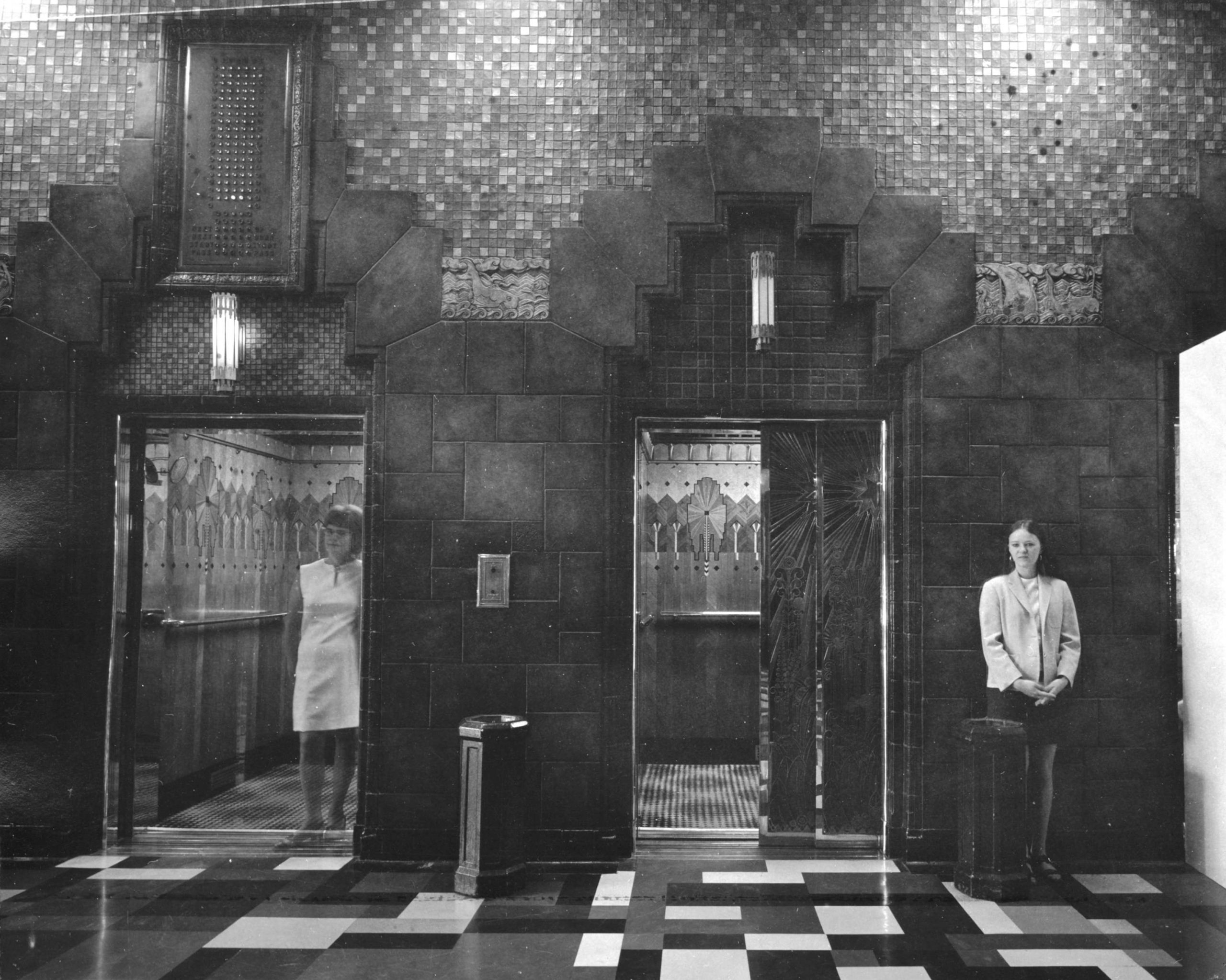
Above: Interior lobby and elevators of the Marine Building.
[Image: City of Vancouver Archives AM336-S3-2-: CVA 677-915]
*****************************************
You’ll note that these years include events listed under “Also in . . .” These are events for which we don’t have a specific date. If YOU know the specific date of an event shown there, please notify us . . . and cite the source! Many thanks!
*****************************************
January 2 General Jan Smuts, Premier of South Africa, addressed the Canadian Club in Vancouver. He told the members, among other things, “There will never be another world war.”
January 27 A Vancouver demonstration by the Communist Party.
February 18 The orbiting object formerly known as the planet Pluto was discovered by astronomer Clyde Tombaugh. (In 2006 Pluto was demoted by a global astronomical congress, and is no longer classed as a planet.)
March 1 The “Fraser Valley Public Library Demonstration” began, with Dr. Helen Gordon Stewart as director. Background: the Carnegie Corporation of New York had donated funds for a bookmobile and library administration service in the Fraser Valley. After the funds were exhausted Valley residents, despite the Depression, voted to pay a new tax to continue the service—and the first regional library in North America was born.
March 15 A group of people gathered in Green Timbers Urban Forest to plant more than 120 baby trees in B.C.’s first “forest plantation,” the beginning of commercial reforestation here. Guests at the ceremony were invited to plant trees, and Victor Harbord-Harbord, a Province reporter covering the story, planted a Douglas fir for the paper. Sixty years later, at an anniversary ceremony at Green Timbers, two of Harbord-Harbord’s great-grandchildren romped and chased each other beneath the very tree planted by their late great-grandfather. It’s still there. Province columnist Chuck Davis planted another tree for the Province that 1990 day.
April 4 American band leader Paul Whiteman arrived in Vancouver and was amazed to learn that Canadian immigration authorities refused to allow his orchestra to perform at two dance dates, although they can perform at a concert. Whiteman said ‘all or nothing,’ and left for Seattle on the 6th.
Also April 4 The Vancouver Sun reports that “no time is to be lost on the construction of the new $225,000 theatre on south Granville street for Mr. Frederick Guest, of Hamilton, Ontario . . . the detail plans and specifications for the theatre are approaching completion in the offices of architects Hodgson and Simmonds, 198 West Hastings street . . . the new playhouse will have a seating capacity of 1,250 and will be ultra-modern in every respect . . . equipped with the latest for talking pictures and also a pipe organ.” That’s our old friend, the Stanley Theatre, which will open later this year.
April 28 Hewitt Bostock died at Monte Creek. We can thank him for the Province, although he wouldn’t recognize the paper today. Born May 31, 1864 in Surrey, England, he graduated in law from Cambridge but, oddly, took up ranching when he came to Kamloops in 1888. In 1894 he started a newspaper in Victoria, the Weekly Province, later sent an associate to Vancouver to test the climate for a competitor to the World and the News-Advertiser. On March 26, 1898 the Vancouver Daily Province appeared, quickly became the biggest paper in town. Bostock became an MP, later Speaker of the Senate.
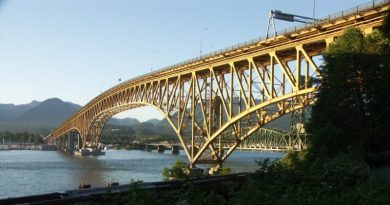
April A ship called the Losmar tore away the south span of the Second Narrows bridge, putting it out of commission.
May 3 Premier Simon Fraser Tolmie opened Capilano Bridge. A concrete bridge had been built across the Capilano River in 1914. That bridge partly collapsed in 1919, was “cobbled up” and lasted to this 1930 replacement. Marine Drive was now classified as a primary highway.
Also May 3 A letter appeared in the Province suggesting that bells be put on automobiles as a safety feature, to sound continuously when the vehicle is going downhill.
May 24 Artist Robert Bateman was born in North Toronto. He lives now on Salt Spring Island.
May There were bright spots during the Depression years: in May 1930 Dominion Bridge opened a plant in Burnaby to produce steel for construction. Clients included Vancouver’s Marine Building, the Alberta Wheat Pool and Second Narrows bridge repairs.
June 11 Airplane and boat builder William Boeing launched his 125-foot twin-screw diesel luxury yacht Taconite in Vancouver. (Today, still in Vancouver, beautifully refurbished and maintained, it’s owned and chartered out by W. Gordon Levett.) Boeing had opened a Canadian arm here in 1929 and bought the Hoffar-Beeching Shipyard at 1927 West Georgia. They started building B1Es (four-seat planes called “flying boats”) on the adjoining property, and about the same time commissioned the building of the Taconite, named for a Montana mine Boeing had an interest in. (He would die aboard the boat in 1956).
June 18 Columnist Denny Boyd was born in Anyox, B.C.
June 25 An aviation hero who spent part of his boyhood in Vancouver—and has a city school named for him—was in the news. Australian pilot Charles Kingsford-Smith and the crew of the Southern Cross, a “famous old patched-up plane” landed at Harbor Grace, Newfoundland “just before 6 o’clock this morning” after a 31-hour flight from Ireland across the Atlantic. The plane’s compass had gone wonky, and the crew was unable to hear radio signals so spent five hours flying in circles over Newfoundland before they found a landing field. Interest in the flight was high for a couple of reasons: a lot of people remembered Charlie Kingsford-Smith as a schoolboy here and, even more important, he had been the first man (non-solo) to fly across the Pacific. Now he’d added the Atlantic to his achievements, the first man to cross both oceans by air.
July 12 A “city market” opened at the corner of Main and Pender Streets.
July 29 “Destined to house an historic display depicting early British Columbia and Vancouver, of which it was once a prominent landmark, the old Hastings Mill store, one of the few buildings which escaped the fire of 1886, was safely beached on the shores of Point Grey near Alma Road . . . Several score pioneers who had gathered to watch the historic building towed to its last resting place cheered as the tug Alert swung the huge scow on which the structure was carried toward the beach. Under direction of Capt. Charles Cates, the scow was beached at high tide.”
Today, the snug little structure is still operated in Pioneer Park, at the north foot of Alma, run as a museum by the Native Daughters of British Columbia, Post No. 1. It makes for a truly interesting visit to the past, including stories, pictures and drawings of the Great Fire.
August 7 The B.C. High Schools Olympiad.
August 20 CBC Vancouver Orchestra conductor Mario Bernardi was born in Kirkland Lake, Ontario. He would study in Italy and graduate at 17 from the Venice Conservatory with the highest marks possible. After beginning his professional conducting career in England, Bernardi would return to Canada in 1968 to form a professional chamber orchestra for the National Arts Centre.
August 21 Newspaper reports said the annual per capita income for BC residents was $4,339.
Also August 21 Princess Margaret was born.
August 22 The new Empress of Japan arrived in Vancouver. Considered Canadian Pacific’s finest trans-Pacific liner, she commenced regular crossings to the Orient via Honolulu. (She would be requisitioned as a troop ship in 1939, with her name changed to Empress of Scotland.)
August 25 15-year-old Stan Leonard won Vancouver’s caddy golf championship.
August 26 The Vancouver Women’s Aeronautic Assn. was organized. First in Canada.
August 30 Future Vancouver city councillor Ed Sweeney was born.
September 7 The oldest surviving bowling centre in Canada, Commodore Lanes and Billiards, in the basement at 838 Granville Street, opened under the direction of Frank Panvin. And here’s a remarkable story, told by reporter Gordon McIntyre: “From opening day until Frank Panvin’s death in 1962, the only time staffer Mitz Nozaki spent away from the alley was when the Canadian government interned him at Shuswap Lake with other Japanese Canadians during World War II.”
September 12 Future Vancouver mayor Art Phillips was born in Vancouver.
September 13 After the incident in April, in which the Losmar tore away the south span of the first Second Narrows bridge, the Pacific Gatherer finished the job by taking out the fixed centre span. No attempt was made to reconstruct the bridge.
September 15 Bill King, future MLA, was born.
September 23 Singer Ray Charles was born in Albany, Georgia. (Fittingly, one of Charles’ greatest songs, Hoagy Carmichael’s Georgia On My Mind, became a hit this same year.)
September 30 The first iron lung was donated to Vancouver General Hospital. The iron lung was a device for artificial respiration for patients with severe respiratory problems.
October 2 Future BC premier Dave Barrett was born in Vancouver.
October 5 The Vancouver Symphony Orchestra performed for the first time at the Orpheum Theatre. (Not until 1976 would they make it their permanent home.) The conductor was Allard de Ridder, born in 1887 in Dordrecht, Holland. He had received his music education in Holland and Cologne Conservatory. Violist. He put up his $3,000 life savings to guarantee the musician’s wages for this first concert. He will lead the orchestra until 1940.
October 23 Contact! The Vancouver branch of the Aviation League of Canada, an organization promoting the growth of the air industry, began formal proceedings today. Maj. D.R. MacLaren, DSO, was unanimously elected president at a meeting at the Hotel Georgia. Ten committees bristled with high-powered local names, including William Templeton (first manager of the Vancouver Airport); Gen. Victor Odlum; Gen. A.D. MacRae (his Hycroft is a famous Shaughnessy mansion); Stanley Burke, a Boeing official (not the CBC-TV newscaster); financier Austin Taylor; newspaperman R.J. Cromie, Duncan Bell-Irving and more.
October The Marine Building opened. It is the most famous and in the opinion of many still the most beautiful building in Vancouver, an art deco masterpiece. This entry is based on Murray Foster’s article in The Greater Vancouver Book.
A Toronto bond-trading house, G.A. Stimson, believed Vancouver would become a major west coast port, and decided to erect an office building to accommodate the city’s marine-related businesses. It would be near the waterfront, and close to the customs house, the Canadian Pacific and the Canadian National steamship terminals. A site was found at the foot of Burrard Street, and a local architectural firm, McCarter and Nairne, was commissioned to realize the vision. “McCarter, the engineer,” Murray Foster wrote, “jumped at the chance to design his first skyscraper. Nairne, the architect, inspired by New York City’s Chrysler Building, was excited at the chance to create his own dazzling Art Deco showpiece. Nairne wanted the design to express the various businesses housed within its walls, firms engaged in shipping, lumber, mining, insurance and the import and export trade.” (McCarter and Nairne moved into the building themselves, stayed until February, 1980. They had been Marine Building tenants for just under 50 years.)
Its architects conceived of it as a great crag of a building, “rising from the sea, clinging with sea flora and fauna, in sea-green flashed with gold.” Alas, by 2004 this Art Deco masterpiece was almost totally hidden by a forest of modern skyscrapers.
Construction of the 25-storey building by E. J. Ryan Contracting began in mid-March, 1929. It was, for more than a decade, the tallest building in the British Commonwealth. Unfortunately, the Wall Street crash occurred during its construction and the Great Depression that followed had a serious effect on the building’s fate. Still, writes Foster, “early tenants included the Vancouver Merchants’ Exchange—which had contracted for a minimum of 10 years tenancy, the Vancouver Board of Trade, the Bank of Montreal and others. The architects themselves moved in, and were tenants for many years.”
In 1933 Stimson and Co. would fail, and the Marine Building would be sold to the Guinness family for $900,000, little more than a third of its cost.
The managing director of British Pacific Properties, which owned all that land on the north shore, was A. J. T. Taylor. (Taylor Way in West Vancouver is named for him.) He moved into the Marine Building’s lavish penthouse with his wife in 1930 and even had a tiny elevator built to connect it with the 18th floor below. But Mrs. Taylor eventually decided she didn’t like heights, so they moved out. The space is occupied by offices today.
November 2 Burnaby was given multi-page prominence in the Province’s Sunday edition. Her roads and railways and easy access to water were lauded, her industries puffed, her people praised. Within its borders were the world’s largest sawmill (the Barnet Lumber Mill) and the world’s largest shingle mill (Bloedel, Stewart & Welch). Burnaby, the paper told readers, was named for “Col. Fred Burnaby of the Royal Engineers . . . a name made famous in geographical circles by the published story of Burnaby’s Ride to Kiva, “the colonel being one of the first white men to explore Thibet (sic).” Burnaby historian Pixie McGeachie laughs at that. “All wrong. Fred Burnaby existed, and did go to Tibet, but he was just a relative of Robert Burnaby. I don’t think they ever met.”
November 3 Vancouverites scoffed at the claim of a Veronia, Ore., sawmill that it was sawing up the world’s tallest tree (species unnamed) at 230 feet. “That is only a toothpick,” the Province huffed, “compared with the giant Douglas fir that was cut near Vancouver in 1895, measured at 415 feet. The size of this tree established a record for all time.” Alas, not so. Guinness gives that title to an Australian eucalyptus at Watts River, Victoria, Australia, reported in 1872. “It was 132.6 metres (435 ft.) tall and must have been over 150 m (500 ft.) originally.”
November 11 The Grandview Park Memorial Flagstaff and Tablet were unveiled.
November 20 The Canadian National Institute for the Blind opened its Vancouver headquarters on Broadway.
November 21 Vancouver got its first shipment of “Lillybet” dolls, modelled after five-year-old Princess Elizabeth—who is Queen Elizabeth II today.
November 22 Spencer’s Department Store held a giant Toy Parade with Santa Claus and a retinue of Story Book people.
November 22 A letter appeared in the Daily Province suggesting it would be a good idea to have traffic lights at Main and Kingsway.
November 24 Gustav Roedde, printer and book binder, died in Vancouver, aged 70. He was born January 7, 1860 in Groß-Bodungen, west of Nordhausen, Germany. He studied bookbinding before emigrating to Cleveland in 1881. Roedde came to Vancouver via San Francisco and Victoria and opened the city’s first book bindery in 1886. He had Roedde House built in 1893. It was the second house, after Barclay Manor next door, to be built in the block. Custodians of the house believe its architect was Francis Mawson Rattenbury, designer of the Vancouver Art Gallery (former Court House) and Victoria’s Parliament Buildings and Empress Hotel. His wife Matilda is said to have complained, “I wish that Rattenbury had given us a basement.” The house was sold to H.W. Jeffreys in 1927, and later became a boarding house. The City of Vancouver bought it in 1966. Called Roedde House, and charmingly restored, it is now used for community activities.
November 25 The Merrysea sinks in English Bay.
December 6 The first airmail to the Orient left Vancouver.
December 8 Work began on the Burrard Bridge. It will open July 1, 1932.
December 15 Mrs. Victor Bruce was visiting British Columbia during the last leg of her around-the-world flight, and took off from Vancouver’s temporary airport on Lulu Island today at 12:00 noon. The “daring British aviatrix” arrived in Victoria shortly after 1 p.m., and went for lunch with Lt.-Gov. R. Randolph Bruce. (We don’t think they were related, although one of the guests at the luncheon was the Rev. Montague Bruce, a cousin of the flyer.) Later that afternoon she would fly to Seattle, and then on to San Francisco. “She had an exciting experience,” ran one newspaper report, “when she made a forced landing in Iraq. The Baluchi tribesmen were friendly, and after dancing with them she was escorted over the desert to Jask.”
Also in 1930
St. George’s private school for boys opened.
Construction began in Richmond on what is today Vancouver International Airport. The first manager of the airport, William Templeton, had been one of the committee who had chosen Sea Island as the location. On the start of construction in 1930 he published a brochure that read, in part: “The day is not far distant when giant airliners and dirigibles will leave this harbor for far-away China, Japan, and even Australia, while large multi-motored planes will carry the passengers and mails which arrive here from these distant countries . . . faster than the winds themselves and higher than the birds which fly.” (The “harbor” reference reflected the fact that much of the early airport’s traffic was “flying boats.”)
Future director Allan King was born in Vancouver. He will make a sensation in 1969 with his documentary A Married Couple, following the real-life couple Bill and Antoinette Edwards.
The Province newspaper started a second station, CHLS.
The Stanley Theatre opened at 2750 Granville Street.
The Vernon Block at 225-255 East Broadway was built. It’s a heritage structure. Also built this year, and a heritage structure, the Memorial Park South Fieldhouse at 5950 Prince Albert.
Sun journalist and executive Erwin Swangard, born in Munich in 1908, came to Vancouver.
London, Ontario-born Mae Garnett, about 55, one of the first female general news reporters in Western Canada (she wrote for the Albertan, Edmonton Bulletin and Vancouver News-Herald) joined the Vancouver Sun.
Henry Forbes Angus, 39, who had joined UBC in 1919 as an assistant professor of economics, is named the university’s head of economics, political science and sociology.
Enrolment at UBC topped 3,000.
The Cora Marie was launched by Vancouver Shipyards. She was considered the finest wooden hulled vessel built in Coal Harbour. Her first owner was bakery executive William C. Shelly of 4X bread fame, but the Depression led to her sale to Paul F. Johnson, a wealthy American. Her future career is really interesting, and will be detailed as we build this chronology.
Fife, Scotland-born William Marr Crawford, master mariner, and president and managing director since 1923 of Empire Stevedoring, launched the Fyfer, described as “the finest private yacht on the Pacific.” (In 1941, he will donate it to the Royal Canadian Navy for war use.
John Grove ended his long service here, retiring after 35 years as the lighthouse keeper at Prospect Point, later at Brockton Point.
The Forum was constructed at a cost of $300,000. It was the largest artificial ice surface in North America at the time, and would hold that title until 1936 and the building, by the Patrick brothers, of the Denman Arena. Source: City of Vancouver website.
The Fraser Highway became part of the Trans-Canada Highway.
Richmond became a member of the Greater Vancouver Water Board. The municipality had been plagued over the years with broken, corroded or frozen pipes as it tried to transport fresh water across bridges or over the bed of the Fraser to Sea and Lulu Islands.
All Japanese students in Steveston were allowed to attend general schools, as well as being able to attend Japanese language schools after-hours.
A world record for egg-laying was set by “No Drone, No. 5H,” a hen from the Whiting farm in Surrey. She has laid 357 eggs in 365 days. “No Drone” was preserved for posterity and her stuffed form put on display at the World Poultry Congress in Rome, Italy in 1934. In 1954 she will be presented by the Whiting family to the Langley Museum.
As a form of unemployment relief, Surrey Council gave one day’s work a week to single men, and two days work to married men, as long as weather conditions permitted and until the allotted sum of $10,000 had been used up.
McKenzie Derrick, later McKenzie Barge and Marineways, opened for business on the Dollarton Highway in North Vancouver.
Burnaby’ first annual Better Baby Contest was held to promote child welfare. Judges were the Medical Health Officer and the School Board doctor.
Burnaby’s Town Planning Commission was established.
200 skeletons were found in the ancient Marpole Midden.
Deadman’s Island, so named because it was once the site of native burial grounds (and was later used by white settlers for the same purpose), was the subject of much dispute until 1930, when the federal government granted the city a 99-year lease on the island.
The CN Dock fire destroyed the new 1,000-ft. long pier.
San Francisco-born Bernice R. Brown (née Dickhoff), 25, settled in Vancouver. She will become the editor of the brand-new weekly publication Jewish Western Bulletin.
St. Andrew’s-Wesley United Church opened at Burrard and Nelson. Its name shows it was a merger of two churches, one Presbyterian, the other Methodist. That had come about because of the formation of the United Church of Canada five years before.
The Canadian Federation of Business and Professional Women’s Clubs was established. One of the key organizers was Vancouver’s Josephine A. Dauphinee, one of the founders (1922) of the Vancouver Business and Professional Women’s Club.
Port Fairy, Australia-born Violet Alice Dryvynsyde, an educator and author, came to Vancouver with her family.
The first school of psychiatric nursing opened in B.C.
Yellow Cab, the oldest company still in operation, began doing business here in 1920 with a single car owned by Roy Long, a lawyer. In 1930, the firm was taken over by the B.C. Electric Co., which was operating Terminal City Cabs.
Arts advocate Anne Macdonald was born in Vancouver.
PEI-born Angus MacInnis, who arrived in Vancouver in 1908, was elected the CCF Member of Parliament for Vancouver East. He would serve to 1956. Husband of Grace MacInnis.
Scotland-born Thomas Reid, who came to Canada in 1909 and farmed in Newton, was elected the Liberal Member of Parliament for New Westminster. He would serve to 1949.
Wigan, England-born (1907) Margaret Elinor Rushton, Holiday Theatre founder, came to Canada.
Ontario-born architect C.B.K. Van Norman, who had arrived in Vancouver in 1928, aged about 21, began his long and distinguished career here. See the Hall of Fame.
Acme Protective Services was incorporated.
Arthur Laing, born in Eburne on September 9th, 1904 is elected to the Richmond School Board. He will serve to 1943, including eight years as chairman. His real fame is still ahead.
Solomon Mussallem was elected reeve of Maple Ridge. He will serve to 1934 (then again from 1936 to 1943 and for a third time from 1946 to 1953.)
Ivan Ackery was named manager of the Dominion Theatre on Granville Street. (It was one of the plush movie houses of the day when J.R. Muir opened it in 1907 to accommodate 1,000 patrons.)
Vancouver-born John Emerson, actor and musician, aged 19, began a long and successful career as a popular pianist and musical arranger.
J.C. McPherson was president of the Vancouver Real Estate Board.
R.D. Williams was chair of the Vancouver Board of Trade.
Jay-walking was banned in Vancouver.
The new Ford automobiles were on display at the Hotel Vancouver. They sold for $540.
Vancouver mountaineers Don and Phyllis Munday began to use skis to explore the immense snowfields of Mount Waddington, the highest peak wholly within British Columbia. This marked the beginning of widespread ski exploration in the Coast Range.
Will Routley moved his Wild Duck Inn upstream slightly to its present location near the Lougheed this year, and added the “Tudor Revival” touches now so familiar. (In 1931 he will add a 100-seat pub, and see business soar. The Wild Duck Inn has been a Port Coquitlam landmark for more than 70 years.)
Rudolph M. Grauer became reeve of Richmond. He will hold that post to 1949.
The University Golf Club opened for play.
The Canadian Pacific Land Department proposed to subdivide vacant land adjoining the Quilchena Golf Course. W.B. Young, assistant city engineer, had been reading a book on astronomy by a famous British scientist, Sir Arthur Eddington, and applied the name to the thoroughfare. Later, when the CPR abandoned the project, the street name remained. And that’s how Eddington Street got its name.
The University of British Columbia cleared 120 hectares between Chancellor Boulevard and Spanish Banks for development. But the Depression was in full flower, and the plans died. The university couldn’t afford to build the infrastructure necessary.
By 1930 only 30 of West Vancouver’s 60 miles of road were paved. And writer Kerry McPhedran writes that many West Van streets still lack sidewalks, and “old-time residents prefer it that way.”
One of our favorite entries: Labor activist Bill (William Arthur) Pritchard, who had been arrested and found guilty of seditious conspiracy in 1920, following an inflammatory speech in June 1919 during the Winnipeg General Strike, and who spent a year in jail, was elected reeve of Burnaby. He would serve to 1932.
There was at least one floating gas station in Coal Harbour. We’d love to hear from anyone who can pinpoint a date for these unique Vancouver landmarks . . . watermarks?
Seton Academy, a Catholic girls’ school, began at 3755 McGill Street in Burnaby in a home built in 1906 for a prosperous dry goods merchant, Charles Peters.
Alta Lake School opened in Whistler.
Vancouver-based Harbour Navigation purchased the MV Scenic, which delivered mail to those living up Indian Arm. The MV Scenic was the only floating post office in the British Empire. It would continue delivering the mail between 1932 and 1968.
North Burnaby developed rapidly in the pre-World War I real estate boom, particularly when it acquired streetcar service to Vancouver in 1913. The Vancouver Heights subdivision was marketed to the wealthy. Some responded, including dry-goods merchant Charles J. Peters, who retained Maclure and Fox, the firm of talented society architect Samuel Maclure, to design him a grand Tudor Revival manor. The house spent a generation, from 1930, as Seton Academy, a Roman Catholic girls’ school.
Construction began on the Crease Unit at Essondale, the mental hospital.
Construction began on the Fort Langley Community Hall at 9167 Glover Road, once the site of the municipal hall. It will be completed in 1931.
With the help of money raised by the Womens’ Auxiliary, founded in 1929, Vancouver’s Greek community built St. George’s Greek Orthodox Church at Seventh and Vine Street in Kitsilano. A Sunday School and a Greek language class were established at the same time.
The Vancouver chapter of AHEPA (Anglo-Hellenic Educational Progressive Association) was founded. AHEPA, the largest Greek Heritage organization in the world, supports a variety of charitable causes.
The Montreal-based advertising agency Cockfield, Brown & Co. opened a Vancouver office.
Granville Island was flourishing. “By 1930,” Catherine Gourley wrote in The Greater Vancouver Book, “about 1200 people worked in the island’s factories, churning out steel rivets, band saws, anvils, bolts, cement, paint, barrels, rope, boilers and chains. They worked six days a week, trying to satisfy their two big customers—the forestry and mining industries.”
The UBC Thunderbirds made history in Athletic Park, at Fifth and Hemlock, the first sports ground in Canada to be equipped with floodlights. An exhibition game against Hamilton Tigers was the first football game in the country to be played under lights.
The women’s basketball team from UBC, representing Canada, won the world championship at the women’s World Games in Prague, beating France 18-14 in the final. A crystal vase signifying the world title is on display at UBC.
Don Bradman, the legendary Australian cricketer, described the cricket pitch adjacent to Brockton Oval in Stanley Park as the most scenic in the world.
Percy Williams of Vancouver, who had won two gold medals at the 1928 Olympics, set a world record of 10.3 second for the 100 metres. That record would last until 1941. “In 1930 he also,” wrote sports scribe Jim Kearney, “won the 100 yards in the first ever British Empire Games at Hamilton, Ont., a race that effectively ended his career, Just before reaching the tape he tore a large thigh muscle. It was not properly repaired and while he did compete in the 1932 Olympics, he didn’t make it out of the heats.”
Jim Kearney noted another 1930 sports accomplishment: “A Vancouver laboratory technician who bowled one night a week, Jean Gordon bowled a 198 average through 47 games to finish 45 pins ahead of her nearest competitor while winning the Women’s World Cup of tenpin bowling at Jakarta, Indonesia.”
The New Westminster Exhibition closed for good this year, and that caused a rise in attendance at the PNE.
The Britannia copper mine began a five-year reign as the largest copper producer in the British Empire.
The Vancouver Bach Choir was formed by Herbert Mason with 130 members. It immediately became the largest choir in the city; it is now also the oldest.
Writer and arts coordinator Betty Keller was born in Vancouver.
Betty Pratt-Johnson, who writes authoritatively on scuba and skin diving, with books for kayakers, canoeists and rafters, was born in the midwestern U.S.
Poet and novelist Peter Trower was born in St. Leonard’s, England. He came to Canada in 1940.
On the south side of Marine Drive in the University Endowment Lands is a plaque titled MUSQUEAM. It reads: “Near this place, in July, 1808, Simon Fraser of the North West Company ended his dangerous exploration of the Fraser River from Fort George. The hostility of the Indians prevented him from proceeding farther. His object was to find a trade route to the Pacific from the Interior forts and thus avoid the long journey across the continent. Erected 1930.” The Musqueam were the people living here when Fraser visited. (Musqueam, according to 1001 British Columbia Place Names, means “the nations at the sea shore.”) The Musqueam people live to this day in this region.
A 10.5-hectare garden, an initiative of Washington State, is installed on the American side of the Peace Arch.
Cecil Green was born in 1900 in England, but grew up and went to school in Vancouver and, in 1930, began working for a company—Geophysical Service of Dallas—that later became Texas Instruments. He would become a US naturalized citizen in Dallas in 1936 and rise to become president and chairman of Texas Instruments.
Winnipeg-born Ellen Harris, radio broadcaster, came to Vancouver. She was about 26. She will become the host of the women’s show Morning Visit on CBC Radio Vancouver from 1944 to 1952.
Here are the radio stations listed in the city directory for 1930. With the exception of the address for CKMO (which had moved from 336 West Hastings), it’s identical to 1929’s list:
CHLS Province Commercial, 198 West Hastings
CJOR Commercial Broadcasting Service, 804 Hornby
CKCD Province News, 616-198 West Hastings
CKFC Radio Station, West 12th Avenue at Hemlock
CKMO Sprott Shaw 1705-500 Beatty
CKWX Radio Station, 801 West Georgia
CNRV Canadian National Railways, 1150 Main Street