1991
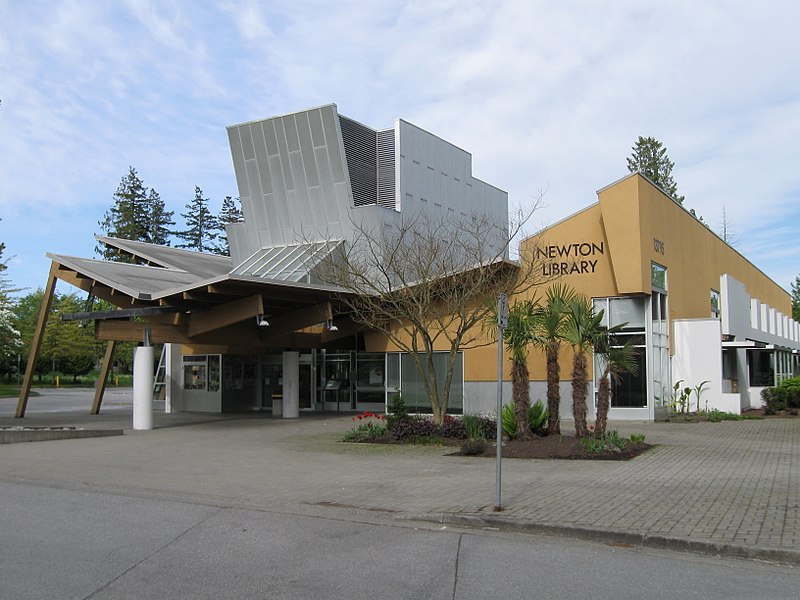
Above: The Award winning Newton Library branch of the Surrey Public Library at 13795 70th Avenue in Surrey, BC, Canada. It was opened in 1991.
[Image: Wikimedia Commons (Leoboudv)]
*****************************************
You’ll note that these years include events listed under “Also in . . .” These are events for which we don’t have a specific date. If YOU know the specific date of an event shown there, please notify us . . . and cite the source! Many thanks!
*****************************************
January Designated as a Schedule A Heritage structure was 2055 West 14th, built in 1910.
March Construction began on a new Kwantlen College campus on the four-hectare site of the former Lansdowne race track at the corner of Garden City and Lansdowne Roads in Richmond. The $37 million complex would officially open in August, 1992.
March Designated as a Schedule A Heritage structure was the Randall Building, at 535-565 West Georgia, built in 1929 and completely rehabilitated this year. This building is now better known as the Cavelti building, after Toni Cavelti, its long-time tenant and a prominent local jewelry designer.
April 2 Rita Johnston (born in Melville, Saskatchewan on April 22, 1935 as Rita Leichert), Social Credit MLA for Surrey, became premier of BC, succeeding Bill Vander Zalm, who had resigned. She will serve to November 5, 1991, seven months. (See November 5 entry below.) She had served on Surrey council for eight years (only the second woman to be elected to council), including a period when Vander Zalm was the mayor. She then became an MLA in 1983, municipal affairs minister in 1986, highways minister in 1989 and deputy premier in 1990.
As the MLA for Surrey-Newton Johnston was instrumental in bringing SkyTrain to Surrey—a move that heralded the municipality’s arrival as the Greater Vancouver Regional District’s second city centre.
April 3 A newsprint machine developed by Vancouver-based consulting engineers firm H.A. Simons for Howe Sound Pulp and Paper Limited at Port Mellon began working today—only one day later than had originally been scheduled three years earlier.
April 28 Gordon Hilker, impresario, died in North Vancouver, aged 77. His father Harry Hilker (1880-1969) was a haberdasher and impresario. “Gordon Hilker,” writes Constance Brissenden, “was born in Vancouver September 19, 1913. With his father he formed Vancouver’s first concert agency, Hilker Attractions. From 1936-50 the company imported more than 1,000 performers including Yehudi Menuhin, Paul Robeson and Isaac Stern. In 1946, Gordon erected the continent’s biggest stage at Stanley Park’s Brockton Oval for Vancouver’s Diamond Jubilee. ‘The city, brave as only the frightened can be, agreed to his ideas.’ The company went bankrupt on September 26, 1950. Gordon later became artistic director of the Vancouver Festival (1961-67) and director of Expo 67’s World Festival of Entertainment in Montreal.”
April The Sustainable Development Research Institute (SDRI) was established to “foster policy relevant research on sustainable development.”
May 6 The Bob Prittie Library opened in Burnaby. The official opening of this striking building will be on the 16th. See this website to see why this library was named for Bob Prittie.
May 24 CKZZ-FM 95.3 signed on at 8 p.m. with a commercial-free weekend of contemporary rhythm-and-blues and dance music. It’s known today as Z95.3 and you can hear it right now here. The history of the station is here.
Spring The 1991 inductees into the Vancouver Board of Trade Hall of Fame (awarded to companies or organizations active for 100 years) were:
– Capilano Suspension Bridge
– BC Telephone Co.
– Royal Columbian Hospital
June 7 Burnaby’s Club Metro Youth Centre opened at 4585 Imperial Street. It held a games room, entertainment room, computer room, etc.
June 30 The Lower Mainland Regional Correctional Centre (which until 1970 had been called Oakalla Prison Farm) closed. Thousands of prisoners had passed through the doors of Oakalla. Originally designed to house a maximum of 484 prisoners, the prison’s population had peaked in 1962-63 at 1,269 inmates. Earl Anderson, author of A Hard Place To Do Time—The Story of Oakalla Prison, says there were 44 hangings from the time the prison farm opened in 1912 to its close. The dead would be buried in the pauper’s section of Mountain View or Forest Lawn Cemetery if their families did not claim them.
June Dorothy Somerset, 91, theatre director, won a Jessie Award for “humanity, integrity and encouragement of young talent in the theatre.” See the August 11 entry below.
July 10 Grace MacInnis, politician, died in Vancouver, aged 85. Winona Grace Woodsworth was born July 25, 1905 in Winnipeg. She was the daughter of J.S. Woodsworth, organizer of the CCF (Co-Operative Commonwealth Federation) party, and was a delegate to the Party’s founding convention in Regina in 1933. She was a lifelong socialist activist in the CCF and its successor, the NDP. She was elected a BC MLA (Vancouver Burrard) and served from 1941 to 1945. She “emerged from the backrooms” to win the Vancouver-Kingsway seat for the federal NDP, becoming B.C.’s first woman MP. She served from 1965 to 1974. She was appointed an Officer of the Order of Canada in 1974 in recognition of her service to others, and was appointed in 1990 to the Order of British Columbia. Her husband was Angus MacInnis, another CCF stalwart.
July 17 Charles Slonecker, UBC’s director of ceremonies and special events, sent a memo today to the President’s Advisory Committee on the Naming of Buildings: “The new University Apartments are nearing completion in the campus area adjacent to Acadia Camp. It is proposed that these two new buildings be named: Acadia House, reflecting the historical faculty housing link with Acadia Camp, and Sopron House, in recognition of the history and achievements of the emigrati of the Sopron University of Hungary (Forestry) to Canada and UBC.”
Done!
Both four-storey structures were designed by architects Eng and Wright.
August 11 Dorothy Somerset, theatre director, died in Vancouver, aged 91. Dorothy Maud Somerset was born June 9, 1900 in Perth, Australia. She studied at Radcliffe College (BA), moved to Vancouver in 1921. She was an actor/director with Vancouver Little Theatre, and a director, University Players’ Club from 1934 to 1938. In 1937 she joined UBC’s extension department, and in 1938 founded its Summer School of Theatre. In 1946 she taught UBC’s first theatre credit courses. Ms. Somerset received a Canadian Drama Award in 1952. In 1958 she helped found UBC’s drama department. The Dorothy Somerset Scholarship Fund was set up in 1965.
September 16 The Vancouver Sun became a morning daily.
September 17 Henry Angus, UBC dean, died in Vancouver, aged 100. Henry Forbes Angus was born April 19, 1891 in Victoria. Writes Constance Brissenden, “He attained a BA from McGill U. in 1911, an MA from Oxford in 1919. In 1919 he joined UBC as an assistant professor of economics. He was head of economics, political science and sociology from 1930 to 1956. He was the first dean of graduate studies from 1949 to 1956, and Dean Emeritus from 1956 to his death. Angus was one of the few public figures in BC to oppose internment of Japanese-Canadians during the Second World War. His wife, Anne Margaret (born in Anatolia, Turkey) was a diplomat’s daughter, a UBC graduate (1923), president of the University Women’s Club and a child welfare activist. She wrote the first UBC student play (The High Priest, 1922) performed by the University Players’ Club.
There is an account of Henry Angus’ UBC career here.
September 25 The Stanley Theatre, built in 1931, today ran its last movie, Fantasia, then shut its doors. It would re-open in October 1998 under the auspices of the Arts Club Theatre with Dean Regan’s hit production of Swing. Beginning with the 2000-2001 season the Industrial Alliance Pacific Life Insurance Company will become a sponsor of the theatre, and on April 5, 2005 it will become the Stanley Industrial Alliance Stage, a newly renovated art deco theatre, beautifully updated, a 650-seat house that will become home to musicals such as My Fair Lady, Swing and Sweeny Todd, revitalized classics such as Hamlet, and comedies ranging from Easy Money to Art. The restoration of the venue will receive a 1999 City of Vancouver Heritage Award.
September Bucharest-born Sergiu Comissiona was appointed music director of the Vancouver Symphony. Popular and dynamic, he will hold the post to June 2000.
September Designated as Schedule A Heritage structures were 8264 Hudson, built in 1912; 835-39 Cambie, built in 1929; 1037 Matthews, built in 1913, and the Haigler House at 3537 West 30th Avenue, built in 1925.
September Rick Watson, a disabled rights activist, began a column for the Province. Disabled by cerebral palsy, he pecked out one letter at a time with a wand attached to a headband. He won a Canada 125 medal for his work for the disabled and a B.C. Newspaper Award for a column critical of telethons, one of which he’d appeared on as a child. He died in 1994, aged 41.
September Burnaby was incorporated as a City. (It had been a Municipality.)
October 6 “Canadian soccer,” wrote the Province’s Jack Keating, “has never seen the like of the Vancouver 86ers. Dominating Canadian soccer like no other franchise, the 86ers added to their prestigious record Sunday, October 6, winning a fourth consecutive Canadian Soccer League Championship with a resounding 5-3 victory over the Toronto Blizzard . . . The 86ers struck like a bolt of lightning, scoring twice in the first three minutes to the delight of 5,692 fans at Swangard Stadium.” This was a great year for Vancouver’s Domenic Mobilio, too: he became the most prolific goal scorer in the Canadian Soccer league, including a CSL record of 25 goals in 28 games. That earned him league MVP honors.
October Ujjal Dosanjh, ran and won for the NDP as Vancouver Kensington MLA. He will be appointed the province’s attorney general in 1995 and premier in 2000.
November 5 Michael Harcourt (born 1943), NDP, became premier. He will serve to February 22, 1996.
Also November 5 Pavel Bure jumped on the ice for his first NHL game against the Winnipeg Jets and stunned fans and players alike with his dazzling speed, prompting Sun reporter Iain McIntyre to label him “the Russian Rocket.”
November 7 The British Columbia Nurses Union (BCNU) and the Hospital Employees Union (HEU) sign a jurisdictional agreement: it guarantees that HEU will not organize Registered Nurses and BCNU will not organize Licensed Practical Nurses.
November The Vancouver Board of Trade presented its Business and the Arts Awards. “The objective of the Awards is to encourage the corporate sector’s involvement with the arts and to recognize those businesses that through financial aid, sponsorships, employee involvement and other corporate services are committed to the arts in Vancouver.”
For a description of the criteria, see 1990.
Categories:
Innovation: South Fraser Broadcasting Limited
Sustained Support, Small Business No award
Sustained Support, Major Corporation Canadian Airlines International
Small Business The Lazy Gourmet
Joint Venture The Vancouver Playhouse
December South Surrey’s new ice arena opened. It was the only Olympic size arena in B.C.
Also in 1991
The District of North Vancouver marked its 100th birthday.
Metro Tower II at 4720 Kingsway in Burnaby was built, the city’s tallest building: thirty storeys and 99.3m (326 feet) high.
The Hatzic Rock archaeological site was discovered; it is one of the oldest intact native villages in North America, dating back to 7000 B.C. A museum has been established there.
Rock superstar Bryan Adams bought the old Oppenheimer Bros. grocery warehouse at Columbia and Powell in Gastown, and turned it into a recording studio. It’s the oldest brick building in Vancouver.
One of the pioneer automobile retailers in the city, Plimley’s—active for 98 years—closed. Thomas Plimley had started a bicycle business in Victoria in 1893, the year he arrived from England. Writes Constance Brissenden: “Thomas Plimley sold the first car in Victoria, a tiller-steered Oldsmobile, in 1901. His wife Rhoda was the first woman driver in Victoria. Plimley’s sold the Swift, Coventry, Humber, Rover, two-cylinder Buick and air-cooled Franklin. Plimley Motors on Howe Street in Vancouver was one of B.C.’s largest dealerships. His eldest son, Horace (Thomas Horace) Plimley (b. March 5, 1895, Victoria; d. March 21, 1985, Vancouver) opened a British car dealership in Vancouver (1936). From 1957 to 1986, grandson Basil (b. June 21, 1924, Victoria) was one of the few third generation executives of a B.C. business.”
Vancouver judge Frank Iacobucci, born in Vancouver June 29, 1937, was appointed to the Supreme Court of Canada. He would serve to June 30, 2004. There’s an interesting interview with Justice Iacobucci, conducted for Il Postino by Fiona Story in 2001 while he was still on the court, in which he admits: “I would have liked to have been the manager of a major league baseball team.”
Michael Goldberg stepped down as executive director of IFC Vancouver (International Financial Centre) and returned to the Faculty of Commerce at UBC. He was succeeded by Liam Hopkins, a career banker. See the February 1986 chronology on this site for an explanation of the significance of the IFC.
Dean and Sherri Duperron took over Sprott-Shaw College, which had been around since 1903. Under their leadership the College would expand rapidly. By 2006 they had 20 locations throughout BC.
Microsoft bought Vancouver-based electronic mail specialist Consumer Software, a Vancouver software development laboratory. In 1994 they would transfer its operation to Redmond, Washington.
Leadership Vancouver was established this year. It was a program to develop, promote and encourage effective community leadership, and it sprang from a concept that began in the United States. That concept was, in turn, sparked by an horrific 1962 plane crash that virtually wiped out every major cultural leader in the city of Atlanta, Georgia. (130 people died, the worst recorded air disaster involving one aircraft to that time.) The grieving city eventually established a leadership program, a volunteer community effort “to foster successive generations of community leaders.” The idea caught on in other American cities and came this year to Vancouver, the first Canadian city to pick up the concept. Modeled after a highly successful Seattle program, Leadership Vancouver was a joint effort by Volunteer Vancouver and the Vancouver Board of Trade.
The BC Research Council—using military volunteers—began a five-year study into human response to vibration and impact. Specifically, more information was wanted on health hazards of “whole-body” vibration and repeated impacts associated with off-road vehicles and heavy industrial equipment. The work was commissioned by the U.S. Army Aeromedical Research Laboratory, which operated a multi-axis ride simulator at Fort Rucker, Alabama, where the experiments for this research were carried out. With high-speed attack vehicles and personnel carriers being developed, this would be essential information. “The challenge,” said BCRI’s Dan Robinson, of the Ergonomics and Human Factors Group, “was to look for early signs of damage to the body without damaging our volunteers! We did that through blood biochemistry, urine chemistry and biomechanical measures. We were looking for muscle fatigue, the effect on bones, and on internal organs.”
Stan Smyl, the Vancouver Canucks’ all-time leading scorer (262 goals and 411 assists during his team-leading 896 games), retired. His number 12 was retired, too, making him the first Canuck so honored. Smyl will later join the team as an assistant coach.
Lui Passaglia of the BC Lions set a new professional football scoring record, finishing the year with a lifetime 2,312 points. Lui also became the longest-playing Lion in history, appearing in a total of 236 games, overtaking Al Wilson’s previous mark of 233 games.
A 1991 study by BC Parks showed that 28 per cent of British Columbians participated in power boating, nine per cent in sailing and 20 per cent in canoeing or kayaking. As well, more than 50,000 visiting U.S. boaters cruised B.C. waters annually, and that number was rising.
The Abbotsford Air Show made an impact with the first public air-show appearance of the exotic American F-117 Stealth plane.
Scotland-born ultra-marathoner Al Howie of Victoria achieved the greatest documented run on record when he ran 7,295.5 kilometres (4,532.2 mi) from St. John’s, Newfoundland to Victoria in 72 days, 10 hours and 23 minutes. That’s about 101 kilometres (63 miles) a day . . . every day . . . for 10 weeks. Not bad for a 45-year-old diabetic.
James Delgado became the executive director of the Vancouver Maritime Museum. Delgado, born January 11, 1958 in San Jose, California, and the author of many books, was the first underwater archeologist to visit the Titanic. In 2006 he will dismay the locals with his decision to leave for greener fields.
Cornelia Oberlander, landscape architect, was named a Companion of the Order of Canada. Her citation read, in part, “Canada’s premier landscape architect, she is known for integrating her designs in the overall architectural project with the natural environment, yet always adding a unique new vision and dimension.” For more than 40 years she’s worked on projects like the National Gallery of Canada and the Canadian Embassy in Washington. Simon Fraser University said “Vancouver is greener and more liveable because of Oberlander’s landscapes at Robson Square, the downtown public library and UBC’s Museum of Anthropology.” Born June 20, 1924 in Muhlheim, Germany she escaped with her family from Nazi Germany in 1939—years later returned to Germany to design the gardens for the Canadian embassy in Berlin. She has landscaped the New York Times’ new headquarters on 42nd Street in New York.
The Globe and Mail‘s urbane glossy magazine, West, inaugurated in 1990, was cited as Western Magazine of the Year this year. It would die in 1992. A similar fate awaited Step, an independent arts magazine launched this year by neophyte publishers Ray Dearborn and Philip Aw. It would win the 1992 title of Western Magazine of the Year, then fold the following year. It’s a tough town for magazines.
Other publications appearing this year:
Interlog Quarterly Review A quarterly focusing on “the common good and economic health of full-phase logging contractors, owner-operators and haulers.”
Just Wages: a Bulletin on Wage Discrimination and Pay Equity A quarterly published by the Trade Union Research Bureau.
Zhen Fo Bao/True Buddha News A free semi-monthly, with text in Chinese, featuring news and views of a Buddhist group.
A weekly Persian (Iranian) newspaper, Shahrzand-E-Vancouver (“Citizens of Vancouver”) was started.
The Georgia Straight began to add news coverage and in-depth investigative feature stories.
The number of passengers arriving at and departing from Vancouver International Airport dropped this year from 1990’s 9,544,300 to 8,996,140. It would rebound in ’92 to 9,449,940.
The Port of Vancouver processed 423,000 cruise passengers in 1991. That compared to 22,800 in 1971. But there was even better to come.
Pacific Princess and Island Princess, two German-built ships owned by P&O’s Princess Cruises and used in the long-running TV series The Love Boat (September 24, 1977 to September 5, 1986), finally left the city after 15 summers. The two ships had been active in the Alaska cruise trade.
Tymac No. 2, a water taxi built in 1938 by Sam Tyson and Alex McKenzie, after a four-year stint as a tour boat in Vancouver harbor, became a tour boat out of Steveston.
As part of the re-zoning of the Marathon lands in Coal Harbour, a piece of waterfront land at the foot of Thurlow Street (Lot 24) was put aside by the City of Vancouver for the development of an arts complex. Plans for the Coal Harbour Arts Complex included a 1500-seat lyric hall and a 350-seat flexible theatre.
The Cedar Building at Capilano College, with three floors of classroom and office space as well as a 90-seat lecture theatre, was constructed this year. A Sportsplex was completed, too, with facilities including a gymnasium with a seating capacity of 1,700, an aerobics gym, and a weight and fitness centre.
A two-storey $6.9 million facility housing the Networks of Centres of Excellence opened at UBC. Designed by architect Zoltan Kiss, it sat atop the University Bookstore and was designed to accommodate laboratories and offices. This is the building that housed Michael Smith’s laboratory, and where he would share a champagne toast with colleagues the day it was announced he had won the 1993 Nobel Prize for Chemistry.
Construction began on the First Nations House of Learning, at 1985 West Mall at UBC. See 1992 (when it’s up!) for more detail.
Coquitlam’s Town Centre Stadium opened in time for the District’s 100th anniversary and its metamorphosis into a city.
To mark Richmond General Hospital’s 25th anniversary, the parkade opened and construction began on a 250-bed extended-care facility. (The name of the hospital will change in 1992. They’ll drop the “General.”)
The Peter Wall Institute for Advanced Studies at UBC was established. To quote from the Institute’s website, it “supports basic research through interdisciplinary initiatives that have the potential to make important advances in knowledge. The Institute brings together researchers from UBC with distinguished scholars from around the world to conduct fundamental research drawing upon and contributing to a wide range of diverse disciplines. The Institute aims to create a community of scholars, composed of outstanding researchers across the whole campus, who will contribute significantly to the intellectual life of the university. Of overriding concern in all Institute activities is excellence in research characterized by being fundamental, interdisciplinary, innovative and unique.”
The World Wide Web was developed in 1991 by Tim Berners-Lee at a high energy physics lab in Switzerland. Thank you, Mr. Berners-Lee. By 1995 it will become the most used Internet service. For an informal skip through Internet history, check out this site.
Salute to the Lions of Vancouver Gathie Falk created a whimsical composition at Canada Place that depicted two lions leaping through lighted rings. The piece is situated on the west side of the deck around Canada Place and looks out at The Lions, the mountains across Burrard Inlet. The piece, writes Elizabeth Godley, “included a bronze plaque commemorating poet Pauline Johnson, was commissioned from Falk by the architects after a cross-Canada competition failed to turn up anything they liked. The artist’s original scheme, comprising eight dogs leaping through rings of fire (‘I wanted it to be a real salute’), was modified considerably.”
The Waterfront Centre Hotel, at 900 Canada Place Way, opened. One of the striking features of this hotel was a major collection of about 50 works by B.C. artists and others. Some highlights include Voyage of Discovery by Peggy Vanbianchi and Emily Standley; Marsh Breeze by Rebecca Perehudoff; an untitled acrylic on canvas by Audrey Capel-Doray; Stanley Park by Leslie Poole; Sun Flowers by Vaughn Neville; Epiphany I, II and III by Jack Shadbolt, and Portrait of Artist at Work by J.C. (Carl) Heywood. (A personal note: that Vanbianchi/Standley work, an antiqued and highly stylized map of George Vancouver’s explorations here is one I never tire of admiring. These two Seattle women have created a beautiful object. Pop in some time and have a look. It’s in the main lobby.)
A Project for Surrey, an installation by Micah Lexier, was commissioned by the Surrey Art Gallery. It was located at the foot of 130th St. near the public fishing dock. Lexier, a Toronto artist, had created works for communities across Canada. This one was a gateway form made of logs.
The sculpture Goddess of Democracy was installed at UBC by Canton-born (February 8, 1946) Chung Hung. “The work was proposed,” said the artist, “to create a symbol of democracy after the Chinese tanks crushed the demonstration on June 4, 1989, at Tiananmen Square.”
A sculpture (Big Chairs) by Edmonton-born Bill Pechet featuring giant concrete chairs was installed at Ambleside Park pier. An adjacent wall was ornamented with concrete soccer balls, airplanes and baseballs. Arts writer Elizabeth Godley says the chairs were first exhibited at the Charles H. Scott Gallery on Granville Island, then would be purchased by West Vancouver’s parks department in 1992. The “ball wall” was commissioned this year as part of renovations to the changing rooms.
Co-produced by Tina VanderHeyden and Garth Drabinsky’s Livent, Inc. Phantom of the Opera ran for six months in 1991 and ultimately led to VanderHeyden’s decision to move back to Vancouver with her production company Headquarters Entertainment. It also sparked Drabinsky’s ill-fated decision to build the Ford Centre here. (Livent went bankrupt in 1998.)
The building that once housed the Arts Club Theatre on Seymour Street was closed for demolition. The company had added the current Granville Island Stage in 1979, and the smaller Revue Stage next door (now home to Vancouver TheatreSports League) in 1983. See a history of the Arts Club here.
A comedy club, Punchlines, was opened in New Westminster by Bernie Stoelzle. The club’s name was later changed to Lafflines.
The Pacific Music Industry Association launched Music West, a high-profile international conference, festival and exhibition produced by Maureen Jack and Laurie Mercer.
Locally-made movies that appeared in 1991 include (with annotations by Michael Walsh):
Cafe Romeo (directed by Rex Bromfield) A dental student (Jonathan Crombie) decides that he loves his cousin’s wife (Catherine Mary Stewart) and managing his family’s neighborhood bistro more than college.
Run (director: Geoff Burrowes) Park Royal plays a New England shopping mall in the story of an accidental killer (Patrick Dempsey) one step ahead of vengeance-seeking mafiosi.
Crooked Hearts (directed by Michael Bortman) Domesticity in the 1980s is seen through the eyes of a Tacoma college dropout (Peter Berg) appalled by his once close-knit family’s self-destructive behavior.
Ski School (directed by Damian Lee) Whistler provided the scenery and party rooms for this winter sports comedy starring Dean Cameron.
Chaindance (directed by Allan A. Goldstein) Based on actual penal reform proposals from the 1970s, this period prison drama focuses on a social worker (Rae Dawn Chong) with a plan to turn a convict (Michael Ironside) into a care giver.
The Legend Of Kootenai Brown (directed by Allan Kroeker) A fictional Scots villain (Donnelly Rhodes) adds a serio-comic note to the tale of real-life Irish adventurer John George Brown (Tom Burlinson), a gold-seeker tried for murder in pre-Confederation B.C.
The Hitman (directed by Aaron Norris) Vancouver doubles as Seattle, the home of an undercover cop (Chuck Norris) posing as a killer to thwart the planned union of Italo-American (Al Waxman) and French-Canadian (Marcel Sabourin) mobsters.
Mystery Date (directed by Jonathan Wacks) In this mistaken identity farce, a college kid (Ethan Hawke) poses as his older brother to impress a girl (Teri Polo) and then runs into all of his shady sibling’s worst enemies.
Bingo (directed by Matthew Robbins) In a remake of 1958’s The Littlest Hobo, an adventurous mutt (Bingo) crosses the country to find his family (Cindy Williams, David Rasche).
Black Cat (directed by Stephen Shin) Chinese is the operative language for this action feature’s heroine (Jade Leung), an urban survivor programmed by CIA scientists to kill for America.
Never-Ending Summer (directed by Lawrence Cheng) Domestic complications are played for laughs in this tale of a Hong Kong immigrant (Lawrence Cheng) who arrives in Vancouver to discover his wife (Do Do Cheng) living with a non-Asian.
Flesh Gordon Meets The Cosmic Cheerleaders (directed by Howard T. Ziehm) In this sex-comedy sequel to the 1972 soft-core serial spoof, the intergalactic hero (Vince Murdocco) is drafted by scantily-clad aliens who need him to restore pleasure to their planet.
Pure Luck (directed by Nadia Tass) Vancouver provides the urban locations for a buddy comedy about the klutzy guy (Martin Short) who helps a detective (Danny Glover) find a missing heiress (Sheila Kelley) in the Mexican jungle.
Russell Kelly was born in Toronto in 1949 and came to Vancouver in 1982. He became editor of B.C. BookWorld this year.
Lots of books appeared in 1991. Much of the annotation below is from Alan Twigg’s B.C. Bookworld site.
UBC’s Dr. Jean Barman and Linda Hale co-produced a bibliography of B.C.’s local history books, under the auspices of the B.C. Library Association, for B.C. Heritage Trust. Some 800 communities were included, and 1,044 local history titles cited in British Columbia Local Histories: A Bibliography.
Nick Bantock of Bowen Island, a British-raised graphic designer and artist, achieved international success with an unconventional art-novel, Griffin & Sabine, which details a bizarre correspondence. Go to Bantock’s site for an exotically refreshing experience.
Karie Garnier, as a White Rock photographer, self-published a tribute to Native elders called Our Elders Speak.
Christopher Hyde, born in Ottawa in 1949, is a Vancouver-based screenwriter and television journalist. Abuse of Trust is his study of UBC psychiatrist Dr. James Tyhurst, who was convicted of sexual and common assault on female patients, then later released on appeal.
Vancouver: A City Album, appeared. It was a second reworking of the 1977 title Vancouver’s First Century. A second printing appeared in 1985. It’s a terrific book, with more than 300 photos and advertisements, complemented with excerpts from newspapers and memoirs, and an introductory essay by David Brock. This 1991 version, with its new title, proved the lasting worth and popularity of this book. Original compilers were Anne Kloppenborg, Alice Niwinski, Eve Johnson and Robert Gruetter.
Audrey Thomas’ short story collection The Wild Blue Yonder won the 1991 Ethel Wilson B.C. Fiction Prize. (She had also won the Wilson award in 1984 for her novel Intertidal Life.)
Scott Watson’s biographical study of Jack Shadbolt, Shadbolt, won the 1991 Evans Non-Fiction Prize. A signed, limited edition of the book with 190 illustrations was also made available at $575, making it one of the most expensive books ever produced in B.C.
Howard White won the Stephen Leacock Medal for Humour for his Writing in the Rain, a collection of stories and articles.
Then there were:
Burnaby: a proud century: a historical commemoration of Burnaby’s centennial by Pixie McGeachie, with additional writing by Jim Wolf.
Mountain memories: a history of Burke by Norma K. Campbell, a history of the Port Coquitlam, Coquitlam and Burke Mountain area.
Fort Langley, birthplace of British Columbia * B.A. McKelvie, annotated by Charles Lillard. This book, by journalist Bruce McKelvie, originally appeared in 1947 as Fort Langley: Outpost of Empire. McKelvie died in 1960, and Lillard edited the new edition. There is an interesting brief bio of McKelvie here.
Queensborough: images of an old neighborhood, by Steve Gatensbury, with illustrations by Charlene Kamachi zen. This is a history of the oldest part of New Westminster.
Hidden cities: art & design in architectural details of Vancouver & Victoria, with text and photographs by Gregory Edwards.
Paving paradise: is British Columbia losing its heritage?, by Michael Kluckner.
The Surrey Pretrial Services Centre opened. It provided facilities for security (maximum), medium and open (minimum) housing for inmates. There were segregation, hostile and observation cells.
The coat of arms for the City of New Westminster was developed by Robert Watt, the Chief Herald of Canada. The design was based, he says, “on Council’s wish that the grant respect the content of the City’s existing emblem as far as possible. Consequently, the changes to the shield were limited to technical adjustments with the color of the cross being fixed as blue and the symbols in the quarters colored in pure heraldic colors where possible. In the crest, a wreath is included in red and white, Canada’s national colors, which were also used to color the mural crown. The grizzly bear, which was dark brown in 1860, became gold. The lions remained red, as they had been for 122 years, but they now wore gold collars and medallions. The medallion of the lion on the left featured the Royal Crown, a special grant recommended by the Governor General and approved by the Queen to recognize New Westminster as the “Royal City” chosen by Queen Victoria as the name of the capital of the Crown Colony of British Columbia. On the right, the medallion shows a black anvil, referring to the world famous ceremonial Hyack Anvil Battery. The compartment of forested hills above the waters of the Fraser, representing the City’s dramatic location, was a new element. The motto remained as chosen in 1860, ‘IN GOD WE TRUST’.”
Bowen Island turned down a referendum on municipal status. The island remained unincorporated and under the jurisdiction of the Greater Vancouver Regional District.
In 1991 about 23 per cent of municipal solid waste generated within the GVRD was recovered for recycling. Based on a population of 1.7 million residents at that time the per capita waste generation rate for all GVRD residents was about 860 kilograms per year and the recycling rate was about 200 kilograms per year. Between 1988 and 1991 the municipal solid waste recycling rate increased significantly: during that time, the quantity of waste generated increased by more than 22 per cent, but the amount recovered for recycling increased by almost 300 per cent. It is estimated that 49 per cent of what is called DCL waste (mostly concrete and asphalt) was recycled in 1991. The remaining 51 per cent was landfilled, mainly in private sites in Delta and Richmond.
The Fraser River Action Plan (FRAP) was set up with $100 million in federal funds. The objective of FRAP was to rebuild salmon stocks, clean up the environment, and protect habitat. “Much has been accomplished but much remains to be done.”
Glen Brae was bequeathed to the City of Vancouver. The stately Shaughnessy mansion, at 1690 Matthews Avenue since 1910, had spent the last few years as a seniors’ long-term care facility. It was given to the city by its owner, Elisabeth Wlosinski. It would re-open in 1995 as Canuck Place, a hospice for children with life-threatening illnesses, sponsored by hockey’s Canuck Foundation. See our article on this striking building in the Archives section.
A high-tech aluminum-clad office addition, designed by Wright Engineers, was made to the Alberta Wheat Pool elevator.
The BC Rail car shop in Squamish (built in 1914 when the line was called the Pacific Great Eastern) was hauled the short distance from the BCR yards to the new West Coast Railway Heritage Park. It was as the largest building—80 by 151 feet—ever to be moved in the province. It formed the centrepiece of the 12-acre railway museum, which features a fine collection of locomotives and rolling stock representing the railways that have operated in British Columbia.
The old Burlington Northern Railroad station in White Rock—built at 14970 Marine Drive since 1912, but unused since 1975—became the White Rock Museum and Archives. It’s a municipal facility that mounts exhibits, serves researchers and operates a gift gallery. Passenger service between Vancouver and Seattle was restored by Amtrak in 1995, and passes by the station’s door, but the train doesn’t stop here anymore.
The Newton Library opened in Surrey. This is a striking building, designed by Patkau Architects. Architectural historian Harold Kalman has written: “The bold library is a boldly angular structure that distinguishes itself from the dull sameness of the instant Surrey townscape. The inverted gable roof is supported by assertive angled glued-laminated wood columns and beams. Two of these frames form a portal at the entrance. The canted aluminum box on the roof contains the air-conditioning equipment. The interior features a large, open, and naturally illuminated reading room, public where the roof rises high, and intimate where it dips low.” Architectural groups visit regularly to see it.
Cathedral Place opened at 925 W. Georgia. This is the building that rose where the Georgia Medical Dental Building stood. It’s 23 storeys reach up 91.4 metres. The Canadian Craft Museum once stood at the base of this building, beside an attractive courtyard (still there), but closed for good in 2002.
Centre Point, four residential towers at Lansdowne and Garden City in Richmond, opened. Both buildings have 15 storeys and reach 45.1 metres in height.
Metro Tower II at 4720 Kingsway in Burnaby opened. It’s 99.3 metres high, with 30 storeys. One of its major tenants: TransLink.
The fountain at the Blue Horizon Hotel, 1225 Robson, was installed. Pavelek & Associates, a Vancouver firm better known as landscape architects, also has an interior-design department, and they created this graceful fountain as part of a major facelift for the hotel in 1991. Artist Markian Olynyk designed the glass.
The city, in conjunction with the Port of Vancouver and four other municipalities, bought five high-speed fire boats. Two are operated by the City and provide water-based firefighting capability.
Robert Stewart ended 10 years of service as the Vancouver Police Department’s Chief Constable, and was succeeded by William Marshall.
There was trouble in the Mount Pleasant neighborhood of Vancouver when local residents took to the streets to try to remove hookers from their neighborhoods. Vancouver Police published the names of Johns nabbed in the area, but the city’s newspapers refused to publish the names.
Federal legislation brought in this year mandated the total elimination of ozone-depleting chlorofluorocarbons (CFCs) by 1996. (They were found in many appliances and some hospital equipment.) That led to an interesting example, described below, of how regional government can accomplish some things faster and more efficiently than individual cities:
Sixteen hospitals in the GVRHD (Greater Vancouver Regional Hospital District) had need to eliminate CFCs from their ethylene oxide (EtO) sterilizers. EtO had been used in local hospitals for 20 years for sterilizing instruments and supplies sensitive to heat and moisture. The problem: 88 per cent of the gaseous EtO mixture was CFCs.
Working together, the hospitals and the GVRHD put out tenders for new CFC-free equipment. They had a surprise coming: one of the suppliers who responded to the tender offered a new and unfamiliar technology called “gas plasma.” This technology does not use EtO or CFCs and is environmentally friendly. Clinical evaluation followed, and it was found that gas plasma did the same sterilizing job better, far faster and cheaper than EtO. Furthermore, Workers Compensation Board regulations were met. Other hospitals outside the District heard about the results, and asked to join in a group purchase of the new sterilizers. Savings in the first year: $3 million. Annual savings since: $1 million.
The annual report of the Greater Vancouver Regional District marked its 25th anniversary. It was particularly rich in historical information and fascinating photographs, such as the construction of the Cleveland Dam.
Ukrainian Canadians all across the country celebrated the centennial of Ukrainian immigration this year.
Yugoslavia broke apart.
Richmond’s population was growing at a tremendous pace. In 1956 the population had been just 26,000. That increased to 43,323 in 1961 and hit 62,120 in 1971. Then the boom began, as Richmond grew to 96,154 people in 1986 and jumped to 126,624 in 1991. In 1971 some 83 per cent of the city’s population had listed English as their first language; by 1991 that had fallen to 69 per cent. Richmond declared itself Canada’s first multicultural city, and began offering city services in a wide variety of languages.
According to federal census data, the population of the West End remained static during the 1980s: there were 36,950 residents in 1981, 37,190 in 1991—an increase of just .6 per cent. “By the end of the decade,” wrote Ed Starkins in The Greater Vancouver Book, “the neighborhood had experienced considerable ‘gentrification,’ recording a 28 per cent increase in residents with incomes over $70,000 per annum and a 20 per cent drop among those with incomes of less than $10,000. During the same period, there had been a 61.3 per cent growth in the number of privately owned dwellings. Housing conditions reflected the ‘two-tier’ economy as deteriorating, ill-maintained buildings, many of them from the 1956-1972 period, stood next to luxury condominiums. During the 1980s, the cost of apartment units in the West End rose steadily, averaging $701 in 1991.
“The West End,” Starkins continued, “has always been a highly transient neighborhood: 72 per cent of its residents moved between 1985 and 1991. Many were low income earners who left the area permanently, but the most significant exodus was among persons of retirement age. During the 1980s, there was a nearly 20 per cent decline in the number of residents over the age of 55. In 1991, 49.7 per cent of West Enders were between the ages of 20 and 40.”
According to this year’s census, the average household income in Shaughnessy Heights declined by 10 per cent between 1980 and 1990 from $112,106 to $102,933. (During the same period, average Vancouver household incomes rose by 4.5 per cent.) In 1991 58 per cent of Shaughnessy Heights residents had a university education compared to 34 per cent in Vancouver as a whole. Seventy-six per cent owned their homes (vs. 40 per cent in Vancouver). In 1991 it cost $913 to rent the average Shaughnessy Heights apartment, as against $707 in the rest of the city.
The population of Shaughnessy Heights remained static during the 1980s; there were 9,345 residents in 1981, 9,035 in 1991—a decline of 3.3 per cent. From 1980 to 1990 Shaughnessy Heights witnessed a 25 per cent drop in the number of residents under the age of 25 and a 55 per cent increase among people in their early 40s—a possible demographic effect of the aging Baby Boom population.
Between 1981 and 1991 some 18 per cent or 28,585 immigrants to the Lower Mainland were from Hong Kong, 14.1 per cent (22,405) from China, 9.3 (14,845) from India, and 6.9 per cent or 10,910 from the Philippines. Immigrants from Great Britain dropped to fifth place at 5.8 per cent or 9,295.
The 1991 census reported that of a total Vancouver population of 465,300, those with aboriginal origins/First Nations registration numbered 13,360. But according to Barbara Charlie, chair of the Vancouver-Sunshine Coast Aboriginal Management Society, a funder of economic and job creation programs, “Our funding is based on the 1991 census and that census does not reflect the reality of numbers or need.”
According to the census, 129,950 people of German descent resided in Greater Vancouver.
According to the 1991 census, 107,355 Greater Vancouver people claim at least some Scandinavian and Nordic ancestors. They represent 6.3 per cent of the 1.7 million residents of the Lower Mainland area.
The 1991 census showed what percentage of the city’s population spoke which languages.
English 270,405 (59.8 per cent of city population)
Chinese 83,535(18.5)
Punjabi 10,700 (2.4)
German 9,160 (2.0)
Italian 7,785 (1.7)
French 6,840 (1.5)
Tagalog (Filipino) 6,465 (1.4)
Vietnamese 6,030 (1.3)
Spanish 5,938 (1.3)
1991 Population (federal census)
Vancouver 471,844
Surrey 245,173
Burnaby 158,858
Richmond 126,624
Delta 88,978
North Van District 75,157
Langley 66,040
Maple Ridge 48,422
New Westminster 43,585
Port Coquitlam 36,773
North Van City 38,436
West Vancouver 38,783
Langley City 19,765
Port Moody 17,756
White Rock 16,314
Pitt Meadows 11,235