1885 – 1891
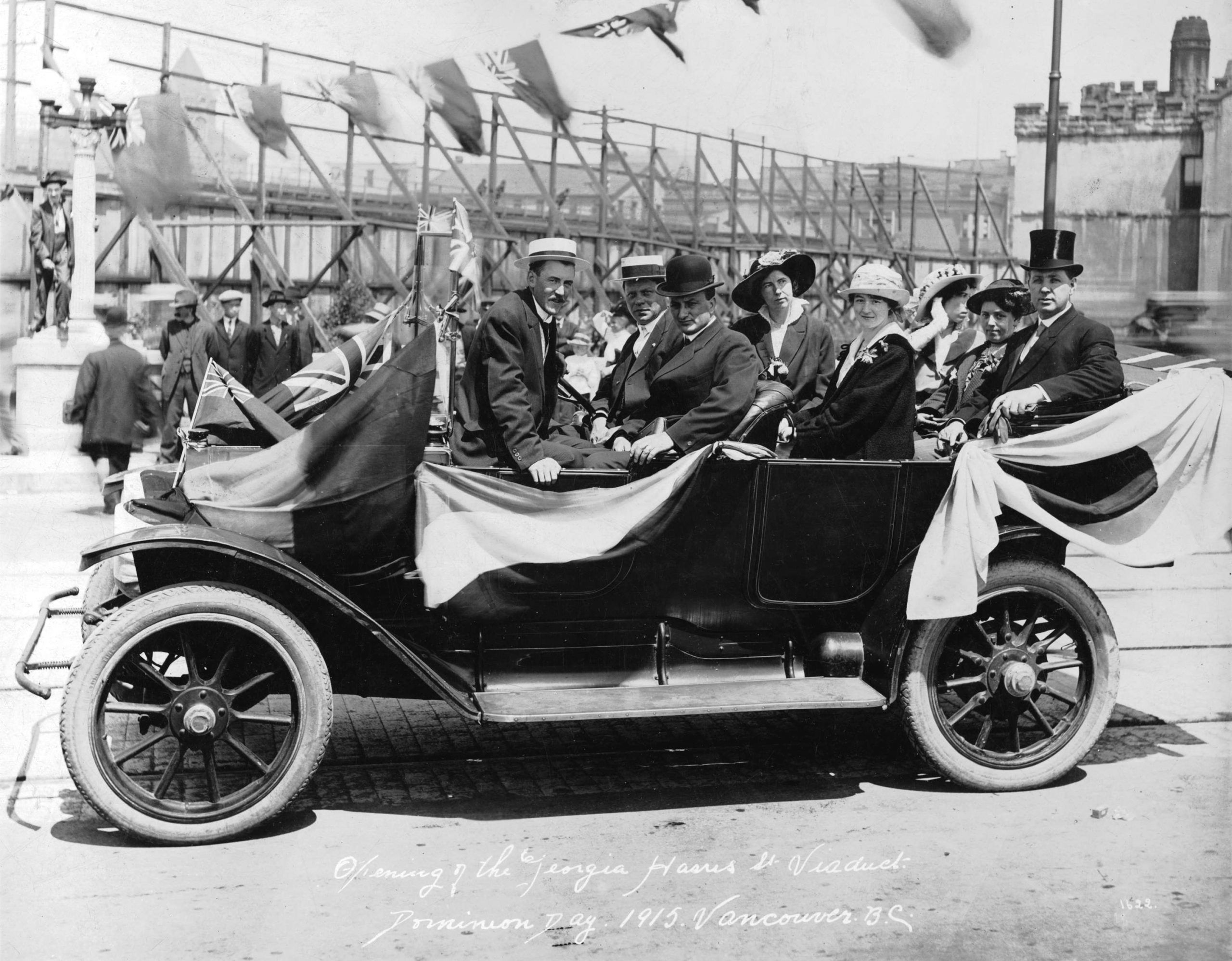
Above: Opening of the Georgia-Harris Street Viaduct. Dominion Day 1915. Vancouver, B.C.
The Main Events
- CPR surveyor Lauchlan Hamilton began to lay out the city’s downtown streets
- The CPR’s last spike at Craigellachie
1885
July 20, 1885 An act to restrict and regulate Chinese immigration into Canada received Royal Assent. Among other restrictions it imposed a Head Tax of $50, and was the first of many enactments to discriminate against Vancouver’s large Chinese population. The result (intended): many men who pioneered in the gold fields of B.C. or worked to build the CPR could not now bring over their families from China to join them.
Fall 1885 The CPR’s Lauchlan Hamilton began his survey and street building in Vancouver. A plaque on the building at the southwest corner of Hastings and Hamilton Streets marks the occasion and location.
October 6, 1885 A resolution of Richmond Council provided that white labor only would be employed on municipal works contracts. Similar resolutions are passed in many Greater Vancouver municipalities in the late 19th century.
November 7, 1885 The CPR’s Last Spike was driven at Craigellachie.
December 25, 1885 Dominic Charlie was born (or baptized) near Jericho Beach. He will become locally famous for his ability to forecast the weather. He and his half-brother collect Squamish legends for publication.
Also in 1885
Seraphim “Joe” Fortes arrived in Vancouver, aged about 20 (he was Barbados-born), as a crewman aboard the Robert Kerr. He jumped ship to settle here and, being an excellent swimmer, began to teach local people, especially kids.
Charles Henry Cates settled in Moodyville and began hauling stone in a 240-foot steam scow called Spratt’s Ark. He later acquired two tugs and began ship-building and towboating.
The first church in Surrey, Christ Church Anglican, near Cloverdale, is built in seven weeks.
A lawyer is retained by Surrey Council for an annual fee of $50.
The first public wharf was built near Steveston at London’s Landing. The Telephone was the first regular steamboat service, calling daily at points on both banks of the South Arm en route to New Westminster.
1886
The Main Events
- The City of Vancouver was incorporated
- The Great Fire virtually destroyed Vancouver
January 15, 1886 On January 15, 1886 the first issue of The Vancouver Herald appeared, the city’s first newspaper. Note that it bears the name ‘Vancouver’ more than two months before incorporation. One interesting item was an advertisement placed by George Black, proprietor of the Brighton Hotel at Hastings, B.C. That hotel was located at what is now the north foot of Windermere Street.
“This fine and commodious new Hotel,” the ad read, “has been recently completed, and is furnished with every convenience for the comfort of guests. The situation and accommodations are unsurpassed on Burrard Inlet, which has become the most fashionable WATERING-PLACE in British Columbia. The prospect is charming, the sea breezes are invigorating, and the facilities for Boating and Bathing are excellent. Private sitting and dining rooms. Suites of apartments for families or parties.
“The Bar is entirely detached from the main building.
“First-class stabling and feed for horses.
“Buses to and from New Westminster twice a day.”
We think the “buses” referred to are what we would call stagecoaches. The Herald’s last issue would be October 12, 1887.
April 6, 1886 The City of Vancouver was incorporated. The ceremony was delayed when it was discovered no one had thought to bring paper on which to write down the details. Someone had to run down the street to the stationery store! The ceremony was held in Jonathan Miller’s house. The population of the city was about 1,000.
April 30, 1886 The corner of Cambie and Hastings Streets was laid out by Hamilton. I’ll explain in the book why Hastings “bends” at this point.
May 3, 1886 Vancouver’s first municipal election was held. It was an at-large vote which elected ten aldermen and the mayor (Malcolm MacLean). There was no voters list, 499 votes were cast. In one of the first by-laws passed by Council, five wards were created, each electing two aldermen for one-year terms of office. An excellent brief biography of Maclean by Richard Mackie may be found here.
May 12, 1886 The first meeting of Vancouver’s first city council. The first piece of business: a petition to lease from the federal government a 1,000-acre military reserve to be used by the city as a park. Today it’s Stanley Park.
May 15, 1886 Lauchlan Hamilton began to survey what would become Granville Street. (Hamilton named the street for the Colonial Secretary of the time.)
May 19, 1886 An ad for the Brighton Hotel appeared in the Daily News-Advertiser. The hotel’s owner, George Black, was already familiar in the month-and-a-half-old city of Vancouver for his butcher shop on the tiny city’s waterfront. No beef or pork here, though: Black went into the forest surrounding the city to bag deer and an occasional elk, sold their meat from his shop or from a rowboat he took out to meet visiting ships. He was famous for his gambling prowess, too, and for the horse races he sponsored down muddy Granville Street.
May 28 Vancouver’s first fire department, Volunteer Hose Company Number One, was formed.
June 1, 1886 J.W. Ross’ News began to publish.
June 13, 1886 A furious, swift fire destroyed Vancouver in a time variously reported between twenty and forty-five minutes, when flames from a brush-clearing fire blew into tinder-dry brush to the west of the city. At least eight people died, and some accounts claim 28. About 1,000 wooden buildings—virtually the entire city—were totally consumed. Said an eye witness, “The city did not burn, it was consumed by flame. The buildings simply melted before the fiery blast . . . The fire went down the sidewalk on old Hastings Road, past our office, so rapidly that people flying before it had to leave the burning sidewalk and take to the road; the fire travelled down that wooden sidewalk faster than a man could run.”
The city’s volunteer fire-fighters had only axes, shovels and buckets. It wasn’t enough. The heat was ferocious: the bell of St. James’ Anglican Church that had warned so many was turned to a molten lump of slag, when the church itself burst into flame. (The melted bell can be seen today at the Vancouver Museum.) The ship Robert Kerr, now a coal hulk, blown from its mooring, came to a stop near the foot of Dunlevy Street and served as a refuge for people jumping into the inlet to escape the fury of the fire.
There are a hundred stories of the fire, but this one has always stayed with me: Lauchlan Hamilton, the CPR land commissioner and city alderman, dashed to his office, collected “the most valuable papers,” shoved them in a sheaf under his arm and ran into a cauldron of fire, “breathing air as hot as cinders.” When Hamilton reached safety, he saw that the papers, still under his arm, were charred black.
June 17, 1886 Four days after the fire, the News was back on the streets.
July 4, 1886 The first scheduled CPR transcontinental passenger train reached Port Moody, after travelling for five days, 19 hours. It was one minute late. Locomotive No. 371, having been placed on the train at North Bend, hauled the first Pacific Express into Port Moody, the first scheduled train to cross Canada from sea to sea.
July 13, 1886 Vancouver city council passed by-law No. 258 to regulate the use of bicycles, which must henceforth not exceed 8 mph.
July 26, 1886 The first inward cargo to the port of Vancouver arrived: tea from China.
July 30, 1886 Vancouver’s first fire engine, the M.A. MacLean, a 5,000-pound Ronald steam pumper—ordered a week after the Great Fire—arrived at Port Moody. A four-horse team hauled it over miles of dusty roads via New Westminster to Vancouver, where it arrived August 1. With its accompanying four hose reels and 2,500 feet of 2 1/2-inch hose, it had cost $6,905.
August 1, 1886 The new fire engine and its supporting equipment arrived, and two days later was placed in service ‘under canvas’, until the new firehall was built. There were no horses available to pull it, so for a time it had to be pulled to fires by the firefighters themselves.
August 11, 1886 The first major fire fought by the VFB was at Spratt’s Oilery, near midnight, and described as ‘a considerable distance from town’ (at the north foot of today’s Burrard Street). The “oilery” dealt in fish oil. The men had to pull the engine to the fire site themselves, there being no horses, and were not able to save the oilery, but they did prevent the fire from spreading.
September 1, 1886 Vancouver’s first bank, the Bank of British Columbia (no connection with today’s) opened on the site of today’s CPR station.
September 13, 1886 The St. Andrew’s and Caledonian Society of Vancouver was formed. It’s still active today, the oldest Scottish organization in the city. Here’s a startling statistic: On St. Andrew’s Day, November 30, 1887 the society held a grand “St. Andrew’s Ball” in McDonough Hall at the southeast corner of Hastings and Columbia. Of the 1,000 or so people who lived in Vancouver at the time, 400 attended. In a rainstorm. The society sponsors Scots-flavored cultural events to this day.
Also in 1886
The first badges for the Vancouver City Police were made of American silver dollars, with one side smoothed down and engraved Vancouver City Police. On the other side, a pin was soldered on.
The city’s first graveyard—it’s at Brockton Point—was closed as Stanley Park began to be developed.
William Macdougall’s Advertiser began publishing in Vancouver. For a brief time Vancouver, with a population of about 1,000, had three daily newspapers.
The Oppenheimer family (food wholesaling) built a warehouse that today is home to Bryan Adams’ recording studio. It is the oldest brick building in the city.
1887
The Main Events
- The first CPR passenger train arrived in Vancouver
- The Vancouver Board of Trade was incorporated
January 17, 1887 First Hudson’s Bay store opened in the city on Cordova Street, on property leased from the CPR. Shelves held what were advertised as the “necessities of life,” saws, axes, lanterns and provisions.
February 1887 A white mob attacked and wrecked a Chinese camp in False Creek. These and other disturbances lead to the suspension of the city charter and the dispatch of special constables from Victoria.
March 16, 1887 The First Baptist Church of Vancouver opened on Cordova Street.
March 31, 1887 The Advertiser, owned by F.L. Carter-Cotton, had merged with the News—both papers about a year old—and the News-Advertiser was created. Their first issue was this date. The big Page One story: A DEMENTED CHINAMAN.
April 1887 Vancouver’s first band concert was held at the Methodist Church on Water Street, opening with The Maple Leaf Forever.
May 1887 The CP main line was extended 12.2 miles along Burrard Inlet to Vancouver.
May 23, 1887 The first CPR passenger train arrived in Vancouver from Montreal. Locomotive 374, attached to the train at Port Moody, brought it in with Peter Righter at the throttle. (It is often thought #374 pulled the train right across the country. Nope, just from Port Moody.) The choice of Vancouver as the Pacific terminus for the CPR ensured the town’s dominant role in southwestern B.C.
May The first passenger to step down onto the platform was a 21-year-old Welshman named Jonathan Rogers. He will become a major developer in the city. The Rogers Building, the attractive white terra cotta building at the northeast corner of Pender and Granville, is one of his.
June 13, 1887 S.S. Abyssinia, chartered by the CPR, arrived from the Orient with a cargo of tea, silk and mail bound for London, England. This marked the beginning of the trans-Pacific, trans-Atlantic trade using the new railway. With Vancouver as the trans-shipment point, the Abyssinia’s cargo gets from Yokohama to London in 29 days. Back then, that was FAST: water-only transport of the same cargo would normally take about 45 days. The Abyssinia showed that Vancouver was going to be an important Pacific Rim port.
July 1, 1887 Vancouver is made a customs port of entry.
Summer, 1887 In the summer of 1887 CPR surveyor Lauchlan Hamilton oared his wooden canoe south across False Creek to pitch a tent on the forested south slope. While plotting road survey lines through the bush he looked back across the water at the brand new city of Vancouver rising against the backdrop of the imposing north shore mountain range, and determined the new subdivision should be called “Fairview.”
August 8, 1887 The first electric lights are turned on in Vancouver.
September 22, 1887 A group of Vancouver businessmen — merchants, lumbermen, bankers and manufacturers—hold a meeting and decide to form a Board of Trade. Within a month, they had drawn up a list of goals and objectives. Besides calling for a land registry office, court house, more schools, playgrounds and mail delivery, the Board wanted direct taxation abolished by both civic and provincial governments.
December 14, 1887 The Vancouver Reading Room opened its doors on the upper floor at 136 Cordova Street West. (In April 1889, it will become a free library).
Also in 1887
The Salvation Army began in Vancouver with four ladies known as the “Hallelujah Lassies.”
Hugh Boyd, a Richmond farmer and its first Warden (like a mayor), was awarded a medal for the best wheat grown in the British Empire.
Surrey appointed E.T. Wade as its first Police Constable. A year later they bought him handcuffs and a gun.
Gihei Kuno, a Japanese fisherman, visited Steveston. He settled in the area, and sent an invitation to other young men from his village which had lost much of its fishing grounds to Osaka. Many of his countrymen followed him.
There was a typhoid outbreak in Delta, due partly to river pollution caused by salmon canneries. There were about 16 canneries operating in the Lower Fraser.
Colonel Richard Moody, who commanded the force of Royal Engineers who either built or contracted our first roads and bridges, died at about 74 in Bournemouth, England.
Jones Tent & Awning was founded by Charles H. Jones. It will last for nearly a century.
1888
The Main Events
- The first Hotel Vancouver opened
- Stanley Park was officially opened
January 30, 1888 Work began on a dam on the Capilano River to create a water supply for Vancouver. The water will be sent through a pipeline lying on the bottom of Burrard Inlet.
February 7, 1888 Vancouver’s oldest union, Local 226 (Vancouver) of the International Typographical Union received its charter.
(Most likely) May 1888 The first Hotel Vancouver opened. (Note: not in 1887.)
May 12 The New Westminster Salmonbellies organized as a field lacrosse club. The club, whose web site is here, is working on an online history. In the 1930s a prominent member of the organization, and once a lacrosse player himself, was Fred Hume, famous for being the mayor of New Westminster and Vancouver . . . although not at the same time!
July 5, 1888 St. Luke’s Hospital was opened in Vancouver by Mayor David Oppenheimer and consecrated by Ven. Archdeacon Woods. Here Sister Frances Redmond ran B.C.’s first nurses training school and Vancouver’s first social services centre.
July 10, 1888 John B. Rivet, blacksmith and wheelwright, opened a shop in Trounce Alley.
July 15 The Daily News-Advertiser had this note: “Mr. W.A. Cumyow, formerly a merchant in Yale and Victoria, and who has lived recently in Westminster, has now opened an office in the new block at the corner of Cordova and Homer streets, and, as will be seen by his advertisements, will act as Chinese and English translator and accountant, also as real estate and custom house broker, conveyancer, etc.” (A note on newspaper style of the time: New Westminster is often referred to as, simply, Westminster.)
July 26, 1888 The first steamer on the West Coast, the Hudson’s Bay Company’s Beaver, ran aground on Prospect Point. After 53 years her days of service end.
September 1888 The first Surrey Fall Fair was held on the grounds of the municipal hall. The fair ended in a deficit, so winners accepted reduced prizes and promised to attend next year.
September 27, 1888 Stanley Park was officially opened, Mayor David Oppenheimer presiding.
September 29, 1888 The World, a daily newspaper, was established by J.C. McLagan.
Also in 1888
Surrey Council paid for residents to be vaccinated against smallpox—the outbreak was contained, with only four deaths in Surrey.
The Delta Agricultural Society was founded for the purpose of holding an annual agricultural fair. A harness-racing track was built on the fairgrounds.
Moodyville’s steamer Eliza was making five round trips a day from Moodyville to Vancouver, and one to Hastings. The fare was 25 cents each way. With increased access the north shore’s population began to grow.
The West School was built at Burrard and Barclay.
First part of the CPR roundhouse in Yaletown built. Today it’s a community centre, and home to Locomotive #374.
McDonough Hall was built at the southeast corner of Hastings and Columbia. “The upper floor,” said City Archivist Major J.S. Matthews, “was a social centre for grand events in those early days.” It later became the Cosy Corner Grocery.
Hastings Park was granted in trust to the City by the Province, with the site to be used as a public park. (Source: City of Vancouver)
1889
The Main Event
- Water was supplied to Vancouver from the North Shore
January 4, 1889 the first Granville Street bridge opened. (The current bridge is the third.)
March 5, 1889 The first banquet of the Vancouver Board of Trade was held in the Hotel Vancouver, at a cost of $12.50 per plate. That also got you a quart bottle of Mumm’s Extra Dry Champagne.
March 14, 1889 The Vancouver Real Estate Board was formed. Today, it’s known as the Greater Vancouver Real Estate Board.
March 26, 1889 A small crowd gathered at Georgia and Granville Streets and watched as a valve was turned and fresh Capilano River water began to gush out. Wrote the Weekly News-Advertiser “. . . water from the water works dam of the Capilano River, ten miles from the place of writing in this city, crossed the Narrows Monday night at 11:10 o’clock, at 1 o’clock had filled the mains on Georgia street and at 2 o’clock had reached Westminster avenue [Main Street].” Vancouver had its water. This subject is treated at more length, with lots of interesting detail, here.
May 6, 1889 The Eiffel Tower opened in Paris.
June 1889 Writer Rudyard Kipling first visited Vancouver.
September 1889 The Vancouver Fire Department finally got horses to pull their fire engine. Since the summer of 1886 the men had had to pull the engine themselves.
September 28, 1889 The windjammer Titania departed Steveston with canned salmon for direct shipment to Britain, the first ship to do so. Earlier, local canneries have imported and exported via Victoria.
Also September 28, 1889 Vancouver’s first city hospital opens, a wooden building at Beatty Street and Cambie, with 35 beds.
October 29, 1889 Governor General Lord Stanley (the same man who gave us the Stanley Cup) dedicated Stanley Park during the first visit of a GG to British Columbia. An observer at the dedication wrote: “Lord Stanley threw his arms to the heavens, as though embracing within them the whole of one thousand acres of primeval forest, and dedicated it ‘to the use and enjoyment of peoples of all colours, creeds, and customs, for all time’.” His statue, in Stanley Park, immortalizes that gesture.
November 16, 1889 The Union Steamship Company was formed from the consolidation of the Moodyville ferry company and Burrard Inlet Towing Company.
December 5 The first Shakespearean production in the city: Richard III at the Imperial Theatre.
Also in 1889
John Howe Carlisle became chief of the Vancouver Fire Department. He will serve as chief for an astonishing 42 years. Carlisle was the first (1922) recipient of Vancouver’s Good Citizen Award.
New Brunswick-born Jay Russell and Victoria-born Len DuMoulin form Russell & DuMoulin, a law firm that will celebrate its 100th anniversary in 1989, making it the oldest and largest law firm in the city. Today the firm is Fasken Martineau DuMoulin, with more than 130 lawyers.
New Westminster formed a lacrosse team called the Salmonbellies and within a year they establish themselves as a team of national rank.
The Trades and Labour Council was formed for the purpose of establishing a nine-hour work day.
The Marpole Midden (refuse heap), largest known in North America to that date, was discovered.
Benjamin Tingley Rogers (born in Philadelphia October 21, 1865) came to Vancouver. He began the B.C. Sugar Refinery, wresting all sorts of concessions from city councillors anxious to have new industry. He was 24. Read John Schreiner’s The Refiners: A Century of B.C. Sugar.
1890
The Main Events
- B.T. Rogers starts a sugar refinery
- Vancouver gets its first electric streetcars
January 1890 Vancouver’s first high school opened.
June 28, 1890 Vancouver’s electric street car system began, running from Granville Street Bridge to Union and Westminster (Main) Streets.
July 8, 1890 First foundation stone of the B.C. Sugar Refinery was laid. That building no longer exists.
November 12, 1890 The first shipment of raw sugar, 250 tons, arrived on board the S.S. Abyssinia from the Philippines for the B.C. Sugar refinery.
Also in 1890
John Oliver rented out the first steam thresher in Delta and transported it from farm to farm on the new main roads of the municipality.
1891
The Main Event
- Burnaby’s Central Park was created
- The Vancouver Opera House opened
- Coquitlam was incorporated
January 2, 1891 Electric street lights are switched on in New Westminster, from a power plant fuelled by sawdust.
January 14, 1891 Lieutenant-Governor Hugh Nelson proclaimed the former military reserve in Burnaby to be Central Park, and sets it aside for recreation. (The park was named after Central Park in New York, where Mrs. Oppenheimer, wife of Vancouver’s mayor, was born.)
January 29 The brand-new B.C. Sugar Refinery invited Mayor David Oppenheimer to tour the plant. Oppenheimer had donated the land on which the refinery sat.
February 9, 1891 The Vancouver Opera House, built for $100,000 by the Canadian Pacific Railway, opened on Granville Street with 2,000 seats. The city’s population was 13,000! It was an astonishingly grand edifice for such a tiny town, but an indication of the CPR’s optimistic view of the future.
March 10, 1891 H.O. Bell-Irving formed the Anglo-British Columbia Packing Company.
April 28, 1891 The CPR’s Empress of India arrived in the city for the first time.
June 12, 1891 The Ross McLaren Sawmills at Millside (later known as Fraser Mills), built in 1889, finally began operation.
July 1, 1891 The Douglas border crossing, named after Sir James Douglas, was established.
August 22, 1891 Coquitlam was incorporated.
August 29, 1891 The first councillors for North Vancouver District were sworn in. Moodyville decided not to be a part of the new municipality, which stretched from Horseshoe Bay to Deep Cove.
September 21, 1891 Sarah Bernhardt starred in “Fedora” at the Vancouver Opera House.
September 21, 1891 E.H. Wall of New York demonstrates the Edison gramophone for the first time in Vancouver at Manor House.
September 26, 1891 Squatter Sam Greer, after whom Greer’s Beach (Kitsilano Beach today) is named, shot the sheriff who came to evict him. While that official healed, Sam and his family were ousted, his buildings levelled, and he spent some time in jail.
September 26, 1891 At Brockton Point the first British Columbia Amateur Athletic meet was held.
October 1, 1891 The Westminster and Vancouver Tramway Co. began Canada’s first interurban line. The “Interurban” ran from Vancouver to New Westminster.
November 27, 1891 The Great Northern Railroad from Seattle reached the south shore of the Fraser at New Westminster.
Also in 1891
The Great Northern Cannery was built near Sandy Cove in West Vancouver, where the fisheries research station now stands. It operated until 1969.
There were now 13,000 residents in Vancouver. In six years it has grown from a population of 400.
Richmond’s Minoru Chapel was built, the first church on Lulu Island.
The first telephone line in Richmond was installed at a Steveston store. Messengers were sent from the store to fetch the person for whom the call is intended while the caller waits.
A map was drawn showing proposed boundaries of Burnaby. It took in all of Point Grey and what is now South Vancouver. A copy hangs today on the office wall of Burnaby’s mayor.