1909
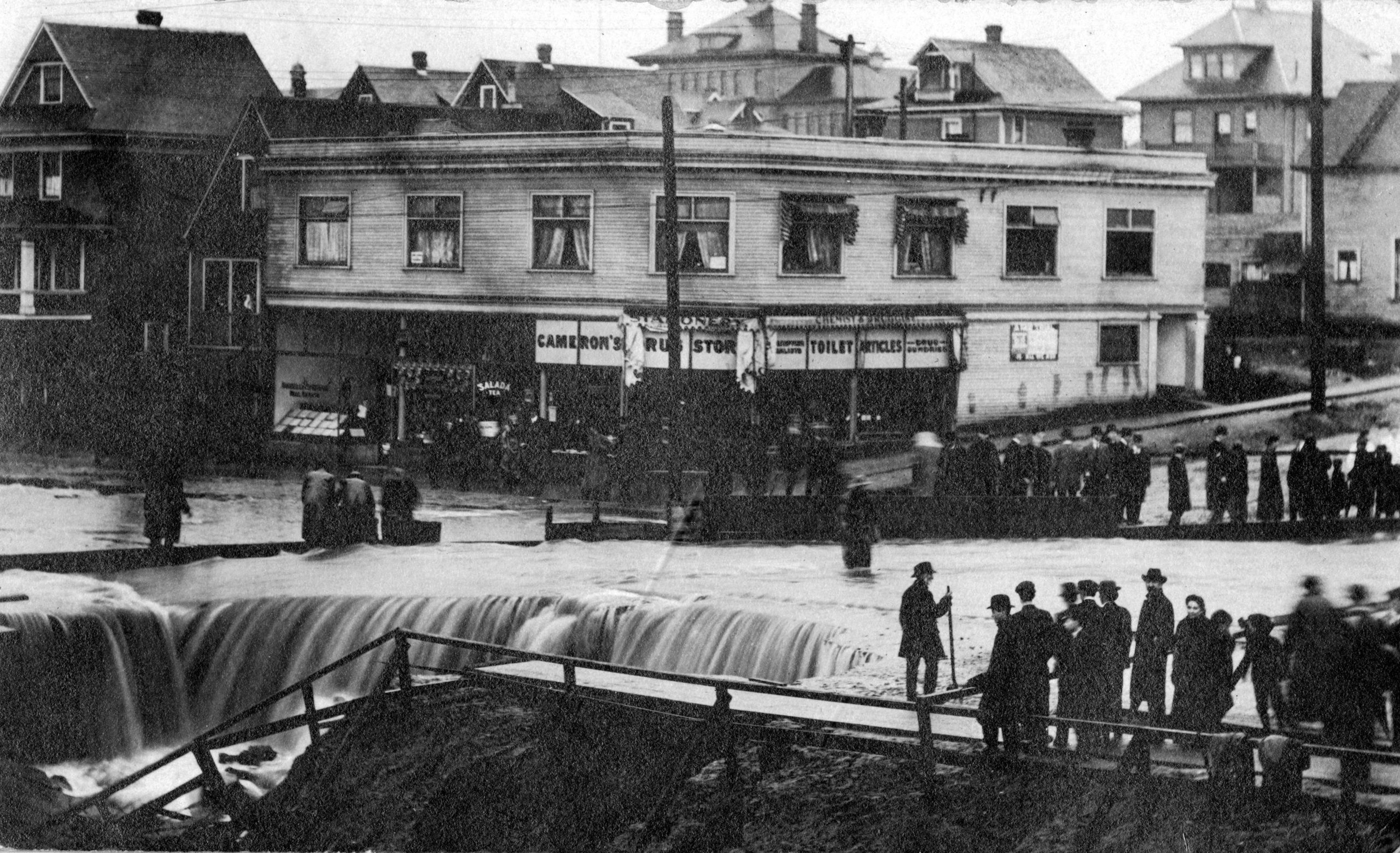
Above: Southeast corner Broadway and Heather Street circa 1909
[Image: Vancouver City Archives]
*****************************************
You’ll note that these years include events listed under “Also in . . .” These are events for which we don’t have a specific date. If YOU know the specific date of an event shown there, please notify us . . . and cite the source! Many thanks!
*****************************************
1909 is the first year with so many events that we gave it its own separate file. Further analysis might show that Metropolitan Vancouver took a giant leap forward this year: many prominent buildings were erected, and there seemed to be a heightened sense of excitement at the promise of the city.
January 7 The first export shipment of grain was made out of Vancouver. Some 50,000 bushels of wheat from the prairies went to Australia.
February 4 Artist Jack Shadbolt was born in Shoeburyness, England. At age 3 he came with his family to Victoria.
February 10 Artist Bertram Charles Binning was born in Medicine Hat, Alberta. He’s most well known for the mosaic design on the outside of the B.C. Electric Building . . . which became the B.C. Hydro Building . . . and which is known today as the Electra, a condominium development at the northeast corner of Nelson and Burrard.
March 9 Hugh Magee, pioneer Point Grey farmer, died in Point Grey, aged 83. He was born June 4, 1826 in what is now Northern Ireland. He moved to Upper Canada (Ontario) in 1843, and married Isabella Crawford in 1850. In 1857 he sold the farm and took his family, which now included three young children, to California. They travelled by sea via New York, across the Panama isthmus (no canal yet) and then by ship again to San Francisco. Hearing news of the Fraser River gold strike in 1858, they headed to New Westminster. Their fourth child, Hugh Crawford Magee, was born while they were on the ship.
By 1861 the family was at “Rosehill,” on the Burnaby/New Westminster border where 10th Avenue intersected with the North Arm Trail (Marine Drive). That’s where their fifth child, James Douglas Magee, was born April 17, 1861. But Magee found the land in that area too marshy for farming, and determined to move again. (A later tenant of that land, Rose Hill Farm, established a dairy farm and sold milk there.) By October 1864 the Magees had settled west of Marpole.
He was the first farmer to settle the North Arm of the Fraser. He and Isabella had fifteen children: seven sons and eight daughters between 1852 and 1880. Two of the daughters died in infancy.
In Michael Kluckner’s Vancouver, The Way It Was, Kluckner describes how Magee purchased a home in New Westminster, put it on a barge, floated it down the Fraser, and landed it in a grove of spruce trees near what is today the foot of Blenheim Street. They called their new home Spruce Grove. Ten years later, high water forced Magee to move the house up the hill to what later became 3250 West 48th Avenue.
In 1902 the Magees cleared a road through the forest from Blenheim Street to the newly constructed Granville Street. It was known as Magee Road until the name was changed to 49th Avenue. The name Magee got on the map the next year when the Canadian Pacific Railway built the Magee station on the Interurban line from Vancouver to Steveston.
Hugh Magee died March 9, 1909 in Point Grey, at the age of 83. He left an estate valued at more than $100,000 and a will with instructions that kept lawyers and the courts busy for the next fifty-three years. It took until the last of his children had died, before the estate was finally settled in 1962.
The Magee name lives on, too, in Magee High School, which had its beginnings in 1913 when Point Grey established its first high school. At first, classes met in Eburne Elementary School until a building was ready at 49th Avenue and Maple Street in 1914. Soon after, the name was changed from Point Grey High School to King George V High School. This name caused confusion with the King George High School in Vancouver, and residents and students persisted in calling the school “Magee.” That name became official in 1927.
This entry relies heavily on research by John Macdonald. Hugh Magee was John’s wife’s great-great-grandfather. We’re very grateful for this interesting material.
March 10 The new world heavyweight boxing champion, Jack Johnson, visited Vancouver for an exhibition bout at the Vancouver Athletic Club against an opponent named Victor McLaglen. It was Johnson’s first fight after winning the title. Trivia: McLaglen, 26, later became a well-known movie actor.
March 15 The first freight train (Blaine, Washington at one end, New Westminster at the other) traveled the new Great Northern Railway track along the White Rock foreshore, precipitating real estate speculation and a building boom. A customs post was opened at White Rock.
March 26 American evangelists John Wilbur Chapman and Charles McCallon Alexander, who have formed the “Chapman-Alexander Simultaneous Campaign,” embarked from Vancouver on a worldwide campaign. Their technique was to hold multiple simultaneous meetings in cities, conducted by themselves and associates. In Philadelphia the year before they had held 21 meetings at the same time.
March 29 Longshoremen struck for higher pay. They want 35 cents per hour for day work and 40 cents per hour for night work.
May The name of Vancouver’s 9th Avenue was changed to Broadway. There were a number of Americans involved in the city’s real estate boom and it was felt that Broadway (after Broadway in New York City) would, in archivist Major J.S. Matthews’ words, “help promote some mysterious advantage.”
May 5 Robert Clark, merchant, died in Vancouver, aged 65. He had an important influence on the business life of Vancouver. He was born in Lanarkshire, Scotland in 1845. His first job was in a grocery store, but then he learned the ship-builder’s trade. On May 1, 1871, at age 25, he left Scotland for Canada.
He built the first steamer that sailed on Lake Manitoba. “Going into the forest,” the 1906 B.C. Illustrated News relates, “he picked out the trees, hewed the lumber and with help whip-sawed the lumber. He then built and launched the boat and delivered her to the owners, a craft one hundred feet in length.”
Clark then moved into the States and worked in various cities until he came up to Victoria in 1875. In 1880 he opened a men’s wear store in Nanaimo, moved it to Yale a year later. His store there burned down. “He remained at Yale until the spring of 1886,” the Illustrated News continues, “when owing to the building of the Canadian Pacific Railroad [sic] he returned to Vancouver. He then opened his store on the same street [Hastings] on which he is now located, and he has a large and successful business. He built his present store, ninety by one hundred and thirty-two feet, and in it he carries a full and complete line of men’s furnishing goods, carefully selected. He is the pioneer clothing merchant of this place . . .”
We also learn he assisted in building the first Presbyterian church in Vancouver, and topped the aldermanic polls here in 1887, ’88 and ’89.
This excerpt from the web site of the Vancouver Board of Trade indicates the key role Clark played in the early business life of Vancouver: “Following the disastrous fire of June 13, 1886, when all but one of Vancouver’s buildings were destroyed, Vancouver businessmen held a number of meetings to discuss the need for some kind of business organization that could help to rebuild the young city. On September 22, 1887, such a meeting was held under the chairmanship of Alderman Robert Clark and the decision was made to form a Board of Trade . . . On November 24, 1887, a Charter was issued which made the new organization official and gave it its name—The Vancouver Board of Trade.”
May 24 Vancouver’s first marathon was run. The location was Recreation Park, and the race was won by Vancouver’s Will Chandler in a time of 3 hours, 22 minutes, 11 1/5 seconds. Eleven runners took part and the race was run around a track in the park. 2,500 spectators attended and Mayor Charles Douglas fired the starting pistol. One of the timekeepers was prominent local jeweler George Trorey, manager of the Birks store here. Our thanks to Andrew Martin of Special Collections in the Vancouver Public Library for this glimpse into the city’s athletic past.
June 20 Errol Flynn was born in Hobart.
June The first moving picture theatre in North Vancouver opened at Larson’s Pavilion.
August 21 Minoru race track, named after King Edward’s Epsom Derby winner, opened in Richmond, with 7,000 people on hand.
August 25 The Canadian Pacific Railway opened its new line over Kicking Horse Pass near Field, BC. The route featured two spiral tunnels, bypassing the former switchback with its 4.4 percent grades.
September 6 Governor General Earl Grey officially opened the new Granville Street bridge. Lady Grey cuts the ribbon. (This bridge will last until 1954.) The new bridge extended from Pacific to 4th, east of the original bridge.
September 28 The first contingent of 110 French Canadians from Quebec’s lumber industry arrived by train to work at Fraser Mills. Their residential settlement, built with company help, becomes known as Maillardville, named after community leader Father Edmond Maillard.
September The St. Andrews and Caledonian Society began a group in North Vancouver for Scottish dancing.
October 6 Vancouver took its first mechanized ambulance out for a test drive and ran over and killed an American tourist.
October 14 Famed American evangelist William Jennings Bryan lectured at the Vancouver Opera House.
October 20 “The Vancouver branch of the Canadian Women’s Press Club,” the Province reported, “held its first regular meeting yesterday afternoon. The club has been formed with the object of bringing together all women writers of the City . . .” One of the founders of the local branch was Lily Laverock, one of the most interesting of all Vancouver pioneers. The Edinburgh-born Miss Laverock (she was Miss Laverock to everyone) had arrived as a child with her parents and went on to become the first female general reporter in the city. She worked first at the World and later became women’s editor of the News-Advertiser. Later she will become an impresario, and an impressive one.
October The first bank in Surrey, a branch of the Bank of Montreal, opened in Cloverdale.
November 8 The West Vancouver Transportation Company began a ferry service across the inlet with the 35-passenger West Vancouver. The pier was at the foot of 17th Street, on land owned by John Lawson (one of the company’s founders), land now called John Lawson Park.
Also in 1909
Construction began on the Evangelistic Tabernacle at 85 East 10th.
The Normal School at 555 West 12th was built.
The Winch Building at 757 West Hastings (now part of Sinclair Centre) was built.
Aberthau, at 4397 West 2nd, was built. It’s now the West Point Grey Community Centre.
Hycroft, at 1489 McRae, was built. It was the grandest home in Shaughnessy at $100,000 at a time when $3,000 would buy you a new house. Its owners, General Alexander McRae and his wife, turn it into a glittering social centre. Owned today by the University Women’s Club, inside and out it is one of the most beautiful buildings in the city.
The Cecil Hotel opened on Granville Street.
Poland-born Jack Diamond was born. He will come to Vancouver at age 17 and become hugely influential.
Realizing the growing importance of Vancouver as a port and that its fame was spreading to many far away places, The Vancouver Board of Trade advocated a new city hall.
English Bay pier was built.
The Chinese Benevolent Association was founded and moved into its own new building at 108 East Pender.
Vancouver’s first skyscraper, the Dominion Trust Building at Hastings and Cambie, was completed.
The Interurban railway was extended from Eburne in Richmond to New Westminster.
The Caulfeild subdivision on the north shore was completed and lots went on sale for summer homes.
Wigwam Inn, at the north end of Indian Arm, was built by German-born financier Alvo von Alvensleben. By 1913 it will be popular enough to have daily boat service provided by the stern-wheeler Skeena.
The work of the Surrey Women’s Institutes began, welcoming new settlers and assisting with such projects as libraries, parks, youth training work and dental clinics.
Richmond entered into an agreement to have its water supply piped from New Westminster’s reservoir, after many years of unsuccessfully drilling to find its own water.
The North Pacific Lumber mill at Barnet was destroyed by fire. A modern plant was constructed to handle 150,000 board feet a day. Separate accommodation was built for Caucasian, Chinese, and Sikh workers, and Barnet, although a part of Burnaby, became a company townsite.
Sculptor Charles Marega arrived in Vancouver, accompanied by his wife Berta. He will become a prolific creator of sculpted work around the city.
Frederick Begg arrived in Vancouver from Lindsay, Ontario and, with his brother Frank as partner, began the Begg Motor Co., the city’s first car dealer.
The Vancouver Police Department began its first mounted patrol for Stanley Park.
The streetcar line was extended from downtown Vancouver to Boundary Road, and the development of Vancouver Heights—which, despite its name, was on the Burnaby side of the line—was spurred. It was designed as an exclusive subdivision which the developers hoped would rival Shaughnessy Heights. An example was “Overlynn,” the Charles J. Peter Mansion at 3755 McGill Street, built at a cost of $75,000.
Alexander McDonald Paterson came to Delta to run the Paterson farm “Inverholme.” Inverholme School (now preserved on Deas Island) was built in 1909 on the Paterson farm.
Charles S. Davies came from England to Port Coquitlam in 1909, and was a contractor and builder there on such projects as the City Hall and the Commercial Hotel. He will later become an alderman and then mayor.
Laburnum Street was named for the tree by the CPR, when the land behind Kitsilano Beach was opened.
Pitt Meadows gets its first school and first telephone.
The Grandview Methodist Church was built at 1895 Venables. It will later become a United Church and, still later, will be converted into the East Vancouver Cultural Centre, the “Cultch.”
Wisconsin-born Charles Stanford Douglas was mayor of Vancouver at the beginning of 1909, Michigan-born L.D. Taylor was mayor at year’s end.
The building boom in Vancouver leads to comprehensive new building regulations.
The Vancouver Fire Department got its first motorized aerial ladder, a 1909 Seagrave 75-foot tractor-aerial ladder, first of its type built by the Seagrave Company. It was purchased because of the large number of high buildings being built downtown, particularly the Dominion Trust Building at Hastings and Cambie, then the tallest in the British Empire.
The No.18 Field Ambulance unit, Army Medical Corps, was founded here.
The Vancouver School Board began to offer night school courses. Some 966 people signed up.
Construction started on the Hospital for the Mind, later renamed Essondale, now Riverview Hospital.
The B.C. Electric Railway purchased plans for two open-air sightseeing cars from the Montreal Tramways Company for 25 cents and constructed them in their New Westminster shops. A young conductor worked one on short notice one day, and found himself a born showman. From that day on “Teddy Lyons and the observation car” were inseparable. His quick wit and non-stop humor became so well known the company even published a book of ‘Teddy Lyons Jokes’. “See that seagull? Richest one in Vancouver. Came by here the other day and made a deposit on a new Packard”. It was corny, and the passengers loved it, almost as much as they loved the little groups of children who would sing at corners where the car stopped, or the long narrow souvenir photos of the passengers taken by photographer Harry Bullen and sold on every trip.
Vancouver-based Placer Dome had its origins this year when a party of prospectors in northern Ontario literally stumbled over what would turn into one of the biggest gold finds of the century. One of the men slipped and fell, dislodging a piece of moss . . . under which was found a dome-shaped rock structure studded with gold. Hence the name Dome Mines. (Dome amalgamated with Placer Development in 1987. Hence Placer Dome.)
1909 was a fiscally feverish year in the city. An alley corner on Hastings Street was sold for $100,000 while one property owner refused an offer of $250,000 for a corner on Robson and Granville Streets. Bank of Toronto officials at the time deplored “the wild speculation which has taken place in real estate.”
The Vancouver labour council joined the Canadian Trades and Labour Council.
The Clayburn brick works were producing 30,000 bricks a day.
Fred Hinckleton built the first shack on Grouse Mountain. It quickly became a rendezvous point for hikers wanting food and refreshments.
Stanley Park covers 405 hectares, much of it with grey squirrels, thanks to a gift of eight pairs from New York City in 1909.
Artist Jack Shadbolt was born.
Percy F. Goldenrath’s name appeared as the sole publisher listed in the Vancouver telephone book.