|

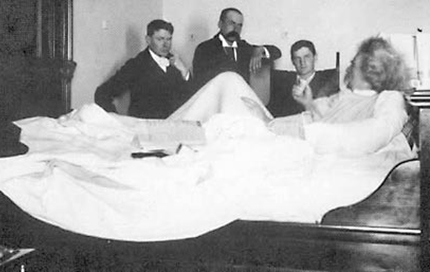
Mark Twain, ill in Vancouver, August 18, 1895,
but not too ill to speak with local reporters
This section of our web site looks at the 80-year-long
history of Vancouver's Orpheum Theatre. New chapters will be added
as time passes.
* Entertainment
Before the Orpheum »
* B. Marcus Priteca, Architect
»
* Tony Heinsbergen, Master Designer
»
* Ivan Ackery, the Promoter (Part
I) »
* Ivan Ackery, the Promoter (Part
II) »
* Ivan Ackery, the Promoter (Part
III) »
* Dal Richards »
Let's begin by looking at
Entertainment before the Orpheum
One of the earliest references we have to entertainment
in the Vancouver area is in 1861 when a touring San Francisco company
arrived to entertain the Royal Engineers here. The Engineers had
been sent to build our earliest roads and bridges, and to discourage
any thoughts of expansionism by the Americans a few miles south.
One of the touring troupe, a 16-year-old girl named Lulu Sweet,
a singer, became an instant favorite with the troops . . . and thereby
hangs a tale. On January 10, 1861 (a date of January 12, 1860 is
also cited), during a tour of local waters, the commander of the
Engineers, Col. Richard Moody, was showing Miss Sweet various features
of the landscape. As they passed one island in the Fraser, she asked
its name. It has no name as yet, Col. Moody responded,
but in tribute to you we shall call it Lulu Island.
So more than 140 years ago show business made its mark on the Greater
Vancouver landscape! There is a photograph of Miss Sweet here.
We dont hear much about entertainment for
the next couple of decades. It was happening; its just that
not much made it into written history.
The Midnight Adieu Club held dances every couple
of weeks at Blair's Hall in Vancouver in the early 1880s, a location
also used by the local Catholic Church for its masses. A place called
Columbia Hall opened June 5, 1886 with Webster and Stehle, an acrobatic
song and dance team. That was a full 25 years after Lulu Sweet and
her company had passed through.
Vancouvers first band concert occurred April,
1887 (opening with the playing of The Maple Leaf Forever,
written 20 years earlier and already a sort of national anthem).
Records of paid entertainment in the interim are sparsemost
entertainment of the time was home-made, when family members would
sing, play musical instruments and perhaps even dance for visiting
friends and family. The Imperial Opera House presented visiting
stock companies, minstrel shows and variety entertainments. Sometimes,
even at this early stage, big names of the time would stop by. The
first Shakespeare production in the city, says Sheila Roberts in
her book Shakespeare in Vancouver, was on December 5, 1889
with Richard III at the Imperial Theatre. Now is the
winter of our discontent made glorious summer by this son of York
. . .
 |
|
|
Emma Juch
[Photo: www.juch.net)
|
|
Then, on February 9, 1891 the CPR opened the $200,000
Vancouver Opera House on Granville Street near where Sears (nee
Eatons) stands today. The initial show in the 1,200-seat theatre
was a performance by the Emma Juch English Opera company, a touring
company from the US. The CPR paid the Juch organization $10,000
to stage Wagner's Lohengrin. In September the great Sarah
Bernhardt appeared there, starring in Fedora . . . speaking entirely
in French. Still, to have The Divine Sarah appear in a city of some
13,000 residents was an important occasion, and the local newspapers
knew it. (On that same day, September 21, 1891, another form of
entertainment was unveiled in the city when E.H. Wall demonstrated
the new-fangled Edison gramophone, great-grandfather of todays
CD players.)
The VOH would become an important part of Vancouvers
entertainment scene for many years, and those who were here when
it was active remember streetcars lining up to wait for the exit
of the late theatre crowd . . . which played havoc with schedules
and traffic.
That word opera in the theatres
nameas was also the case with the Imperial Opera Housewas
misleading. The first production at the VOH was an opera, true,
but other operas were actually few and far between on these stages.
Much more frequent were variety shows. A Daily World edition
of Sept. 28, 1893 carries exactly one entertainment-themed ad, and
its for the Imperial. They were presenting The Oliver Musical
Comedy Company in a highly entertaining and amusing programme,
consisting of Songs, Dances, Pleasing Specialties, Roaring Comedy
Sketches, Funny Farces. Prices were 15, 25 and 35 cents. The
theatre invited the public to attend a free concert by its Novelty
Band on the street each day at 2:30.
| |
 |
| |
Pauline Johnson
[Photo: Vancouver Public Library 9429]
|
Mark Twain came to the Imperial August 15, 1895
and made audiences laugh so long and loud that parts of his commentary
couldnt be heard. Twain had a bad cold at the time, and a
famous photograph shows him laid up at the Hotel Vancouver and chatting
with writers from the local newspapers. Public speaking and poetry
readings were big draws at the time. In October of 1897 Pauline
Johnson was reading her poems to a big crowd at Homer Street Methodist
Church. From 1895 to 1902 the Vancouver Opera House, with its 1,200
seats, was leased by Robert Jamieson. He brought in musicals, opera,
vaudeville and drama . . . and also gave us his son, Teddy, who
was to become one of Vancouvers best known musicians. It was
Teddy Jamieson who led the orchestra at the 1927 opening of todays
Orpheum.
Harry Lindley was a prominent theatrical figure
in Canada around the turn of the 20th century, and has been called
Vancouver's first resident professional. His company performed plays
in the 1890s with titles like In the Cariboo and A Scene
on Hastings. Lindley and his company made annual tours of Canada,
performing at various cities. One of his companys hits was
a play titled The Duplicate Man, in turn written by the Prairie
playwright and journalist Kate Simpson Hayes. So there was lots
of Canadian content, even more than a hundred years ago. (They spread
it around, too: Lindleys company ventured into the U.S. with
some success.)
Some of these stage presentations were extraordinarily
complex and vast: a touring production of Ben Hur at the
VOH had a cast of 275 and a real chariot race! There were four live
horses for each chariot, running on a treadmill . . . with everyone
deserting the wings in case there was an accident.
On August 2, 1897 the movies came to
Vancouver with an Edison Kinetoscope exhibition at Market Hall.
(The first public demonstration of the Kinetoscope had been at the
Brooklyn Institute of Arts and Sciences in New York May 9, 1893.)
For some time, however, movies would not be an important entertainment
factor. They were still too crude to be more than a novelty. On
October 7, 1898 what may have been Canadas first motion picture
theatre opened on Cordova Street in Vancouver, but one hears nothing
of it after its opening. In 1902 the Edison Electric Theatrecalled
Canadas first permanent cinemaopened in Vancouver but,
again, one hears little or nothing of it after its opening. Frank
Kerr opened a movie house in New Westminster two years later. The
first motion picture house in North Vancouver opened in Larsons
Pavilion in June of 1909. Flat (and fat) black discs of the Victor
Talking Machine Company and magic lanterns began to bring a new
kind of entertainment into the home.
The Province newspaper began appearing as
a daily in Vancouver March 26, 1898, but advertisements for entertainment
events were still sparse. Their edition of September 1, 1898 has
a single showbiz ad, for the Vancouver Opera House,
showing a Japanese musical play titled The Geisha. The show
was presented under the auspices of the Lyric Operatic
and Dramatic Association. Tickets were $1, then 75 cents, 50 cents
and 25 cents.
Six years more and now there are three theatres
advertising: the VOH, the Peoples Theatre at Pender and Howe, and
the Empire at Hastings at Gore. The Empire noted in its advertisement
January 2, 1904 that it was also showing Moving Pictures,
but apart from that two-word phrase no description was provided.
These were likely the tiny short subjects that so startled early
motion picture audiences: locomotives thundering down to the camera
(reportedly frightening some people out of their chairs), brief
scenic views of exotic lands, and other documentary items.
You will find an advertisement for the Orpheums
vaudeville show in the Daily Province for March 1, 1907,
but this is an earlier theatre of the same name. (More on that in
later chapters.)
The precursor to the Pacific National Exhibition,
the Vancouver Exhibition, began August 16, 1910. It was a major
event, and the exhibition was opened by Prime Minister Wilfrid Laurier.
 |
|
|
Fred and Adele Astaire (photo: Wikipedia)
|
|
Fred and Adele Astaire, already famous, were in
Vancouver in 1917 and danced at the Orpheum of that time. At
a time when it was unheard of to dance anywhere except on a floor,
Ivan Ackery recalls, Fred and Adele shattered tradition by
dancing up stairways and on table tops.
1918 brought two cataclysmic events: one was the
horrific Spanish flu epidemic that killed more people during the
years of World War I than the war itself (with Vancouver being hit
just like any other major North American city). The second, far
happier event, was the end of that war. The Marx Brothers performed
here in 1918, and so did the great Sarah Bernhardtfor the
third time. The Divine Sarah had, because of an accident, lost a
leg since her 1913 visit and Orpheum stagehand Buck Taylor had to
carry the frail 74-year-old actress on and off the stage.
At the other end of the age scale, there is a showbiz
legend in Vancouver that child actress Mitzi Green (she was 10 when
she starred as Becky Thatcher in the 1930 movie Tom Sawyer)
got her start on the Orpheum stage in Vancouver in the 1920s when
she toddled on stage during her parents act and joined in.
The audience, it is said, loved her and she quickly became part
of the act. These sorts of stories must be checked carefully. It
seems every city in North America, for example, claims that movie
producer Mack Sennett was in the audience in one of its theatres
when the great comic Charlie Chaplin appeared as part of a British
comedy troupe. Sure enough, according to local old-timers, Chaplin
was on the stage of the Orpheum (the earlier one) in Vancouver when
Sennett spotted him and went on to make him a star. Chaplin was
certainly here (in 1911) with the Fred Karno troupe, but Sennett
first saw him in New York City.
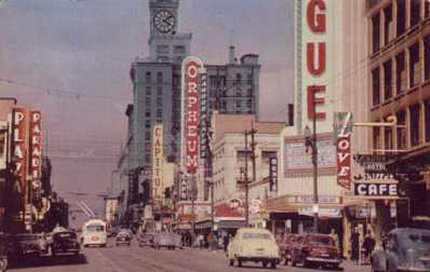
On March 25, 1921 the Capitol Theatre opened on
Granville Street. Unlikely as it seems, the Capitol is even older
than the Orpheum, but its conversion in 1977 to a multiplex cinema
erased all traces of its earlier configuration.
Radio made its arrival in Vancouver in 1922. On
March 13 of that year the Vancouver Province began broadcasting
a "radiophone" program of news and music from a transmitter
in the Merchants Exchange Building. The Sun followed
with its own station on March 15, followed by the World a
week later. By the end of the year only the Provinces
station was still around. In 1923 radio was used in the citys
mayoralty race. In 1924 CFXC, which would later become CJOR, began
broadcasting out of a coat closet in New Westminster. (CFXCs
owner, Fred Hume, was mayor of New Westminster from 1934 to 1942,
later mayor of Vancouver (1951-1958), and later still, from 1962
to his death in 1967, an owner of the NHLs Vancouver Canucks.)
Radio, and the looming introduction of sound into
motion pictures, would alter the future of entertainment . . . but
in 1927 the Vancouver Evening Herald reported on an immediate
and major phenomenon: a grand new theatre on Granville Street.
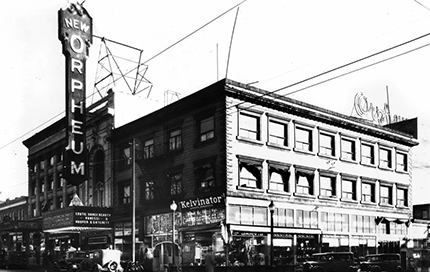
The mammoth building of the New Orpheum Theatre
which is daily growing higher and gradually nearing completion brings
to mind the wonderful growth of vaudeville and improvement in vaudeville
in the past few decades.
No amusement form in the world has enjoyed
the wonderful growth in popularity which has fallen to the lot of
vaudeville theatre in America. Today there is not a city of any
size without such a place of amusement. The Orpheum Circuit, which
has just celebrated its 40th birthday, now has 46 theatres under
its control and operates in every city of importance from Chicago
to the Pacific Coast and from New Orleans to Vancouver . . .
New Orpheum theatres are now under construction
in Sioux City, Omaha, Seattle and Milwaukee. But of all of them,
none will be finer or more commodious than the new Vancouver house.
The Heralds optimism over vaudeville
was misplaced: that form of entertainment was already beginning
to wane. But it was right about the fine and commodious Orpheum
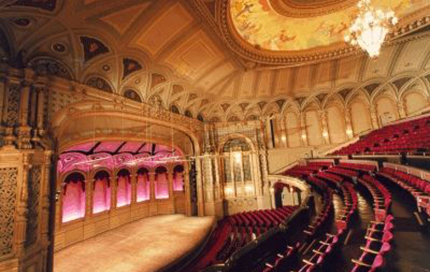
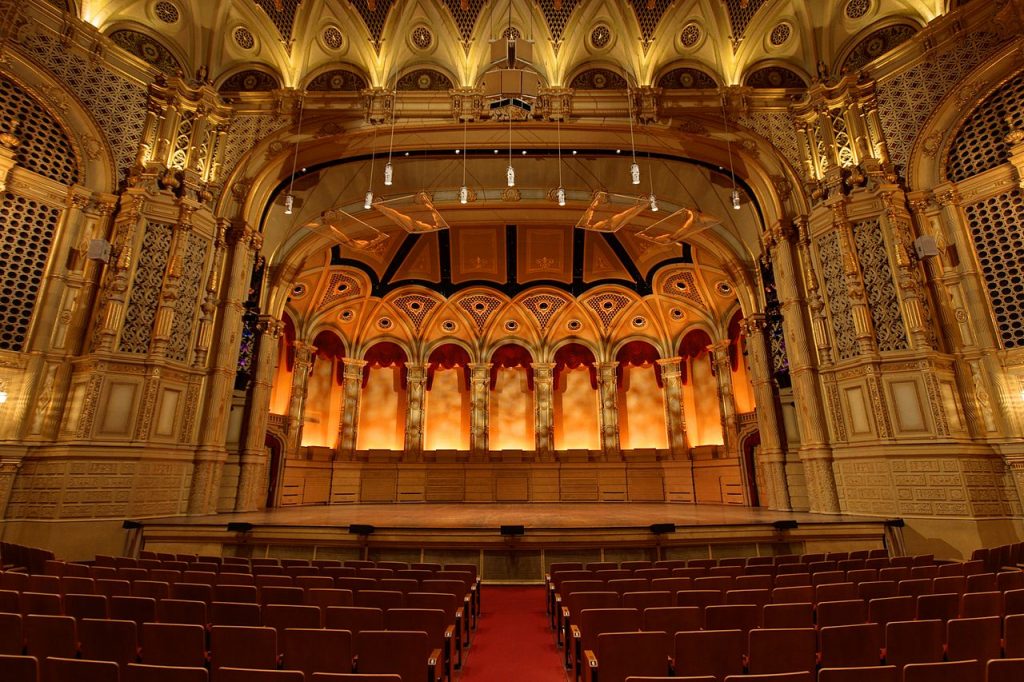
Theatre: Vancouver was about to welcome a splendid new palace of
entertainment.
B. Marcus Priteca »
|
 |

|